|

 |
Mithras and the Hyper-Cosmic Sun Part 1by David Ulansey
ed. Rome: "L'Erma" di Brettschneider, 1994 pp. 257-64. One of the most perplexing aspects of the Mithraic mysteries consists in the fact that Mithraic iconography always portrays Mithras and the sun god as separate beings, while - in stark contradiction to this absolutely consistent iconographical distinction between Mithras and the sun - in Mithraic inscriptions Mithras is often identified with the sun by being called "sol invictus," the "unconquered sun."
It thus appears that the Mithraists somehow believed in the existence of two suns: one represented by the figure of the sun god, and the other by Mithras himself as the "unconquered sun."
It is thus of great interest to note that the Mithraists were not alone in believing in the existence of two suns, for we find in Platonic circles the concept of the existence of two suns, one being the normal astronomical sun and the other a so-called "hypercosmic" sun located beyond the sphere of the fixed stars.
Since from the geocentric perspective the precession appears to be a movement of the entire cosmic sphere, the force responsible for it most likely would have been understood as being "hypercosmic," beyond or outside of the cosmos.
It will be my argument here that Mithras, as a result of his being imagined as a hypercosmic entity, became identified with the Platonic "hypercosmic sun," thus opening up the way for the puzzling existence of two "suns" in Mithraic ideology.
These oracular sayings were, as is well known, seized upon by Porphyry and later Neoplatonists as constituting a divine revelation. For our purposes, the most important element in the Chaldaean teachings is that of the existence of two suns.
As Hans Lewy says, The Chaldaeans distinguished between two fiery bodies: one possessed of a noetic nature and the visible sun.
The former was said to conduct the latter. According to Proclus, the Chaldaeans call the "solar world" situated in the supramundane region "entire light." In another passage, this philosopher states that the supramundane sun was known to them as "time of time...." 1 As Lewy showed definitively in his study, the Chaldaean Oracles were the product of a Middle Platonic milieu, since they are permeated by concepts and images known from Platonizing thinkers ranging from Philo to Numenius.
It is thus likely that the Chaldaean concept of a hypercosmic sun is at least partly derived from the famous solar allegories of Plato's Republic, in which the sun is used as a symbol for the highest of Plato's Ideal Forms, that of the Good. In Book VI of the Republic (508Aff.)
Plato compares the sun to the Good, saying that as the sun is the source of all illumination and understanding in the visible world (the horatos topos), the Good is the supreme source of being and understanding in the world of the forms (the noetos topos or "intelligible world").
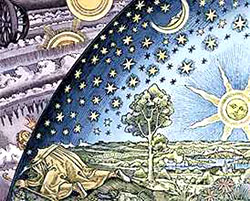
Plato then amplifies this image in his famous allegory of the cave at the beginning of Book VII of the Republic. In this famous passage, Plato symbolizes normal human life as life in a cave, and then describes the ascent of one of the cave-dwellers up out of the cave where he sees for the first time the dazzling light of the sun outside the cave.
The account in the Phaedrus reads: For the souls that are called immortal, so soon as they are at the summit [of the heavens], come forth and stand upon the back of the world: and straightway the revolving heaven carries them round, and they look upon the regions without.
Of that place beyond the heavens none of our earthly poets has yet sung, and none shall sing worthily. But this is the manner of it, for assuredly we must be bold to speak what is true, above all when our discourse is upon truth.
It is there that true being dwells, without colour or shape, that cannot be touched; reason alone, the soul's pilot, can behold it, and all true knowledge is knowledge thereof.2 As R. Hackforth says, No earlier myth has told of a hyperouranios topos [place beyond the heavens], but this is not the first occasion on which true Being, the ousia ontos ousa, has been given a local habitation. In the passage of Rep. VI which introduces the famous comparison of the Form of the Good to the sun we have a noetos topos contrasted with a horatos (508C): but a spatial metaphor is hardly felt there...
A truer approximation to the hyperouranios topos occurs in the simile of the cave in Rep. VII, where we are plainly told that the prisoners' ascent into the light of day symbolizes ten eis ton noeton tes psyches anodon (517B); in fact, the noetos topos of the first simile has in the second developed into a real spatial symbol.3 Paul Friedländer agrees with Hackforth completely in seeing a connection in Plato's mind between the ascent from the cave in the Republic and the ascent to the "hypercosmic place" in the Phaedrus: The movement "upward"... had found its fullest expression in the allegory of the cave in the Republic. [Now in the Phaedrus]... the dimension of the "above" is stated according to the new cosmic co-ordinates.
For the "intelligible place" (topos noetos) in the Republic (509D, 517B) now becomes "the place beyond the heavens" (topos hyperouranios)...4 What is, of course, important to see here is that there exists already in Plato the obvious raw material for the emergence of the idea of the "hypercosmic sun": when the prisoners escape the cave in the Republic what they find outside it is the sun, but if Hackforth and Friedländer are correct the vision of what is outside the cave in the Republic is linked in Plato's mind with the vision of what is outside the cosmos in the myth recounted in the Phaedrus. It would therefore be a natural and obvious step for a Platonist to imagine that what is outside the cosmic cave of the Republic - namely, the sun, the visible symbol of the highest of the Forms and of the source of all being - is also what is to be found outside the cosmos in the "hypercosmic place" described in the Phaedrus. The intelligible as far surpasses the visible in the brilliancy of its radiance, as sunlight assuredly surpasses darkness...
Now that invisible light perceptible only by mind... is a supercelestial constellation [hyperouranios aster], fount of the constellations obvious to sense.
It would not be amiss to term it "all-brightness," to signify that from which sun and moon as well as fixed stars and planets draw, in proportion to their several capacity, the light befitting each of them... 5 Here we see Philo referring to the existence in the intelligible sphere of a "hypercosmic star" (hyperouranios aster) which he links with the image of sunlight, and which he sees as the ultimate source of the light in the visible heavens.6
Philo's formulation here is, of course, strikingly similar to the Chaldaean concept of the hypercosmic sun, the description of which by Lewy we should recall here: "The Chaldaeans distinguished between two fiery bodies: one possessed of a noetic nature and the visible sun. The former was said to conduct the latter. According to Proclus, the Chaldaeans call the 'solar world' situated in the supramundane region 'entire light.'" 7 The trajectory we have been tracing from Plato through Middle Platonism to the Chaldaean Oracles continues beyond the time of the Chaldaean Oracles into early Neoplatonism, for we find the concept of the existence of two suns clearly spelled out in the writings of Plotinus, in a context that makes it clear that for Plotinus one of these suns was "hypercosmic."
In chapter 2, paragraph 11 of his fourth Ennead, Plotinus speaks of two suns, one being the normal visible sun and the other being an "intelligible sun."
According to Plotinus, ...that sun in the divine realm is Intellect - let this serve as an example for our discourse - and next after it is soul, dependent upon it and abiding while Intellect abides. This soul gives the edge of itself which borders on this [visible] sun to this sun, and makes a connection of it to the divine realm through the medium of itself, and acts as an interpreter of what comes from this sun to the intelligible sun and from the intelligible sun to this sun... 8 What is especially interesting for us is that in the same third chapter of the fourth Ennead, a mere six paragraphs after the passage just quoted, Plotinus explicitly locates the intelligible realm - which he has just told us is the location of a second sun - in the space beyond the heavens.
The passage reads: One could deduce from considerations like the following that the souls when they leave the intelligible first enter the space of heaven. For if heaven is the better part of the region perceived by the senses, it borders on the last and lowest parts of the intelligible. 9 As A.H. Armstong says of this passage, "There is here a certain 'creeping spatiality'... [Plotinus'] language is influenced, perhaps not only by the 'cosmic religiosity' of his time, but by his favorite myth in Plato's Phaedrus (246D6-247E6)." 10 In any event, we here find Plotinus in the third chapter of the fourth Ennead first positing the existence of an "intelligible sun" besides the normal visible sun, and then locating the intelligible realm spatially in the region beyond the outermost boundary of the heavens.
According to Julian, in certain unnamed mysteries it is taught that "the sun travels in the starless heavens far above the region of the fixed stars." 11
Given the fact that Julian's thinking was steeped in the Neoplatonic philosophy of Iamblichus who was deeply committed to the Chaldaean Oracles as a source of divinely inspired knowledge, and given the fact that the doctrine of the "hypercosmic sun" is an established teaching of the Chaldaean Oracles, it is virtually certain, as Robert Turcan points out in his remarks about this passage, that Julian is referring here to the teaching of the Chaldaean Oracles.12
The passage from Julian, therefore, shows that the "hypercosmic sun" of the Chaldaean Oracles was understood as being "hypercosmic" not in a merely symbolic or metaphysical sense, but rather in the literal sense of being located physically and spatially in the region beyond the outermost boundary of the cosmos defined by the sphere of the fixed stars. Our discussion thus far has shown that in the late second century C.E. there is found in the Chaldaean Oracles the doctrine of the existence of two suns: one the normal, visible sun, and the other a "hypercosmic" sun.
The evidence from Julian shows that the "hypercosmic" nature of this second sun was understood as meaning that it was literally located beyond the outermost sphere of the fixed stars.
The fact that the Chaldaean Oracles emerged out of the milieu of Middle Platonism suggests that the doctrine of the "hypercosmic sun" found in the Oracles did not develop overnight, but that it has roots in the Platonic tradition, most likely, as we have seen, going back ultimately to Plato himself: specifically, to the allegory in the Republic of the ascent beyond the world-cave to the sunlit realm outside and the related myth of the Phaedrus describing the ascent of the soul towards its ultimate vision of the hyperouranios topos, the "hypercosmic place" beyond the heavens. An intermediate stage between Plato and the Chaldaean Oracles is found in Philo's reference to the "hypercosmic star" which is the source of the light of the visible heavenly bodies, and slightly later than the Chaldaean Oracles we find Plotinus making reference to two suns, one of them being in the intelligible realm which he places spatially beyond the heavens. a "hypercosmic" sun located in that "place beyond the heavens" (hyperouranios topos) described in Plato's Phaedrus.
We see here, of course, a striking parallel with the Mithraic evidence in which we also find two suns, one being Helios the sun-god (who is always distinguished from Mithras in the iconography) and the other being Mithras in his role as the "unconquered sun."
On the basis of my explanation of Mithras as the personification of the force responsible for the precession of the equinoxes this striking parallel becomes readily explicable.
For as we have seen, the "hypercosmic sun" of the Platonists is located beyond the sphere of the fixed stars, in Plato's hyperouranios topos.
But if my theory about Mithras is correct (namely, that he was the personification of the force responsible for the precession of the equinoxes) it follows that Mithras - as an entity capable of moving the entire cosmic sphere and therefore of necessity being outside that sphere - must have been understood as a being whose proper location was in precisely that same "hypercosmic realm" where the Platonists imagined their "hypercosmic sun" to exist.
A Platonizing Mithraist (of whom there must have been many - witness Numenius, Cronius, and Celsus), therefore, would almost automatically have been led to identify Mithras with the Platonic "hypercosmic sun," in which case Mithras would become a second sun besides the normal, visible sun.
Therefore, the puzzling presence in Mithraic ideology of two suns (one being Helios the sun-god and the other Mithras as the "unconquered sun") becomes immediately understandable on the basis of my theory about the nature of Mithras.
Finally, the line of investigation which I have pursued here can also allow me to provide a simple and convincing interpretation for two further puzzling elements of Mithraic iconography.
First, all the various astronomical explanations of the tauroctony which scholars are currently advancing (including my own) agree that the bull in the tauroctony is meant to represent the constellation Taurus.
However, the constellation Taurus as seen in the night sky faces to the left while the bull in the tauroctony always faces to the right.
How can this apparent discrepancy be explained? On the basis of my theory this question has an obvious answer.
For although it is the case that the constellation Taurus as seen from the earth (i.e., from inside the cosmos) faces to the left, it is also the case that on ancient (and modern) star-globes which depict the cosmic sphere as it would be seen from the outside the orientation of the constellations is naturally reversed, with the result that on such globes (like the famous ancient "Atlas Farnese" globe - image right)Taurus is always depicted facing to the right exactly like the bull in the tauroctony.
This shows that the Mithraic bull is meant to represent the constellation Taurus as seen from outside the cosmos, i.e. from the "hypercosmic" perspective, which is, of course, precisely the perspective we should expect to find associated with Mithras if my argument in this paper is correct.13
As is well known, Porphyry, quoting Eubulus, explains in the Cave of the Nymphs that the Mithraic cave in which Mithras kills the bull and which
Of course, the hollow Mithraic cave would have to be an image of the cosmos as seen from the inside.
But caves are precisely hollows within the rocky earth, which suggests the possibility that the rock out of which Mithras is born is meant to represent the cosmos as seen from the outside.
Confirmation of this interpretation is provided by the fact that the rock out of which Mithras is born is often shown entwined by a snake, a detail which unmistakably evokes the famous Orphic motif of the snake-entwined cosmic egg out of which the cosmos was formed when the god Phanes emerged from it at the beginning of time.14
It thus seems reasonable to conclude that the rock in the Mithraic scenes of the "rock-birth" of Mithras is a symbol for the cosmos as seen from the outside, just as the cave (the hollow within the rock) is a symbol for the cosmos as seen from the inside.
He is therefore pictured as bursting out of the rock that symbolizes the cosmos (not unlike the prisoner emerging from the cosmic cave described by Plato in Rep. VII), breaking through the boundary of the universe represented by the rock's surface and establishing his presence in the "hypercosmic place" indicated by the space into which he emerges outside of the rock. in the supermundane (worlds) [en tois hyperkosmiois]; for there exists the "solar world (and the) whole light..." as the Chaldaean Oracles say and which I believe.15
NOTES [1] Hans Lewy, Chaldaean Oracles and Theurgy (Paris: Études Augustiniennes, 1978) pp. 151-2.
|