|

 |
Solar Mythology in the New testament Part 2The Sun Enters Aquarius at "Age 30"The constellations of the Zodiac are not all the same size, nor are they evenly spaced. Some of the constellations even overlap one another. It's somewhat arbitrary where to draw the line between one constellation and another. Part of this problem is alleviated by simply declaring that the divisions between the twelve constellations are evenly spaced. The zodiac is divided into twelve equal areas, with each area containing one zodiac constellation. Each area is known as a "house". So when the sun is in the constellation Capricorn, it may be said, "the sun is in the house of Capricorn."
The tradition of having 360 degrees in a circle probably comes from it being a nice convenient number very near the number of days in a year. 360 is a nice round number that can be evenly divided into 2 parts, or 4 parts, or 10 parts, or 12 parts, or 36 parts, or 72 parts—whatever you feel like, whereas the actual solar year of 365.2421934 days is not as easy a number to deal with. The sun travels about one degree each day. It's not exact, since there are actually 365.2421934 days in a solar year instead of 360. Also the earth's orbit isn't a perfect circle, it's slightly elliptical. The earth travels slightly faster during the winter months when it's slightly closer to the sun, and it travels slightly slower during the summer months when it's slightly farther from the sun. In general though, one degree equals about one day. (The seasons are primarily caused by the earth's tilt, not by it's varying distance from the sun. See Cause of the Seasons [offsite]) It's still ambiguous exactly when the sun leaves one house and enters another. The standard dates used by astrologers for the past two millennium (the ones given in the table above) correspond to a time somewhere in the range of around 600 B.C.E. to 1 C.E. Today, some 2000 years later, due to the Earth's precession the sun is in Sagittarius on Dec. 22, and you have to wait until around Jan. 18 before you can say the sun is in Capricorn. However, the tradition of having Capricorn cover the days from December 22 to January 19 still remains today. Have a look at any astrology or horoscope section of a newspaper (if your newspaper has such a section. No one today really believes in astrology, but some newspapers still have one just for the fun of it.) You'll see there listed the twelve constellations of the zodiac, covering the full year, with Capricorn beginning on December 22, the Winter Solstice. Though the winter solstice is a natural place to begin the year, you'll notice the astrology section always begins with Aries, March 21, which is the vernal equinox, another common place to begin the year. For our purposes it doesn't matter exactly what day the sun leaves one house and enters the next. It's the overall story line we are concerned about. We want to know the general sequence of events that occurs during the solar year. If we accept the old tradition of having the sun enter Capricorn on the Winter Solstice, a natural place to start the yearly cycle, then when the sun has traveled 30 degrees the sun exits Capricorn and enters Aquarius. Thus an allegorical story of the sun's annual travels could have the sun character visiting the Aquarius character at "Age 30" That's actually 30 degrees, or about 30 days, but an allegory could use 30 years instead. 2. On the Winter Solstice the sun enters Capricorn. The Sun then passes through Capricorn, traveling 30 degrees in 30 days, to reach Aquarius at "age 30". Entering Aquarius is the first big event of the journey. 3. The Sun's annual journey around the zodiac takes one year. Outlining the Solar Myth - AquariusSo far we have:
Aquarius is depicted by a man pouring out a pitcher of water. At left we have the illustration of what Aquarius is supposed to look like on the western horizon, if you have a very good imagination. It takes quite an imagination to see this in the stars. The idea of a man pouring out water has more to do with what is happening at that time of year. (See The constellations don't look like what they're named).
The Sun enters Aquarius around Jan. 20. January is the rainy season. There is a lot of water everywhere. In January the days start to get longer and longer, as the Sun climbs higher and higher in the sky each day. The days also begin to get warmer and warmer, because the angle of the Sun's rays changes (see Cause of the Seasons [offsite]). The longer warmer days cause any snow that has accumulated in the higher mountains to melt, adding to the inundation of water. Rivers rise and may flood. This is the first step in the harvest cycle. We look forward to the promise of a good harvest later on in the year. 4. The Sun visits Aquarius who immerses the land with water. Outlining the Solar Myth - Theme of Temptation to be LazyNear the beginning of any long and difficult journey, such as the one the Sun has just embarked on, there is the temptation to be lazy. Why should the Sun embark on such a long and difficult journey? Why should the Sun bother to climb higher and higher in the sky each day, making the days longer and the dark nights shorter? We want the Sun to conquer the cold and darkness with longer warmer days. The Sun is tempted to be lazy. However, for our sake, the Sun will resist that temptation to give in to the forces of cold and darkness. The Sun has a mission to fulfill. The Sun must embark on its journey so that we may have a bountiful harvest and continue to live.The temptation to be lazy is a common theme we find expressed near the beginning of a solar myth. The Sun is tempted, but the Sun spurns the temptation. The Sun will not allow cold and darkness to reign. The Sun will continue on it's journey. 5. The temptation to give in to the forces of darkness, Aquarius goes below the horizonAfter a month has passed the Sun leaves Aquarius and Aquarius goes below the horizon. We might say Aquarius has entered the underworld, or hades, or hell, or has been handed over. Since Aquarius is depicted by a man, we might figuratively say our character has been put in prison, since we won't be seeing Aquarius again at Sunset for quite awhile. 7. The Sun leaves Aquarius. Aquarius is figuratively is put in prison. 8. The Sun goes on it's way, leaving Aquarius behind. In the Jesus story after Jesus [the Sun], visits John the Baptist [Aquarius] the Bible says, “After John was put in prison, Jesus went into Galilee,....” (Mark 1:14; Matthew 4:12; Luke 3:20; John 3:24). Suddenly John the Baptist is "put in prison", and Jesus just goes on his merry way! There is no further explanation in the Bible, which seems quite strange if John were a real person. We want to know why he was "put in prison." What crime was he accused of? Who threw him in prison? Was there a trial? Did Jesus attend the trial and speak on his behalf? No. Nothing more is said. Jesus just continues on his journey and appears unconcerned about John the Baptist. This is all very strange and hard to understand if interpreted as a story of real life events, but it all makes perfect sense when understood as an astronomical allegory. John the Baptist being put in prison is merely an allegory for the constellation Aquarius at sunset moving lower and lower until it is below the horizon at the end of the month and can no longer be seen. It is a natural phenomenon that requires no further explanation, and that is why there is no further explanation in the Bible. So Jesus [the Sun], continues on his way into "Galilee". The word "Galilee" literally means "circuit". The original Greek word is γαλιλαις {gal-il-ah'-yah} (Strong's Greek #1056. Click here to see the verse in Greek), which is a word of Hebrew origin לילג {gaw-lee-law'} (Strong's Hebrew #01551). A "circuit" is a closed, usually circular path. The ecliptic is the circuit the Sun travels along during the year. The ecliptic is a great circle inscribed on the celestial sphere. Jesus, a personification of the Sun, continues on his way along the ecliptic, or "Galilee". PiscesAfter the Sun passes through Aquarius, the Sun enters Pisces, the two fish. There's a lot of water around, brought on by Aquarius, and there's no harvest yet, and not much good hunting, so this is a good time to go fishing. Hence the theme of fish and fishing. 9. The Sun visits Pisces, the two fish. Theme of fishing.
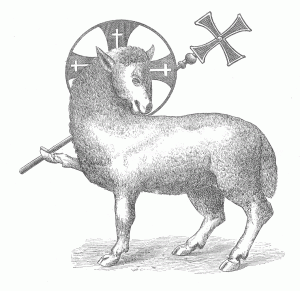
1) Born on 25th of December, birthday of the sun. 2) Starts his mission at "age 30" (Luke 3:23) 3) Mission is said to take one year [Synoptic Gospels] 4) Starts his mission by visiting John the Baptist (Mat. 3) 5) Is then tempted by the devil (Mat. 4:1-11) 6) resists the devil's offers (Mat. 4:4,7,10-11) 7) John is put "in prison." (Mat. 4:12) 8) Jesus goes on his way, leaving John behind. (Mat. 4:13-17) 9) Jesus then visits Simon and Peter, two fishermen. (Mat. 4:18-22) (Note how Aquarius is now below the horizon. We won't be seeing Aquarius for awhile.) AriesAfter passing through Pisces, the Sun enters Aries, the ram, sheep, or lamb. The traditional date for this is the Vernal Equinox (or Spring Equinox), March 21. This is an important date, because this is when day and night are of equal length, and after this day the days are longer than the nights. The battle of warmth and light against cold and darkness has finally been won. Sin means a deviation from the way things ought to be. The sin of the Earth was that it was cold and dark during Autumn and Winter. We would prefer it to be warm and light. When the Sun reaches the lamb the sin of the earth is figuratively taken away, as that is when the warmth and light of Spring and Summer finally wins over the cold and darkness of Autumn and Winter. Thus figuratively the lamb is that which takes away the sin of the earth. It's common for solar religions to associate their savior with the zodiac symbol the Sun is in at the Vernal Equinox. Jesus is known as the "lamb of God." "The next day John saw Jesus coming toward him and said, "Look, the Lamb of God, who takes away the sin of the world!" (John 1:29) "When he saw Jesus passing by, he said, "Look, the Lamb of God!" (John 1:36) Jesus is often depicted with a lamb. 10. The Sun visits Aries, a ram, sheep, or lamb, on the Vernal Equinox, when darkness and cold, the figurative sins of the earth, are overpowered by light and warmth. 11. Easter, when we celebrate Jesus as risen from the grave, is celebrated on the first Sunday after the first full moon after the Vernal Equinox. It is a Spring time celebration of the rebirth of the Sun and the Sun overpowering the cold and darkness of Winter. Solar Mythology in the New testament Part 3
|
 If we divide a circle into twelve equal parts, and place the twelve constellations of the zodiac in order around the circle, one in each part, we see that each constellation occupies 30 degrees of the circle.