|

 |
The Enduring Enigma of Rennes Les ChateauPrologueThree little words, Rennes-le-Chateau… The passing millennia have produced many bizarre mysteries; the riddle of the Sphinx and the Pyramids on the Giza plateau are probably the most famous, but in recent years, perhaps the most engrossing of these enigmas concerns what transpired in the quiet village of Rennes-le-Chateau in the foothills of the French Pyrenees during the dying years of the 19th century. There have been many theories proffered to explain the events, but in essence, not one has provided either the complete picture or a wholly satisfactory explanation. In this mixture of history, fact and well-informed conjecture, there are elements of buried treasure, unexplained wealth and clandestine meetings, in fact, all the aspects of a traditional mystery story; however there are other arcane, less obvious facets to the tale. Secret societies, strange rites, an order of incredibly wealthy and powerful warrior monks, alchemy and magic, it is to these aspects that we address ourselves. However, before dealing directly the enigma, it is important that the main players are identified and to this end, I have included a description of them. I also wish to pay tribute to Ms Leslee Dru Browning, of Seattle USA, a powerful and talented shaman, psychic and author, whose unstinting advice and insights made this project so much easier. First, a brief outline of how the mystery began: Following his appointment to the village of Rennes-le-Chateau in 1885, the young priest Fr. Berenger Sauniere lived an austere and unremarkable life, but suddenly in 1891, during some restoration work on the church, Sauniere found, in a Visigoth pillar under the alter, two parchments. It is the information contained on these parchments that ignite the mystery. They appear to have been hidden there by Sauniere’s predecessor in the parish of a century before, an Abbe Antoine Bigou. At first sight, the parchments appeared to be Latin texts of passages copied from the Gospels, but on closer examination, there was code or cipher present. It was observed that certain letters were out of line with the rest of the text and the letters spelled out words in French.
On the other, equally enigmatic parchment was inscribed:
Whatever the meaning of these ciphers, it was enough to send Sauniere to the local mayor who gave him permission to visit his superior, the bishop at Carcassone. Like Sauniere, the bishop could not understand the cipher either, so at his own expense, he sent the priest to Paris for assistance and advice. It was here that he met Emile Hoffet, who, although studying for the priesthood was also an expert in cryptography. Interestingly, and perhaps paradoxically, Hoffet was also involved in various arcane and occult organizations that flourished in Paris and indeed throughout Europe, at that time. Following this meeting, Sauniere spent three weeks in Paris where he became involved with the exotic circles in which Hoffet moved. It was during this interlude that Sauniere reportedly became the lover of the opera singer Emma Calve, who like Hoffet was involved with the same esoteric groups. She was also friendly with the composer Claude Debussy whose name will appear again in this tale. He had a library ‘The Tour Magdala’, or ‘The Magdalene Tower’ [Trans] constructed overlooking the sheer side of the mountain, he also had a large villa built, the Villa Bethania, which he never occupied. His church was also redecorated, but there were some curious features added, for example, there is a statue of the demon Asmodeus immediately inside the door, the demon symbolizes hidden treasure and secrets. It also said to be the builder of Solomon’s Temple. There are a number of other unusual examples including illustrations depicting the Stations of the Cross, in Station eight there is a child wrapped in a Scottish plaid. In another, Jesus Christ is depicted being carried into his tomb at night…or is he being carried out? In yet another Pontius Pilate is depicted wearing a veil and finally St Joseph and Mary are depicted each carrying a baby. There is even an inscription above the church door saying ‘Terribilis Est Locus Iste’ or ‘This Place is Terrible’ [Trans]. The significance of this inscription is unknown and adds yet another element of mystery to the enigma. According to accepted wisdom, two French knights, Hughes de Payens and Godfrey of St.Omer, founded the original Knights Templar, or The Poor Knights of Christ and the Temple of Solomon around 1118 AD. They traveled to the holy land and approached King Baudouin, (or Baldwin) 1st, King of Jerusalem, taking with them the blessing and sponsorship of St. Bernard of Clairvaux a prominent member of the Cistercian order of monks and the spokesman for all of Christendom in this era. Ostensibly, their intention was the protection of pilgrims traveling to and from the holy land after the first Crusade from assorted Saracen thieves and bandits. Evidently King Baudouin, himself a former crusader, was delighted at the prospect and promptly presented them with a wing of his palace to use as their headquarters. However, what happened next is open to conjecture. So, who sent them and why? It is worth noting that the Templars were, due to their strict discipline and religious fervor, probably the most feared and efficient fighting men in the world. Because of this, they were held in high regard by their sworn enemies the Saracens, themselves fierce and disciplined warriors. Indeed, it was from this mutual respect with the Saracens that they learned their considerable pharmacological and metalworking skills. This probably resulted in the Templars absorbing some of the mystical beliefs of Islam, which had it been generally known, would not have found much favor with the church authorities and most likely been condemned as heresy. It was during this time that the Templars, because of their wealth and influence began operating a form of banking. A pilgrim would deposit money with a local preceptory where he was issued with an encrypted letter. The letter he took with him on his journey, and on arrival in the Holy Land, the letter was taken the preceptory there and his money was retuned to him, less interest of course, in effect, they invented the cheque.
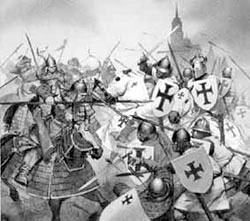
Given the unique position of the Order is inconceivable that they did not have prior knowledge of their fate. It is known that immediately preceding to the fateful events of October the 13th, the night before the raids took place, the Templar fleet, some 18 vessels, sailed from the port of La Rochelle presumably carrying the contents of the various treasuries. Why De Molay and the rest of the knights elected to stay and be captured is unknown but it is speculated that due to a mixture of arrogance and pride they did not believe the king’s seneschals would go through with the raids, to his cost he discovered that they did. Where then did they go? Some went to Germany and joined one of their kindred orders, the Teutonic Knights; some went to Portugal where they aligned themselves with the ruling house, others came to Scotland where they enjoyed the protection and patronage of King Robert the Bruce, the disposition of the rest remains a mystery as indeed the whereabouts of the treasuries. There is well-founded speculation that the remaining Templars made their way to Switzerland and founded the countries reputation as the very hub of the banking world. As we shall see later, this is not the only secretive, close knit organization founded by the Knights Templar. Finally, the Templars did not forget the punishment dealt to them by the Vatican and at the time of the Reformation and the emergence of Protestantism in 1522, the forces of the Catholic Church found themselves facing the Teutonic Knights in battle. The origins of this shadowy organization are far from clear-cut, according to which information you have; it was either instituted following the demise of the Merovingian dynasty in the seventh century AD, or it has existed only from 956 as a natural successor to the Order of Sion which was founded in 1090AD. From the available information, it is more likely that the Order of Sion was the earliest of the organizations and does indeed date from the seventh century AD. The Priory was founded with one objective, to restore the Merovingian house to the throne of France and indeed the continent of Europe. It is also suggested that the Priory was directly responsible for the existence of the Knights Templar whose military wing they are alleged to have been. The evidence suggests that in fact the Templars were in existence from 1115 and not 1118 as the official line decrees. The history books on the other hand tell us that The Order of Sion had it’s own abbeys, one on Mt. Sion in Palestine and others throughout the Holy Land. The abbey on Mt Sion was called ‘Notre Dame do Sion’ and was in use until 1291,when in common with other Christian and Crusader organizations and properties it was seized by the Muslims. It is likely that there is a considerable overlap between both the Priory and the Order of Sion and to some extent they may have been interchangeable to the point of having the same grand masters, for the sake of clarity I will refer only to the Priory of Sion. Like it’s progeny, the Templars, the Priory had its Grand Masters too, they, amongst others included; Jean de St. Clair, Nicholas Flamel, Sandro Filipepi (better known as Botticelli), Leonardo da Vinci, Robert Fludd, Robert Boyle, Isaac Newton, Victor Hugo, Claude Debussy, Jean Cocteau, and more recently, Pierre Plantard de Saint Clair. The masters of the Priory all take the name Jean or John, which reflects their interest in the heretical belief in Johanism or the belief that John the Baptist and not Jesus Christ was the true messiah. This is also a feature of the Mandean heresy, which holds to the same belief. It also appears that the Masonic, Swiss ‘Grand Lodge Alpina’, the equivalent of Scottish or English Grand Lodges may have been a source of Priory members, there are also ties to the Italian P2 Lodge. It is important to realize that the P2 lodge is linked to both the CIA and the former KGB; it had its agents in high positions within both the Italian Government and the Vatican. It is also linked to the ultra-conservative Knights of Malta and Opus Dei (God's work) within the Vatican itself. The involvement of this early French royal house cannot be understated and indeed appears to be the link between all the diverse factors. As far is known, the Merovingians descended from a Germanic tribe, the Sicambrians, who collectively were known as the Franks. This people who were also referred to as the ‘Long Haired Kings,’ and ‘The Sorcerer Kings’, bore classic tall, blond, Germanic looks, and from the fifth to the seventh centuries ruled parts of what is now Germany and France. According to tradition, one ‘Merovee’ sometimes referred to as Merovech, whose parentage is to say the least highly unusual, founded the dynasty, but as we shall see later this is not the only explanation. According to the attendant mythology he had two fathers, one was human enough, but the others was allegedly a sea creature, or at least amphibious; a ‘Quinotaur’. It was apparently from this heritage that the Merovingian reputation for the possessing supernatural abilities arose. Some of the esoteric customs attributed to them relate to their burial rituals, several Merovingian tombs have yielded such objects as tiny golden bees, a golden bulls head, and a crystal ball. The skulls of many of the monarchs and been ritually trepanned, a ritual reflecting the old belief that the soul resided in the head and correspondingly trepanning was designed to allow the spirit of the deceased easy passage to the afterlife. This belief still holds sway today among primitive cultures and is a common belief with former head-hunters, the Dayaks of Borneo. Perhaps the most extraordinary claim made for the Merovingian lineage relates to events that took place 2,000 years ago; there are many assertions that the Merovingians were descended from the blood of Jesus Christ and the woman he allegedly married, Mary Magdalene, we will return to this point later. The Enigma It is at this point that we try to draw the disparate threads together, and as we shall see, there is evidently more than one mystery associated with the Rennes Valley. First, what was the significance of Fr Sauniere’s find? There have been assertions that it referred to various hoards of treasure amassed by alternatively the Merovingians, the Visigoths or the Cathars, even the lost treasure of the Knights Templar; while all this is possible, and would explain Sauniere’s sudden wealth it is the least likely. However, it is probable that the arcane references were related to spiritual knowledge affecting traditional Christian teaching and that of the Catholic Church in particular. One interpretation concerns the Cathars once again, who had a strong presence in the area during the middle ages. The Cathars had aroused the ire of the Vatican because of their perceived heretical beliefs, which were based on the view that there were two ‘Gods,’ one purely spiritual and therefore ‘good’. The other was made flesh and therefore fallible, the ‘Rex Mundie’ or ‘God of the World’; based on this belief, the Cathars viewed the Roman Church with its reliance on ostentation, pomp and grandeur is inherently evil. Another version postulated by Dr Keith Laidler suggests that the fleeing Cathars may have had the mummified head of Jesus Christ with them; the same head that he claims lies beneath the Apprentice Pillar at Rosslyn. While this theory is based on well-researched information, unless someone was in possession of specific knowledge, there is little chance of discovering whether the head is there or not because it would require the removal of the pillar, and there is no chance of this happening. The Knights Templar who were the Priory’s military wing searched for, and probably found both actual and spiritual treasures beneath the Temple of Solomon. What the treasures actually were is still hotly debated, but consensus suggests that they comprised a fortune in gold and artifacts etc and also the lost gospels of Jesus Christ. The Priory therefore would have had access to at least some of the spoils and documentation, certainly enough to finance any of its plans. This is not as ridiculous as might first appear. It is stated clearly in the bible that Jesus Christ was a rabbi or teacher, to be a rabbi a man had to be married; there was no option about this. Further, the wedding feast at Canaan may well have been a description of his wedding. It is also possible that Jesus Christ did not die on the cross and was spirited away with the Magdalene ending up in France, where, according to ‘The Holy Blood and The Holy Grail,’ his bloodline allegedly founded the Merovingian dynasty. This then may be one secret of Rennes-le-Chateau the other is equally incredible. It has been suggested that within the Rennes valley is encoded a message left to us nine thousand years ago by the remnants of a lost race: the Atlanteans. Whether this is true or not is in my opinion not too important at this time, what is important is the message and not the writers. My own research using the services of a powerful psychic suggests that there may be a portal here, a gateway between worlds, between realities. In my opinion this part of the puzzle can only be solved is by the use of that talented and perceptive group of people, psychics.
|