
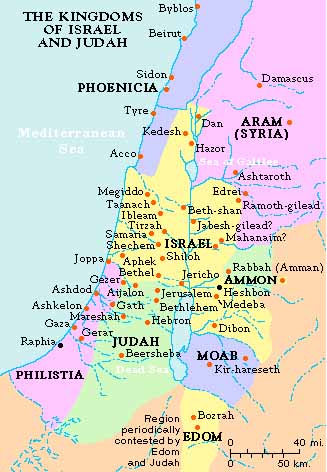
Bethlehem (House of Bread - House of Lahmu) is is a Palestinian city in the West Bank and a hub of Palestinian cultural and tourism industries. It is first mentioned in the Armana letters fourteen centuries BCE. It lies about 10 km (6 mi) south of Jerusalem, standing at an elevation of about 765 m (2 510 ft) above the sea, thus 30 m (100 ft) higher than Jerusalem. The Bethlehem agglomeration also covers the small towns of Beit Jala and Beit Sahour, the latter also having biblical significance. Beit Sahor = House of Morning
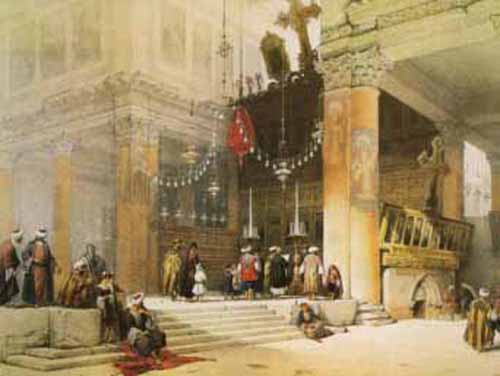
The city has great significance to the Christian religion as it is believed to be the birthplace of Jesus of Nazareth. The traditional site of Rachel's tomb, which is important in Judaism, lies at the city's outskirts. Bethlehem is also home to one of largest Palestinian Christian communities in the Middle East.
Bethlehem plays a significant part in the Old Testament, in the history of the Israelites, both before they entered Egypt and slavery, and after the Exodus. It appears in the Old Testament as Ephrat, where Rachel the beloved matriarch of the Jewish People, the favorite wife of Jacob, died during childbirth.
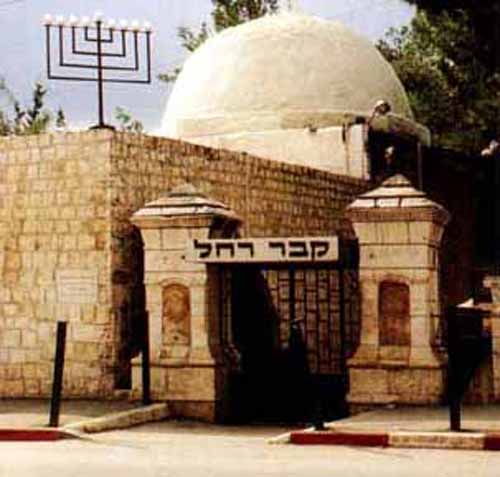
The Tomb of Rachel, is a pilgrimage place for Jews and Muslims alike. Among other Biblical mentions and Holy Sites in Bethlehem: Rachel's tomb, Naomi and Ruth, Samuel anoints King David and the well from which David's warriors brought him waters.
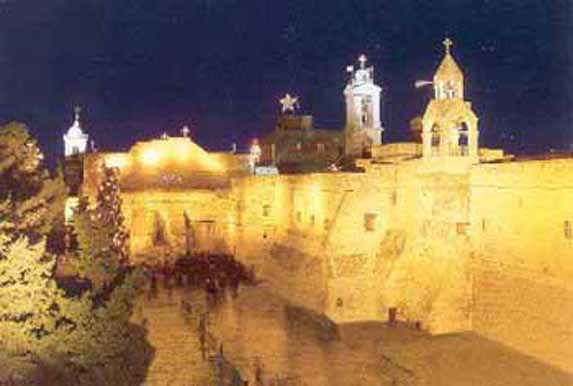
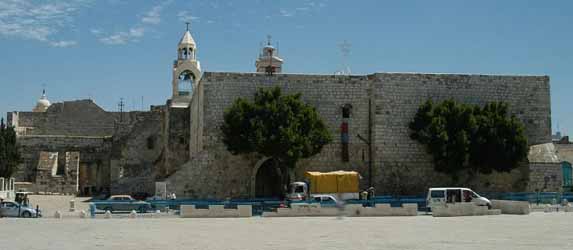
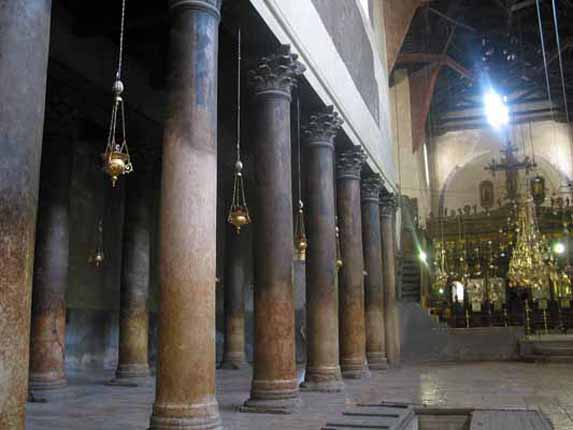
The Church of the Nativity in Bethlehem is one of the
oldest continuously operating churches in the world.
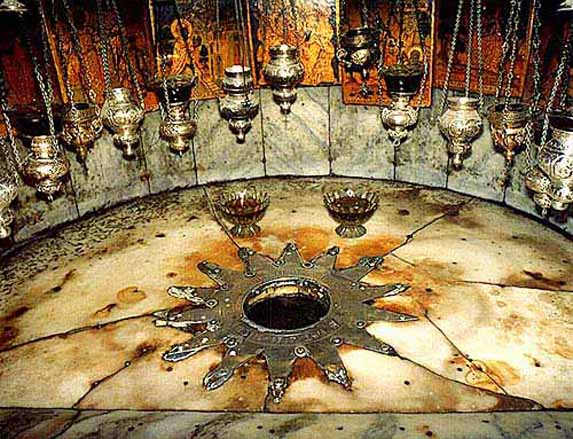
Silver star marking the place where Jesus was born according to Christian tradition
The Manger is situated on the north side of the Grotto, and opposite the Manger, an Alter is dedicated to the Wise Men who came to Bethlehem from the East under the guidance of a star bearing gifts to Baby Jesus.
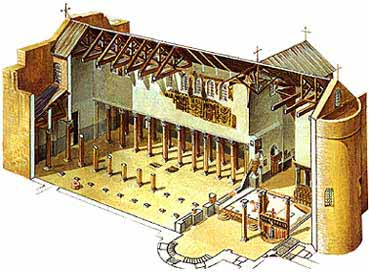
The original structure was built by Bishop Makarios of Jerusalem at the direction of Constantine I of the Roman Empire following the First Council of Nicaea in 325. That structure was burned down in the Samaritan revolt of 529. It is administered by a coalition of Roman Catholic and Greek Orthodox clerics. Tradition has it that the church was built over Jesus' birthplace, and it is held as sacred by followers of Christianity and Islam. Was Makarios named after the castle where John was beheaded?
It is actually a combination of two churches, with a crypt, the Grotto of the Nativity, where Jesus is said to have been born:
In 2002, 200 Palestinians, including 50 armed fighters entered and occupied the Church of the Nativity for 39 days. They were seeking refuge from an Israeli Defense Force incursion into Bethlehem. Israeli army snipers killed seven and wounded more than forty people during the siege. Following extensive negotiations, the Israeli army lifted the siege on condition that 13 of the Palestinian fighters were deported to Cyprus and another 26 transferred to the Gaza Strip.
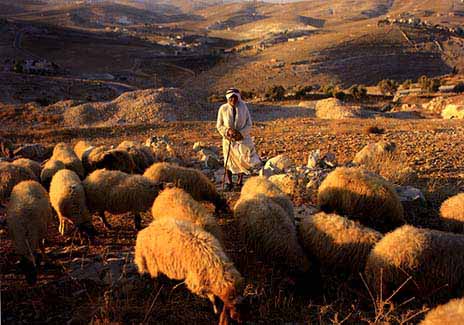
Today, the vast tracts of pasture land are roamed by flocks of sheep and goats, led by shepherds who wear, now as in the past, severe dark robes and their typical headdress. Against this backdrop events transpired which are recorded in the Scriptures, both Jewish and Christian. The pastures known as the 'Shepherds' Fields' witnessed lives of ancestors of David, the great king of the Jews; and they also witnessed and Angel's Annunciation of the birth of the Son of God to the Shepherds.
The first historical reference to the town appears in the Amarna Letters (c. 1400 BC) when the King of Jerusalem appeals to his overlord, the King of Egypt, for help in retaking "Bit-Lahmi" in the wake of disturbances by the Apiru. It is thought that the similarity of this name to its modern forms indicates that this was a settlement of Canaanites who shared a Semitic cultural and linguistic heritage with the later arrivals. Apiru = Hebrew
Lachmo was the Akkadian god of fertility. Worshiped by the Canaanites as Lachama, some time in the 3rd millennium BC, they erected a temple to worship the god on the hill now known as the Hill of the Nativity. The town was known as Beit Lachama, meaning "House of Lachama." William F. Albright notes the pronunciation of the name remained essentially the same for 3,500 years, but has meant different things: "'Temple of the God Lakhmu' in Canaanite, 'House of Bread' in Hebrew and Aramaic, 'House of Flesh' in Arabic."
Note the appearance and disappearance of the C in Beit Lachama and Beit Lahem, and thus a different phonetic - much like in sahar and sachar. Is the Sahara the lost kingdom of Seker (the real Saqqara)?
Biblical scholars believe Bethlehem, located in the "hill country" of Judah, may be the same as the Biblical Ephrath, which means "fertile", as there is a reference to it in the Book of Micah as Bethlehem Ephratah. The Bible also calls it Beth-Lehem Judah, and "a city of David". It is first mentioned in the Tanakh and the Bible as the place where the matriarch Rachel died and was buried "by the wayside" (Gen. 48:7).
Rachel's Tomb, the traditional grave site, stands at the entrance to Bethlehem. According to the Book of Ruth, the valley to the east is where Ruth of Moab gleaned the fields and returned to town with Naomi. Biblical tradition holds that Bethlehem is the birthplace of David, the second king of Israel, and the place where he was anointed king by Samuel. It was from the well of Bethlehem that three of his warriors brought him water when he was hiding in the cave of Adullam.
The well of the House of Bread - the well of the abyss of Virgo. He must've been hiding nearby so the cave of Adullam must be near the well of Virgo. Cave of Dullim?
Between 132-135 the city was reoccupied by the Romans after its capture during the Bar Kokhba Revolt. Its Jewish residents were expelled by the military order of Hadrian. The Romans built a shrine to the mythical Greek cult figure Adonis on the site of the Nativity.A church was erected in 326, when Helena, the mother of the first Byzantine emperor Constantine, visited Bethlehem.
During the Samaritan revolt of 529, Bethlehem was sacked and its walls and the Church of the Nativity destroyed, but they were rebuilt on the orders of the Emperor Justinian I. In 614, the Persian Sassanid Empire, supported be Jewish rebels, invaded Palestina Prima and captured Bethlehem. A story recounted in later sources holds that they refrained from destroying the church on seeing the magi depicted in Persian clothing in a mosaic.
In 637, shortly after Jerusalem was captured by the Muslim armies, the Caliph Umar ibn al-Khattab visited Bethlehem and promised that the Church of the Nativity would be preserved for Christian use.
In 1099, Bethlehem was captured by the Crusaders, who fortified it and built a new monastery and cloister on the north side of the Church of the Nativity. The town prospered under their rule. On Christmas Day 1100 Baldwin I, first king of the Frankish Kingdom of Jerusalem, was crowned in Bethlehem, and that year a Latin episcopate was also established in the town.
Some researchers believe that the New Testament is mistaken on the location of Jesus' birth, and claim that the true birthplace was Bethlehem in the Galilee. The site featured the ruins of a church and a synagogue until the late 19th century, and was found to have archeological evidence of a prosperous city; many scholars place Beth Lehem of Galilee as one of the birth places of Rabbinical Judaism - it is by all accounts a logical place for a spiritual leader with a small group of followers to develop his doctrines. The distance from Nazareth also settles the problem of Jesus crossing the distance between the two cities in six hours according to the New Testament. Jesus was a rabbi - John was a Kohen Gadol
Israeli archeologist Aviram Oshri of the Israel Antiquity Authority, who has excavated and mapped the site, found solid evidence of a flourishing Jewish community at the site well before the year 1, and a wall built around the settlement later (though neighboring Jewish towns never built one). To some archeologists this is a sign of a separatist cult community of some sort, which probably feared the religious wrath of their neighbors rather than more enemies.
In comparison, the Bethlehem area south of Jerusalem has never produced any archeological evidence of a town existing in about 1 AD, until the first Byzantine town in that area some time in the 3rd century. The Judean Bethlehem location was the preferred mythical birthplace of Christ, backing up his lineage to King David.
Geography
Bethlehem stands at an elevation of about 775 meters (2,543 ft) above sea level, 30 meters (98 ft) higher than nearby Jerusalem. Bethlehem is situated on the southern portion in the Judean Mountains. The city is located 73 kilometers (45 mi) northeast of Gaza and the Mediterranean Sea, 75 kilometers (47 mi) west of Amman, Jordan, 59 kilometers (37 mi) southeast of Tel Aviv, Israel and 10 kilometers (6.2 mi) south of Jerusalem. Nearby cities and towns include Beit Safafa and Jerusalem to the north, Beit Jala to the northwest, Husan to the west, al-Khadr and Artas to the southwest, and Beit Sahour to the east. Beit Jala and the latter form an agglomeration with Bethlehem and the Aida and Azza refugee camps are located within the city limits.
Two accounts in the New Testament describe Jesus as being born in Bethlehem. According to the Gospel of Luke, Jesus' parents lived in Nazareth and travelled for the Census of Quirinius to Bethlehem, where Jesus was born, after which they returned home.
The Gospel of Matthew accounts that Jesus was born in Bethlehem and fled later to Nazareth to escape persecution. Matthew says that Herod the Great, told that a 'King of the Jews' has been born in Bethlehem, ordered the killing of all the children aged two and under in the town and surrounding areas. Joseph is warned of this in a dream, and the family escapes this fate by fleeing to Egypt and returning only after Herod has died. Modern biographers of Herod doubt the massacre was a real event.
Early Christians interpreted a verse in the Book of Micah as a prophecy of the birth of the Messiah in Bethlehem. Modern scholars question whether Jesus was born in Bethlehem, seeing the biblical stories not as historical accounts but as symbolic narratives invented to present the birth of Jesus as fulfillment of prophecy and imply a connection to the lineage of King David.
The Gospel of Mark and the Gospel of John do not include a nativity narrative, but refer to him only as being from Nazareth.
In a 2005 article in Archaeology magazine, archaeologist Aviram Oshri points to an absence of evidence of the settlement of Bethlehem near Jerusalem at the time when Jesus was born, and postulates that Jesus was born in Bethlehem of Galilee.
In a 2011 article in Biblical Archaeology Review magazine, Jerome Murphy-O'Connor argues for the traditional position that Jesus was born in Bethlehem, near Jerusalem.
The existence of early traditions of Jesus' birth in Bethlehem is attested by the Christian apologist Justin Martyr, who stated in his Dialogue with Trypho (c. 155-161) that the Holy Family had taken refuge in a cave outside of the town. Origen of Alexandria, writing around the year 247, referred to a cave in the town of Bethlehem which local people believed was the birthplace of Jesus.