 If we divide a circle into twelve equal parts, and place the twelve constellations of the zodiac in order around the circle, one in each part, we see that each constellation occupies 30 degrees of the circle.
The constellations of the Zodiac are not all the same size, nor are they evenly spaced. Some of the constellations even overlap one another. It's somewhat arbitrary where to draw the line between one constellation and another. Part of this problem is alleviated by simply declaring that the divisions between the twelve constellations are evenly spaced.
The zodiac is divided into twelve equal areas, with each area containing one zodiac constellation. Each area is known as a "house". So when the sun is in the constellation Capricorn, it may be said, "the sun is in the house of Capricorn."
If we divide a circle into twelve equal parts, and place the twelve constellations of the zodiac in order around the circle, one in each part, we see that each constellation occupies 30 degrees of the circle.
 |
Dec. 22 - Jan. 19 | Capricorn (the goat, in the wedge marked 30°) |
 |
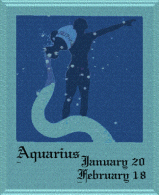
Jan. 20 - Feb. 18 | Aquarius (man pouring water from pitcher) |
 |
Feb. 19 - Mar. 20 | Pisces (the two fish) |
 |
Mar. 21 - Apr. 19 | Aries (a sheep, ram, or lamb) |
 |
Apr. 20 - May 20 | Taurus (the bull) |
 |
(The Milky Way lies between Taurus and Gemini) | |
 |
May 21 - June 20 | Gemini (the twins Castor & Pollux [see Acts 28:11]) |
 |
June 21 - July 22 | Cancer (the crab) |
 |
July 23 - Aug. 22 | Leo (the lion) |
 |
Aug. 23 - Sept. 22 | Virgo (the virgin, holding a sheaf of wheat, or an ear of corn, or a fruit) |
 |
Sept. 23 - Oct. 22 | Libra (the scales) |
 |
Oct. 23 - Nov. 21 | Scorpio (the scorpion) |
 |
Nov. 22 | Sagittarius (the archer or hunter, depicted as a centaur, half man half horse) |
The tradition of having 360 degrees in a circle probably comes from it being a nice convenient number very near the number of days in a year. 360 is a nice round number that can be evenly divided into 2 parts, or 4 parts, or 10 parts, or 12 parts, or 36 parts, or 72 parts—whatever you feel like, whereas the actual solar year of 365.2421934 days is not as easy a number to deal with.
The sun travels about one degree each day. It's not exact, since there are actually 365.2421934 days in a solar year instead of 360. Also the earth's orbit isn't a perfect circle, it's slightly elliptical. The earth travels slightly faster during the winter months when it's slightly closer to the sun, and it travels slightly slower during the summer months when it's slightly farther from the sun. In general though, one degree equals about one day. (The seasons are primarily caused by the earth's tilt, not by it's varying distance from the sun. See Cause of the Seasons [offsite])
It's still ambiguous exactly when the sun leaves one house and enters another. The standard dates used by astrologers for the past two millennium (the ones given in the table above) correspond to a time somewhere in the range of around 600 B.C.E. to 1 C.E. Today, some 2000 years later, due to the Earth's precession the sun is in Sagittarius on Dec. 22, and you have to wait until around Jan. 18 before you can say the sun is in Capricorn. However, the tradition of having Capricorn cover the days from December 22 to January 19 still remains today. Have a look at any astrology or horoscope section of a newspaper (if your newspaper has such a section. No one today really believes in astrology, but some newspapers still have one just for the fun of it.) You'll see there listed the twelve constellations of the zodiac, covering the full year, with Capricorn beginning on December 22, the Winter Solstice. Though the winter solstice is a natural place to begin the year, you'll notice the astrology section always begins with Aries, March 21, which is the vernal equinox, another common place to begin the year.
For our purposes it doesn't matter exactly what day the sun leaves one house and enters the next. It's the overall story line we are concerned about. We want to know the general sequence of events that occurs during the solar year.
If we accept the old tradition of having the sun enter Capricorn on the Winter Solstice, a natural place to start the yearly cycle, then when the sun has traveled 30 degrees the sun exits Capricorn and enters Aquarius. Thus an allegorical story of the sun's annual travels could have the sun character visiting the Aquarius character at "Age 30" That's actually 30 degrees, or about 30 days, but an allegory could use 30 years instead.
2. On the Winter Solstice the sun enters Capricorn. The Sun then passes through Capricorn, traveling 30 degrees in 30 days, to reach Aquarius at "age 30". Entering Aquarius is the first big event of the journey.
Jesus is said to have begun his ministry at age 30 (Luke 3:23). Jesus begins his ministry by visiting John the Baptist (Aquarius), who baptizes with water.
3. The Sun's annual journey around the zodiac takes one year.
Jesus' ministry is said to have lasted one year. [At least according to the Synoptic Gospels (Matthew, Mark, Luke). The Gospel of John implies Jesus' ministry lasted 3 years. The Gospel of John contradicts the Synoptic Gospels many times, which, by definition, is why it's not one of the "Synoptic" Gospels. Here we are concentrating on Jesus' mission as described in the Synoptic Gospels.]
So far we have:
| 1 | The Sun is born, or re-born, on December 25th. | Jesus is born on December 25—Christmas Day. |
| 2 | On the Winter Solstice the sun enters Capricorn. The Sun then passes through Capricorn, traveling 30 degrees in 30 days, to reach Aquarius at "age 30". Entering Aquarius is the first big event of the journey. | Jesus begins his ministry at "about 30 years of age" by visiting John the Baptist, who baptizes with water. |
| 3 | The Sun's annual journey through the twelve houses of the zodiac takes one year. | Jesus' ministry is said to take one year (according to the Synoptic Gospels). |
 |
Aquarius is depicted by a man pouring out a pitcher of water. At left we have the illustration of what Aquarius is supposed to look like on the western horizon, if you have a very good imagination. It takes quite an imagination to see this in the stars. The idea of a man pouring out water has more to do with what is happening at that time of year. (See The constellations don't look like what they're named).
The Sun enters Aquarius around Jan. 20. January is the rainy season. There is a lot of water everywhere. In January the days start to get longer and longer, as the Sun climbs higher and higher in the sky each day. The days also begin to get warmer and warmer, because the angle of the Sun's rays changes (see Cause of the Seasons [offsite]). The longer warmer days cause any snow that has accumulated in the higher mountains to melt, adding to the inundation of water. Rivers rise and may flood. This is the first step in the harvest cycle. We look forward to the promise of a good harvest later on in the year.
4. The Sun visits Aquarius who immerses the land with water.
Jesus starts his one year ministry by visiting John the Baptist who baptises with water (Matthew 3).
Near the beginning of any long and difficult journey, such as the one the Sun has just embarked on, there is the temptation to be lazy. Why should the Sun embark on such a long and difficult journey? Why should the Sun bother to climb higher and higher in the sky each day, making the days longer and the dark nights shorter? We want the Sun to conquer the cold and darkness with longer warmer days. The Sun is tempted to be lazy. However, for our sake, the Sun will resist that temptation to give in to the forces of cold and darkness. The Sun has a mission to fulfill. The Sun must embark on its journey so that we may have a bountiful harvest and continue to live.
The temptation to be lazy is a common theme we find expressed near the beginning of a solar myth. The Sun is tempted, but the Sun spurns the temptation. The Sun will not allow cold and darkness to reign. The Sun will continue on it's journey.
5. The temptation to give in to the forces of darkness,
6. and the resistance to that temptation.
[Jesus, after starting his one year mission by visiting John the Baptist (Mat. 3), is tempted by the devil (Mat. 4:1-11)] but he rebukes the devil's offers (Mat. 4:4,7,10-11)]
After a month has passed the Sun leaves Aquarius and Aquarius goes below the horizon. We might say Aquarius has entered the underworld, or hades, or hell, or has been handed over. Since Aquarius is depicted by a man, we might figuratively say our character has been put in prison, since we won't be seeing Aquarius again at Sunset for quite awhile.
7. The Sun leaves Aquarius. Aquarius is figuratively is put in prison.
After Jesus visits John the Baptist who baptizes him with water, John the Baptist is put "in prison" (Mat. 4:12).
[NOTE: The King James version reads, "Now when Jesus had heard that John was cast into prison, he departed into Galilee;" (Mat. 4:12 [King James Version]) Actually a more literal translation reads, "And Jesus having heard that John was delivered up, did withdraw to Galilee," (Mat. 4:12 [Young's Literal Translation]) The single word παραδιδωμι, which the KJV version translates as "was cast into prison" means "to deliver up one to custody". The word "prison" is not found anywhere in the Strong's definition. (See Strong's #3860.)
8. The Sun goes on it's way, leaving Aquarius behind.
Jesus goes on his way. (Mat. 4:13-17)
In the Jesus story after Jesus [the Sun], visits John the Baptist [Aquarius] the Bible says, “After John was put in prison, Jesus went into Galilee,....” (Mark 1:14; Matthew 4:12; Luke 3:20; John 3:24). Suddenly John the Baptist is "put in prison", and Jesus just goes on his merry way! There is no further explanation in the Bible, which seems quite strange if John were a real person. We want to know why he was "put in prison." What crime was he accused of? Who threw him in prison? Was there a trial? Did Jesus attend the trial and speak on his behalf? No. Nothing more is said. Jesus just continues on his journey and appears unconcerned about John the Baptist.
This is all very strange and hard to understand if interpreted as a story of real life events, but it all makes perfect sense when understood as an astronomical allegory. John the Baptist being put in prison is merely an allegory for the constellation Aquarius at sunset moving lower and lower until it is below the horizon at the end of the month and can no longer be seen. It is a natural phenomenon that requires no further explanation, and that is why there is no further explanation in the Bible.
So Jesus [the Sun], continues on his way into "Galilee". The word "Galilee" literally means "circuit". The original Greek word is γαλιλαις {gal-il-ah'-yah} (Strong's Greek #1056. Click here to see the verse in Greek), which is a word of Hebrew origin לילג {gaw-lee-law'} (Strong's Hebrew #01551). A "circuit" is a closed, usually circular path. The ecliptic is the circuit the Sun travels along during the year. The ecliptic is a great circle inscribed on the celestial sphere. Jesus, a personification of the Sun, continues on his way along the ecliptic, or "Galilee".
After the Sun passes through Aquarius, the Sun enters Pisces, the two fish. There's a lot of water around, brought on by Aquarius, and there's no harvest yet, and not much good hunting, so this is a good time to go fishing. Hence the theme of fish and fishing.
9. The Sun visits Pisces, the two fish. Theme of fishing.
Reviewing the Jesus story vs. the solar mythology story, so far we have about the Sun:
So far we have about Jesus:
1) Born on 25th of December, birthday of the sun.
2) Starts his mission at "age 30" (Luke 3:23)
3) Mission is said to take one year [Synoptic Gospels]
4) Starts his mission by visiting John the Baptist (Mat. 3)
5) Is then tempted by the devil (Mat. 4:1-11)
6) resists the devil's offers (Mat. 4:4,7,10-11)
7) John is put "in prison." (Mat. 4:12)
8) Jesus goes on his way, leaving John behind. (Mat. 4:13-17)
9) Jesus then visits Simon and Peter, two fishermen. (Mat. 4:18-22)
(Note how Aquarius is now below the horizon. We won't be seeing Aquarius for awhile.)
After passing through Pisces, the Sun enters Aries, the ram, sheep, or lamb. The traditional date for this is the Vernal Equinox (or Spring Equinox), March 21. This is an important date, because this is when day and night are of equal length, and after this day the days are longer than the nights. The battle of warmth and light against cold and darkness has finally been won.
Sin means a deviation from the way things ought to be. The sin of the Earth was that it was cold and dark during Autumn and Winter. We would prefer it to be warm and light. When the Sun reaches the lamb the sin of the earth is figuratively taken away, as that is when the warmth and light of Spring and Summer finally wins over the cold and darkness of Autumn and Winter. Thus figuratively the lamb is that which takes away the sin of the earth.
It's common for solar religions to associate their savior with the zodiac symbol the Sun is in at the Vernal Equinox. Jesus is known as the "lamb of God."
"The next day John saw Jesus coming toward him and said, "Look, the Lamb of God, who takes away the sin of the world!" (John 1:29)
"When he saw Jesus passing by, he said, "Look, the Lamb of God!" (John 1:36)
Jesus is often depicted with a lamb.


10. The Sun visits Aries, a ram, sheep, or lamb, on the Vernal Equinox, when darkness and cold, the figurative sins of the earth, are overpowered by light and warmth.
[Jesus is the lamb of God who takes away the sins of the earth.]
11. Easter, when we celebrate Jesus as risen from the grave, is celebrated on the first Sunday after the first full moon after the Vernal Equinox. It is a Spring time celebration of the rebirth of the Sun and the Sun overpowering the cold and darkness of Winter.
 Due to the earth's precession the Vernal Equinox gradually moved from Aries the ram to Pisces the fish sometime vaguely around 1 CE to 300 CE. (Since there are no well defined borders between the zodiac constellations there's no definitive date.) Hence the symbol of a fish, representing Pisces, became the symbol of Christianity, because the Sun was in Pisces, the fish, on the Vernal Equinox.
Sometimes the fish symbol has the Greek letters ΙΧΘΥΣ in it. This is just the Greek word for "fish" (see Strong's Greek #2486). Some people though have made use of the letters of the word as an acronym for a clever phrase.
 The symbol of the fish is also found in the miter the Pope wears. (See the fish in the side view?)
As for Christ on the cross, the oldest artistic representations of the Christian cross depict a figure of a lamb (Aries). The practice of symbolising the saviour by a lamb continued until the Council of Constantinople (692 CE) under the pontificate of Agathon and during the reign of Constantine Pogonat. It was decreed that, instead of the ancient astrological symbol of Aries the lamb, all crosses depicted in art should be combined with the figure of Jesus. The retiring of the Lamb as the main Christian symbol, translated from the Latin, is as follows:
| In the Roman Sotteranea of Antonio Bosio, concerning the image of Christ under the figure of a lamb: |
| In certain representations of the images of the saints, a lamb is portrayed. We, therefore, accepting the old forms and shadows as signs of the truth and as traditional symbols of the church, prefer Grace and Truth, which we accept as the fulfilment of the Lamb. So, that which is perfect, let us place in pictures, even before the eyes of all. We have decreed that the Lamb, which taketh away the sins of the world, Christ our God, ought to be portrayed henceforth in human form in place of the Lamb. (Higgins, Anacalypsis, Vol.2, pp.111-112) |
At first, Jesus was represented fully robed, standing calmly before the cross with outstretched arms. The lamb continued to be shown, usually at the foot of the cross. Later, the figure of Jesus was placed on the cross, undraped, bleeding and tortured by pain from wounds, as he is represented on crucifixes today. Pope Adrian I confirmed this point.
12. Due to earth's precession the Sun is now in Pisces the fish on the Vernal Equinox.
[A fish is now the symbol of Christianity.]
Larry M. Wright Christianity, Astrology and Myth pg. 79
Autumn and Winter are the seasons for stormy weather. Around Spring time the storm season ends and we start having nice weather again. So when the Sun enters the constellation of spring time the storms calm.
13. The Sun in Spring brings an end to stormy weather.
[Jesus does a lot of talking in Matthew chapters 5, 6, & 7. If you have one of those Bibles that print the words Jesus speaks in red you'll see we have several pages entirely red. Scholars of Comparative Religion say all of the ideas expressed here were already extant in previous religions, so there's really nothing new. In Matthew chapter 8 Jesus gets to moving again, and in Matthew 8:23-27 we have the story of how Jesus Calms the Storm.]
Around roughly 4000 B.C.E. to 2000 B.C.E. the Sun was in Taurus the bull on the Vernal Equinox, and we find in ancient religions of this period that a bull was worshipped as the one who saves the world from the evils of winter. Due to the earth's precession this later became Aries the lamb who saves the world, and later when the Sun was in Pisces the symbol of the lamb was abandoned and replaced with that of a fish.
There are no bulls in the Gospels, nor are there any crabs, lions, or scorpions. We do find a bull and lion in Revelations 4:7, "and the first living creature like a lion, and the second living creature like a calf, and the third living creature having the face as of a man, and the fourth living creature like a flying eagle." This is a reference to the four seasons of the year. The lion is Leo, the calf is Taurus, the man is Aquarius, and the eagle is one of the three symbols for Scorpio (see Saint Matthew: a sermon by Robert Taylor - 1831)
Instead we need to look at what changes happen around this time of year and compare that to what happens in the Jesus story.
Recall how Aquarius went below the horizon early on in our story. Aquarius is down there in the underworld, where the dead are, or is figuratively "put in prison". Some months later, if you wait a few hours after sunset, you'll see Aquarius poking its head up above the eastern horizon, rising from the underworld, and it appears as if Aquarius is being beheaded by the horizon. Aquarius figuratively "rises from the dead" and is beheaded by the night eastern horizon.
By mid-May you only need wait until 11:00 PM to see the beheading of Aquarius. By July it's too late for this story, as Aquarius is already above the eastern horizon by sunset.
14. The head of Aquarius rises from below the eastern horizon (rises from the dead)
15. and appears beheaded by the horizon.
Following the Jesus story we come to the beheading of John the Baptist. John the Baptist, who baptizes with water, is our personification of Aquarius the water bearer, who starts the harvest cycle by bringing on the rainy season. In Matthew 14:1-12 John rises from the dead: "This is John the Baptist; he has risen from the dead!" (Matthew 14:2) and then John is beheaded by Herod, a personification of night. (See The Birth of Jesus for more on how Herod is a personification of night and the evil cold and darkness that comes with it.)
16. There is some inference that John somehow survives this beheading and "rises from the dead" intact (Mark 6:16 "When Herod heard this, he said, 'John, the man I beheaded, has been raised from the dead.'") And sure enough as the night progresses we see all of Aquarius rising intact from below the eastern horizon.
The Bible says Joseph took Jesus as a baby and fled to Egypt where they stayed until the death of Herod (Mat. 2:13-15). However, here we have king Herod apparently still alive and ruling 30 years later during Jesus' mission. And now we have a headless John running around still alive. This Jesus story is impossible to interpret literally, but quite easy to interpret using solar mythology. (We'll talk more about Herod in a later lesson.)
Right after Taurus the Bull lies the Milky Way, that starry band that lies like a lake across the night sky. The sun crosses the Milky Way around May 20 to June 4.
17. The Sun “walks on the water”.
At this point in Jesus' travels we have the story of Jesus crossing the lake by walking on the water (Matthew 14:22-33). “Jesus went out to them, walking on the water.”

Since the beginning of the year when our story began the sun has been climbing higher and higher in the sky each day. Each day the sun rises farther northward in the east, and sets farther northward in the west. The days are getting longer and brighter and warmer.
On June 21 we reach the Summer Solstice, the longest day of the year. On this day the sun rises farthest northward, the sun climbs to its highest point in the sky, and then sets farthest northward in the west. It is the beginning of Summer, a period of bright, sunny, warm, and wonderful weather.
It is at this point in the Jesus Story that we have the Transfiguration of Jesus. Jesus goes up a high mountain, the highest point Jesus reaches in the story, and shines brighter than ever, the brightest he shines in the whole story. "His face shone like the sun." (Matthew 17:1-13)
18. The sun reaches the Summer Solstice.
Jesus has his transfiguration.
Jesus brings with him Peter, James, and John, and at the mountain top they meet Moses and Elijah. For an interesting aside about Elijah and Moses on the Transfiguration see commentary by Bishop John Shelby Spong.
The Summer Solstice is a turning point in our story. Up to now everything has been getting better and better. But from this day forward the sun starts slipping southward again. The sun can not escape its ultimate fate. The sun will continue slipping southward, Autumn will come, and the sun will eventually die in the cold dark of the Winter Solstice on December 22, to be resurrected again three days later, on December 25—Christmas day. This turning point is the first time we may think about the eventual death of the sun—it's ultimate fate in winter.
Jesus first predicts his death just before the Transfiguration (Matthew 16:21-28). Peter says, "Never Lord! This shall never happen to you!" That is, everything is wonderful right now, let's just have it this way always and forever. But the sun can not remain at it's highest point forever. If it did there would be no seasons of the year and no harvest cycle. We rely on the harvest for our food, without which we would die.
And just as the sun can not escape it's fate, so too Jesus, a personification of the sun, can not escape his fate, as he begins to tell us at this point in the story.
But that is all a long way off. For now all is happy and wonderful. It's summer time, and thoughts of the sun's ultimate death in winter are easily dismissed. It's just too good a time right now. Even though Jesus is now on his way to Jerusalem, where he predicts he will die, it's still a happy story up to this point. Jesus hasn't encountered any problems yet. Indeed, the happiest point in his story is about to occur.
In the Babylonian zodiac the sign for the house of Cancer was the ass and foal.1 Two bright stars in the constellation of Cancer still bear the names "northern Ass" and "southern Ass", with the "southern ass" lying directly on the ecliptic.
"North and south of the nebula Praesepe are two stars, which Orientalists speak of by a name evidently of some antiquity. Asellus means an Ass, and one was called Asellus Borealis, the northern Ass; while the other, Asellus Australis, is the southern Ass. The sign [for Cancer] was afterwards known by the symbol  , which stands for these two asses."2 This glyph for Cancer is still used today.
A quick check of any star map confirms this. The star γ (gamma) is named Asellus Borealis, or 'northern donkey', and the star δ (delta) is named Asellus Australis, or 'southern donkey'.3
"Asellus borealis and Asellus australis, the Northern and the Southern Ass Colt, were the ’Όνοι, or Asses, of Ptolemy and the Greeks; the Aselli, or Asini, of the Latins, distinguished by their position as here given, even to the present day, and now popularly known as the Donkeys. ... and the Arabians similarly knew them as Al Himārain, the Two Asses."4
Hence as the Sun travels through the constellation of Cancer, it figuratively rides two asses, or an ass and colt, into the middle of summer. Of course everyone is happy to greet the arrival of summer. It's the best time of year, and the harvest is just around the corner.
Comparing this with our Jesus story, a high point of the Jesus story is Jesus' triumphal entry into Jerusalem, awkwardly riding both an ass and colt. "They brought the ass and the colt and put their garments upon them, and he sat on them. (Matthew 21:7) We have here Jesus riding on both an ass and a colt. Quite a trick if interpreted literally, but in astronomical allegorical terms it's simply what happens.
19. The Sun figuratively rides an ass and foal into the middle of summer.
Jesus rides an ass and colt into Jerusalem.
Arthur Weigall The paganism in our Christianity (1928) p. 221
(Larry M. Wright Christianity, Astrology and Myth (2004) pg. 114 repeats the claim, though he may have gotten it from Weigall.)
E. W. Bullinger The Witness of the Stars (1893) p. 149
Ian Ridpath, Wil Tirion Stars and Planets (1984) p. 94
Richard Hinckley Allen Star Names: Their Lore and Meaning (1899) p. 111
Let's review the parallels we have so far between the cronological events in the Jesus story and the corresponding astronomical events in the annual journey of the Sun:
| 1. | The Sun is born, or re-born, on December 25th. | Jesus is born on December 25th. |
| 2. | On the Winter Solstice the sun enters Capricorn. The Sun then passes through Capricorn, traveling 30 degrees in 30 days, to reach Aquarius at "age 30". Entering Aquarius is the first big event of the journey. | Jesus started his mission at "age 30" by visiting John the Baptist. |
| 3. | The Sun's annual journey around the Zodiac takes one year. | Jesus' mission lasted one year (according to the Synoptic Gospels). |
| 4. | The Sun visits Aquarius who immerses the land with water. | Jesus visits John the Baptist who baptizes with water. |
| 5. | The Sun is temptated to give in to the forces of darkness. | Jesus is tempted by the Devil, the "angel of darkness." |
| 6. | The Sun resists that temptation and continues on its journey. | Jesus resists the Devil and continues on his journey. |
| 7. | The Sun leaves Aquarius. Aquarius is figuratively put in prison. | Jesus leaves John the Baptist, who is "put in prison." |
| 8. | The Sun goes on it's way, leaving Aquarius behind. | Jesus leaves John the Baptist behind, apparently unconcerned about his fate. |
| 9. | The Sun then visits Pisces, the two fish. Theme of fishing. | Jesus then visits Simon and Peter, two fishermen. |
| 10. | The Sun visits Aries, a ram, sheep, or lamb, on the Vernal Equinox, when darkness and cold, the figurative sins of the earth, are overpowered by light and warmth. | Jesus is the "lamb of God" who takes away the sins (cold and darkness) of the earth. |
| 11. | The Vernal Equinox is a time to celebrate the victorious resurrection of the Sun. It is a Spring time celebration of the rebirth of the Sun and the Sun overpowering the cold and darkness of Winter. | Easter, when we celebrate Jesus as risen from the grave, is celebrated on the first Sunday after the first full moon after the Vernal Equinox. It is a Spring time celebration of the victorious resurrection of Jesus. |
| 12. | Due to the earth's precession the Vernal Equinox gradually moved from Aries the ram to Pisces the fish. | A fish became the symbol of Christianity. |
| 13. | The Sun in Spring brings an end to stormy weather. | Jesus calms the storm. |
| 14. | The head of Aquarius rises from below the eastern horizon (rises from the dead). | John the Baptist "rises from the dead." |
| 15. | The head of Aquarius appears beheaded by the horizon. | John the Baptist is beheaded. |
| 16. | The head of Aquarius continues to rise above the horizon intact. | John the Baptist somehow survives this beheading and "rises from the dead" intact. |
| 17. | The Sun then crosses the Milky Way, that starry band that lies like a lake across the night sky. The Sun figuratively walks on water. | Jesus then "walks on water." |
| 18. | The Sun reaches the Summer Solstice, the day it reaches its highest point and shines brightest and longest. | Jesus goes up a high mountain, the highest point in his journey, and shines brighter than ever. "His face shown like the Sun." |
| 19. | The Sun figuratively rides an ass and foal (Babylonian Zodiac sign for the house of Cancer) into Summer. | Jesus rides an ass and foal for his triumphal entry into Jerusalem. |
And looking ahead in the Jesus story, we know Jesus eventually dies and is resurrected three days later, just as the Sun dies on the Winter Solstice and is reborn three days later on Christmas day.
On August 23rd the sun enters the house of Virgo the virgin. Virgo is the virgin that figuratively gives birth to the sun each year when the sun passes out of Virgo. Even though Virgo gives birth, she remains a virgin, just as Mary is the virgin who gives birth to Jesus and yet remains a virgin.
 |
| The star on the shoulder of the Virgin Mary was a traditional symbol in all art prior to the 1600's. It is derived from the star 'Spica' which figures in the constellational image of Virgo.1 (Duccio's 'Virgin and Child', National Gallery, London.) |
A star on the shoulder of the Virgin Mary was a traditional symbol in all art prior to the 1600's. The star is derived from the star 'Spica', which is the brightest star in the constellation Virgo.1 'Spica' is Latin for "ear of wheat," which Virgo holds in her hand. The sun's ecliptic path passes very close to this bright star as it moves through Virgo. Hence when the sun reaches Spica, it's time to harvest the wheat. Virgo is also sometimes depicted as holding an ear of corn.
Food and drink are literally the elements which sustain life. Mother earth brings forth food which grows up out of the ground. Because life springs forth from the earth, the earth is given the female role of mother, since it is from the female that life emerges. And if earth is the mother, then the father must be the god above who pours down rain from the sky impregnating the earth. This is why God above is a masculine "He" instead of a feminine "She" or a sexless "it."
The sun is born or re-born in four different ways:
[1] Frederick Goodman Zodiac Signs pg. 87
[2] E. Walter Maunder The Astronomy Of The Bible p.124 (1908).
After the harvest the sun moves from Virgo into Libra, the Scales. (September). These are the "Scales of Justice." The harvest has been gathered, it is now time to sell the harvest. Scales are used in buying and selling the harvest. At the end of harvest time, when there is nothing left to sell, the money changers pack up and leave. The Bible says, “Jesus entered the temple area and drove out all who were buying and selling there. He overturned the tables of the money changers.” (Mark 11:12-19; Matthew 21:12) Jesus, the sun, representing the passage of time, moves out of Libra, the Scales of Justice, and the money changers pack up and leave, because the season has passed and they are finished selling the harvest.
As we enter the season of Autumn the leaves fall from the trees and the trees appear to wither. It is at this point in the story that Jesus is said to curse the fig tree and make it wither, a story which makes no sense if Jesus were a real person, but it makes perfect sense when understood as an allegory. It is simply Autumn, and Jesus, the sun, who makes the seasons pass, causes the leaves to fall from the trees (Mark 11:20-25; Matthew 21:18-22)

In the Jesus story we then have the Last Supper, where Jesus and his twelve disciples, a reference to the twelve zodiac months of the year, recline and eat the harvest. (Mark 14:12-26; Matthew 26:17-30; Luke 22:7-38) This is the natural time of year to have a huge feast. In America we celebrate Thanksgiving and have a huge feast of food. We eat the flesh of the fruit—figuratively the flesh of Jesus, who personifies the sun which make the fruit grow; and we drink wine—the blood of the grapes, figuratively the blood of Jesus, who personifies the sun which made the grapes grow. Without this food we would perish.
Note that food and drink are literally the elements which sustains life. When we participate in the Communion ritual in church we eat bread, figuratively the body of Jesus, and drink wine (or grape juice), figuratively the blood of Jesus, because food and drink are literally the elements which sustains life. It is the sun which makes plants grow so we can have food to eat and wine to drink. We personify the sun as Jesus and then give thanks to Jesus (the sun) for our food and drink. The harvest is our salvation.
In late October the sun enters Scorpio, the Scorpion. The name of this sign in Arabic and Syriac is Al Akrab, which means wounding him that cometh. The brightest star in this sign bears the ancient Arabic name of Antares, which means the wounding.1 Thus, when the sun enters the house of Scorpio, the Scorpion figuratively stings the sun wounding it to make it slowly die.
By late October it becomes very noticeable that the days are getting shorter and colder as the sun rises lower and lower each day. The sun, which lived to give us the harvest of food so that we may live, is now weak and dying. Darkness and cold begin to reign. The sun spends more of it's time down below in the underworld then it does above. The sun has descended down into hell. Night is longer than day, and the days aren't very warm.
We've harvested the food. We've had our feast. Now the year tragically winds down and comes to an end as the days become short and cold. Similarly, after the last supper the Jesus story goes tragically downhill.
In the Jesus story Jesus is betrayed by Judas, one of the twelve. Judas represents Scorpio the scorpion. Scorpio stings the sun condemning it to death, just as Judas kisses Jesus condemning him to death.
It is interesting to note that even though the chief priests want to arrest and kill Jesus, they can not identify which person is Jesus, and resort to bribing Judas to point him out for them. It should be obvious by now which person Jesus is. Jesus has thousands of people following him. A huge crowd welcomed him as he entered Jerusalem, riding both an ass and a colt, quite a theatrical performance that would naturally draw a crowd. After entering Jerusalem Jesus continues to teach every day to the crowds assembled. Supposedly by now anyone could point him out, yet inexplicably the chief priests can not identify him, and resort to bribing Judas to point him out for them.
Judas is a personification of Scorpio. Pilate, whom Jesus sees next after being betrayed by Judas, is a personification of Sagittarius, the next sign in the zodiac following Scorpio. Scorpio, the scorpion, stings the sun condemning it to death, just as Judas kisses Jesus condemning him to death. After the sun has it's fateful encounter with Scorpio it moves on to Sagittarius, leaving Scorpio below the horizon, a figurative death for Scorpio. Similarly, after Jesus (the sun) is kissed by Judas (Scorpio), Jesus (the sun) moves to stand trial before Pilate (Sagittarius), and Judas (Scorpio) dies a tragic death.
There is a contradiction in the Bible regarding the death of Judas. Matthew 27:3-5 claims Judas returns the money and then hangs himself in an act of suicide. But in Acts 1:18 Judas is said to have used the money to buy a field in which "he fell headlong, his body burst open and all his intestines spilled out," which sounds somewhat like an accident. Christian apologists try to come up with clever scenarios whereby both are true so there is no contradiction. I leave it to the reader and his imagination to try and reconcile these two conflicting passages. For our purposes we only care that Judas dies (Matthew 27:1-10), followed immediately by Jesus being handed over to Pilate (Matthew 27:11-26).
[1] Joseph A. Seiss. The Gospel In The Stars pg. 45
The claim is repeated by Ethelbert W. Bullinger in his book Witness of the Stars but he may have gotten it from Seiss. Other sources say Antares means "Rival of Mars" (Anti—Rival of, Ares—Mars), due to the star's noticeably red color which rivals that of the red planet Mars. I don't know where Seiss came up with wounding as a definition of Antares.
Sagittarius is the last constellation the sun passes through before the Winter Solstice, when our story ends. Similarly, Pilate is the last person Jesus sees in his story before the story ends. Pontius Pilate is a personification of Sagittarius.
Sagittarius is a man on a horse with a bow and arrow. The theme is hunting. We're all done harvesting, so let's go hunting. It is a good time of the year to go hunting. The animals are full grown. And we've not much else to do, except it sure is getting dark and cold this time of year, isn't it? What's happening to our sun? It seems to be leaving us. Will it leave us forever?
After the death of Judas (after Scorpio goes below the horizon), Jesus (the sun) is handed over to Pontius Pilate (Sagittarius). Pilate is the last person Jesus encounters in the story before being put to death, only to be resurrected three days later; just as Sagittarius is the last zodiac month of the year the sun passes through before dying on the Winter Solstice, December 22, only to be resurrected three days later and begin anew its journey northward, on December 25, Christmas day.
"Pontius", ποντιος {pon'-tee-os} (Strong's Greek #4194), is literally "of the sea", a reference to the sea of stars above. (It's also of Latin origin, betraying it's late addition to the text.) [Click here to see the verse in Greek].
"Pilate", πειλατος {pil-at'-os} (Strong's Greek #4091), is literally "armed with a spear". Sagittarius, the archer, is armed with a bow and arrow, which serves the same purpose as a spear. The theme is hunting. We're all done harvesting, so let's go hunting.
Sagittarius also pierces the side of the sun with his arrow, just as Jesus has his side pierced while on the cross.1
But the days are getting shorter and shorter, and colder and colder, as the year comes to a close. The dark nights are getting longer. Things look dark and gloomy. What will happen to our savior, the sun, who makes the harvest grow providing us with life saving food? Will he disappear forever? Are we doomed? Is this the end? The good news of the Bible is, "No, this is not the end. It is the preface to a new beginning. The sun will arise again, the cycle will begin anew, and we will all be saved, again."
HEROD
Jesus is handed over to Herod (Luke 23:7-11) This makes it somewhat difficult for us to place these events in a historical context, because Herod died in 4 B.C., yet here we apparently have him alive again, at a time supposedly around A.D. 27. Christian apologists deal with this by claiming this is a different Herod, not the same Herod who tried to kill Jesus when Jesus was born. Christian apologists go even further to claim the Herod mentioned in Acts 23 is a third Herod. Well, why not? After all, the Bible doesn't explicitly say these are all the same Herod.
But of course using this logic we could claim multiple copies of any character whenever it was convenient for us. We could have two Judas characters, both who betray Jesus for 30 pieces of silver, one who returns the money and hangs himself (Matthew 27:3-5), and the other who uses the money to buy a field in which "he fell headlong, his body burst open and all his intestines spilled out." (Acts 1:18). The Bible doesn't say there are two different people both named Judas, but then again the Bible doesn't explicitly say the Judas who tripped and fell is the same Judas who hanged himself, though such would be the natural conclusion, were it not for the fact that the two versions of the story contradict one another.
So the Bible does not explicitly say this is a different Herod, though it would be the norm for any writer to mention such a thing if it really were a different person who happens to have the same name. After all the Bible does distinguish between John the Baptist and John the brother of James and son of Zebedee, so there's no confusion between which John it is referring to. Yet for Herod the Bible makes no distinction, leading us to believe it is the same Herod mentioned earlier.
This of course leaves us desperate when trying to force this story into a historical context. However, there is no problem when we interpret the story as an allegory, with Jesus a personification of the sun and Herod a personification of the darkness and cold of night time and the dark and cold seasons of Autumn and Winter. As an allegory Herod figuratively "dies" every morning with the rising of the sun (Jesus), and regains power every evening with the setting of the sun. Herod also looses power when the bright warm seasons of Spring and Summer commence. Herod regains power in the dark and cold seasons of Autumn and Winter.
Herod is a personification of Night. Herod, or the darkness of Night, is taking over Jesus, the sun, as the days get shorter and shorter in Autumn and darkness begins to reign. (See Matthew Chapter 2—The Birth of Jesus for more on King Herod).
ANTI-SEMITISM
We also have clear anti-Semitism in the Bible here. The writer makes it very clear it is the Jews who are forever to blame for demanding Jesus be crucified. The Bible says, "Let his blood be on us and on our children!" (Matthew 27:25) Christians have used this passage ever since to justify persecution of the Jews. Yet the Jews don't have this as a part of their sacred scriptures. You don't find anywhere in the Old Testament a statement that the Jews should forever hence forth be persecuted. It is only in the Christian scriptures that we find this statement.
Imagine if the Koran had a statement that Muslims used to justify endless persecution of Christians. Christians would forever be persecuted by Muslims, because of a statement in the Koran, a book Christians don't believe is holy scripture and never read.
Persecution of Jews diminished after World War II when it was revealed that 6 million Jews had been exterminated during the war by the Nazis. It finally became unfashionable to persecute Jews.
THE DEATH AND RESURRECTION OF JESUS
Jesus is crucified and placed in a cave. It is the end of the story. A sad ending. But have faith. Jesus, the sun, will arise again — a new year will begin. Three days after Jesus is placed in the cave he will arise again. This is the prophecy. This is the good news of the Bible.
On Christmas day, December 25, we celebrate the birth of Jesus. December 22 was the Winter Solstice, the shortest day of the year, when the sun was at its lowest. Three days later, on December 25, the sun rises 1/10 of it's width farther north — just barely detectable by carefully observing the shadows cast at sunrise. Our savior, the sun, has been reborn, to begin the cycle of the year and the cycle of life again.
Originally Jesus was said to have been born in a cave. The Catholic Encyclopedia (1910) article on "Bethlehem" says, “The tradition of the birth in a cave was widely accepted, as we see from Origen's words about a century later: — In Bethlehem the cave is pointed out where He was born, and the manger in the cave where He was wrapped in swaddling clothes, and the rumor is in those places and among foreigners of the Faith that indeed Jesus was born in this cave —. (Contra Celsum, I, li.) It is reproduced also in the apocryphal gospels (Pseudo-Matt., xiii, ap. Bonaccorsi, op. cit., 159-163; Protevang. of James, xvii sqq., Bonaccorsi, 155-159; Gospel of the Infancy, II-IV, Bonaccorsi, 163-164).”
[See Eusebius's Life of Constantine, lib. 3, chs xl, xli, and xlii.] [Also see Matthew Chapter 2—The Birth of Jesus]
[Also note that archaeological evidence indicates Bethlehem of Judea was uninhabited at the alleged time of Jesus' birth. "There is surprisingly no archaeological evidence that ties Bethlehem in Judea to the period in which Jesus would have been born." (The likelihood is there was no settlement at this site at that time.)— Where was Jesus really Born? Archaeology magazine’s article Volume 58 Number 6, November/December 2005]
Hence the story is circular, just as the years are circular. A new year begins after the old year ends.

 On New Years Eve we personify Father Time and Baby New Year, but we know these two figures aren't real people, they are merely personifications of the passage of time and the beginning of a new year. The current year is old and finished with. A new year is about to begin. The moment the Old Year ends a New Year begins. The cycle of life is circular and never ending.
In the Gospel story of Jesus, after his resurrection the story ends. People have always asked what did he do after that? Why does the story end here? Why isn't the rest of his life chronicled? — The reason is, if you want to read the continuation of the story, turn back to page one. The story is circular. Three days after Jesus dies and is placed in the cave he is born again, and the story begins anew.
In church it is customary to begin reading through one of the Gospels at the beginning of the year. Each Sunday we take the next chunk of the story and read it and the pastor makes a sermon on it, never realizing that the story is an allegory for the passage of time, the seasons of the year, which we ourselves live and experience, as we live our lives, dependent on the sun for light and for food.
[1] Acharya S interview at http://www.consciousmedianetwork.com/members/acharya.htm (Oct. 2005) [Return to text.]
Here is a literal translation of Matthew 2:1. This shows why it is so difficult to create a decent English translation of the original Greek. This explains why there are so many different English translations of the Bible. The top row is Greek. The middle row is the Strong's number corresponding to the Greek word — if there is one. Note not all of the original Greek words have a corresponding Strong's number. The bottom row is the literal English translation of the Greek word.
| του | δε | ιησου | γεννηθεντος | εν | βηθλεεμ | της | ιουδαιας | εν |
| [5120] | [1161] | [2424] | [1080] | [1722] | [965] | [2449] | [1722] | |
| His | but | Jesus | begat | in | Bethlehem (literally "house of bread") | of | Judaea (literally "he shall be praised") | in |
| ημεραις | ηρωδου | του | βασιλεως | ιδου | μαγοι | απο | ανατολων |
| [2250] | [2264] | [5120] | [935] | [2400] | [3097] | [575] | [395] |
| the day of | Herod (literally "heroic") | his | king | behold | wise men | out of | the east (direction of the sun's rising) |
| παρεγενοντο | εις | ιεροσολυμα |
| [1519] | [2414] | |
| raise partly | toward | Jerusalem = "set ye double peace" |
LATE ORIGIN OF STORY
The earliest Christians, viz., the Ebionites, Nazarenes, Corinthians, &c., excluded as forgeries the two first chapters of Matthew, containing the miraculous conception and birth, declaring them to be spurious, and not to be found in the genuine copies of Matthew. Both Saint Jerome and Epiphanius allow that this is true.1
The writer of that portion of the Gospel according to Matthew which treats of the place in which Jesus was born, states that he was born in a house. In Matthew 2:11 the Greek word is οικια. (Strong's Number [3614]) However, the writer of the Luke version implies that he was born in a stable (Luke 2:7). If these accounts were contained in these Gospels in the time of Eusebius, the first ecclesiastical historian, who flourished during the Council of Nice (A. D. 327), it is very strange that, in speaking of the birth of Jesus, he should have omitted even mentioning them, and should have given an altogether different version. He tells us that Jesus was neither born in a house, nor in a stable, but in a cave.2 [See Eusebius's Life of Constantine, lib. 3, chs xl, xli, and xlii.(on CD-R)]
In Matthew 2:4 the Magi ask about "the Christ", referring to Christ Jesus. This again betrays the late origin of this chapter. Speaking of Jesus as "the Christ" is equivalent to speaking of Tacitus as "the Historian," or George Washington as "the General," or of any individual as "the Mister," without adding a name by which either could be distinguished. Therefore, it would have no sense or meaning, unless it was written after Christianity was already well established and the term "Christ" had already became exclusive to meaning Christ Jesus.3
COMPARATIVE RELIGION:
This story of the child who threatens the reign of a ruling monarch is a common motif found in many ancient religions. It is also found in the Old Testament with Moses as a baby being placed in a basket and sent down the river to avoid the mass slaughter of all the children.
 |
| King Herod (night) ordering the death of all the children (stars). |
Darkness hears a child will be born that will overthrow him. Indeed when the Sun rises it will conquer the darkness. So darkness orders all the stars extinguished. Allegorically all the children of the land are to be killed. What better way to insure darkness rules than to murder all those little points of light. All the stars are killed, but the sun survives the slaughter and rises anyway, conquering the darkness.
The Players
Jesus — The Sun. Comparative Religion shows that all the ancient religions were forms of sun worship. The story of Jesus is just another allegorical personification of the sun as will be shown here.
Herod — Night; Darkness. We have seen in the lecture on Night how Darkness is the original evil. The ancient religious stories personified the evil Darkness and gave it names. In this case the name for Darkness is Herod.
Darkness reigns supreme at night until overpowered by the rising sun in the morning. The sun rising in the morning is figuratively a form of the sun being born. Just before the sun rises all the stars disappear. Figuratively this is Darkness trying to save itself by killing all the stars. What better way to keep things dark than to kill all those little points of light. But Darkness fails to kill the sun. The sun rises, overpowering the Darkness, the darkness dies, and its reign is ended.
There is no historical record of this mass infanticide slaughter ever actually happening or being ordered. It never really happened on Earth. Our whole story takes place in the starry night sky. Paul says, "For our conversation is in heaven [i.e. the stars above] from whence also we look for the Saviour [the Sun], the Lord Jesus Christ." (Philippians 3:20)
The Three Magi or Wise Men — The three bright stars in the belt of Orion, which rise in the East just as the Sun sets in the West. These three stars travel across the sky at night and eventually set in the West at dawn. It's as if the stars were following the Sun, looking for it.
Bethlehem — Literally "house of bread", referring to the zodiac house of Virgo the eternal celestial virgin.
Star of Bethlehem — planet Venus, which is always seen near the sun.
Joseph — the constellation Bootes, which is next to Virgo, the virgin.
SYNOPSIS
Our story takes place every night after September 23, the Autumn Equinox, when the Sun moves out of Virgo the celestial virgin. After the Sun sets the three bright stars in the belt of Orion rise in the east, slightly south of due east. They travel across the sky during the night, towards where the sun set. They set slightly south of due west, near where the Sun set the evening before.
During the last quarter of the year you will see this story repeated each night. On September 23 (the Autumn Equinox) these three bright stars rise in the east around 11PM. By December 1 these three stars rise in the east around 7PM, just around Sunset. This is probably the best time for this story, as the stars will travel all the way across the night sky and set in the west just before sunrise.
Here now is my annotated explanation of Matthew Chapter 2 — The birth of Jesus. (The rest of the Jesus Story can be similarly annotated, which I am working on. Indeed the rest of the Bible can be similarly annotated, which I am working on.)
MATTHEW 2
THE VISIT OF THE MAGI
After Jesus [the Sun] was born in Bethlehem [literally "house of bread". The zodiac house of Virgo. Thus "After the sun has moved out of Virgo"] in Judea during the time of King Herod [during the night], Magi from the east [the three stars in the belt of Orion which rise in the east] came to Jerusalem [the starry night sky] and asked, "Where is the one who has been born king of the Jews? [where is the Sun?] We saw his star [the Sun's "star" is the bright planet Venus, which is always seen near the Sun] when it rose in the east [the Sun and its star always rise in the east] and have come to worship him." [Since Jesus is a personification of the Sun this shows the whole religion was originally about Sun worship.]
When King Herod [night] heard this he was disturbed, [night is worried there is a Sun that will rise (be born) and conquer him.] and all Jerusalem with him. When he had called together all the people's chief priests and teachers of the law, he asked them where the Christ [the Sun] was to be born. [Note the use of the word "Christ" here to refer to Jesus. This betrays the late origin of the text.] "In Bethlehem in Judea," they replied, "for this is what the prophet has written:
[Following is a garbled quote of Micah 5:2 This is an attempt to tie this new story with the established Jewish stories, which are also astrological. However, the quote isn't exact, indicating the writer isn't familiar with the original Hebrew but is instead using a poor Greek translation of the original Hebrew. (Note that Judah is not the same as Judea.)]
"But you, Bethlehem, in the land of Judah,
are by no means least among the rulers of Judah;
for out of you will come a ruler
who will be the shepherd of my people Israel."
Then Herod [night] called the Magi [astronomers] secretly and found out from them the exact time the star [Venus] had appeared. He sent them to Bethlehem [the house of Virgo] and said, "Go and make a careful search for the child [see if the Sun is in Virgo]. As soon as you find him, report to me, so that I too may go and worship him."
After they had heard the king, they went on their way, and the star they had seen in the east went ahead of them until it stopped over the place where the child was [the Sun rises in the east, and sets in the west]. When they saw the star, they were overjoyed [seeing the Sun is always nice]. On coming to the house [the zodiac house of Virgo], they saw the child [the Sun] with his mother Mary [Virgo], and they bowed down and worshiped him. Then they opened their treasures and presented him with gifts of gold and of frankincense and of myrrh. [Gold is bright and shiny like the Sun. The scent of frankincense when burned was considered by the ancient people to be evidence of God on Earth.] And having been warned in a dream not to go back to Herod, they returned to their country by another route. [The three bright stars in the belt of Orion return to their starting point by setting in the west and going under the earth back to their starting point, thus returning by another route.]
THE ESCAPE TO EGYPT
When they had gone, an angel of the Lord appeared to Joseph in a dream. "Get up," he said, "take the child and his mother and escape to Egypt. [Egypt is the underworld, below the horizon. Hence the Sun, along with the constellation Virgo (Mary) and Bootes (Joseph) sets at the end of the day and goes below the horizon.] Stay there until I tell you, for Herod [night] is going to search for the child [the Sun] to kill him."
[Thus begins the common motif of a prophesied child (the Sun) who threatens the reign of a ruling monarch (darkness).]
So he [the constellation Bootes (Joseph)] got up, took the child [the Sun] and his mother [Virgo (Mary)] during the night [this is when the story takes place] and left for Egypt [went below the horizon], where he stayed until the death of Herod [Herod "dies" when the Sun rises in the east the next morning].
[The Sun sets, along with the constellations Bootes and Virgo, and it is night time. They all stay underneath the earth (Egypt) until sunrise, when the Darkness of Night (Herod) will die.]
And so was fulfilled what the Lord had said through the prophet: "Out of Egypt I called my son." ["Out from under the world the Sun will rise." This is an attempt to tie this story with the established Jewish stories, which are also astrological.]
When Herod [night] realized that he had been outwitted by the Magi, he was furious, and he gave orders to kill all the boys in Bethlehem and its vicinity who were two years old and under, in accordance with the time [the time of Sunrise]he had learned from the Magi [the astronomers who watch the sky and know when the Sun will rise].
[Darkness kills all the stars at Dawn, just before Sunrise, but fails to kill the Sun. The Sun rises, ending the reign of darkness of the night.]
Then what was said through the prophet Jeremiah was fulfilled: [Jer. 31:15 Another attempt to tie this story with the established Jewish stories, which are also astrological.]
"A voice is heard in Ramah,
weeping and great mourning,
Rachel weeping for her children
and refusing to be comforted,
because they are no more."
THE RETURN TO NAZARETH
After Herod [night] died, [night "dies" when the Sun rises in the morning. Thus "After the sun rose..."] an angel of the Lord appeared in a dream to Joseph in Egypt [below the horizon] and said, "Get up, take the child and his mother and go to the land of Israel [above the horizon] for those who were trying to take the child's life are dead." So he got up, took the child and his mother and went to the land of Israel.
[The Sun rises, along with Virgo and Bootes. The "land of Israel" is the hemisphere above us. "Egypt" is the hemisphere below us, below the earth, under the world, the underworld', where things go when they set in the west, and where things come from when they rise in the east.]
But when he heard that Archelaus [Dawn] was reigning in Judea in place of his father Herod [night], he was afraid to go there. [The constellations Virgo and Bootes don't show themselves during the day.] Having been warned in a dream, he withdrew to the district of Galilee [the ecliptic], and he went and lived in a town called Nazareth. So was fulfilled what was said through the prophets: "He will be called a Nazarene." [The word "Nazarene" is not to be found anywhere in the Old Testament, so it's not for certain how this fulfills any prophecy. Nazarite = "one separated". Nazareth = "the guarded one".]
[THIS ENDS MATTHEW CHAPTER 2]
THE CHRISTIAN CROSS
"Galilee" is literally "Circuit". i.e. a closed, usually circular path. The ecliptic is the circuit the Sun travels along during the year. The ecliptic is a great circle inscribed on the celestial sphere. The ecliptic is also a circle on a planisphere. The circle you often see in the center of the Cross, the symbol of Christianity, represents the ecliptic, the circular path of the Sun. The four posts of the Cross divide the year into the four seasons. The circle in the middle is the circuit the Sun makes during the year. A planisphere is a map of the starry night sky. A planisphere also doubles as a time of year calendar. On the planisphere along with the stars is drawn the ecliptic — the apparent path the Sun takes through the stars during the year. On the planisphere the ecliptic is close to a circle. You can divide the planisphere into the four seasons of the year by drawing a cross on it. Thus you end up with a cross with a circle in the middle. The Cross on top of Goleta Presbyterian Church has the traditional circle in the middle of it.


 |
|
House of Bread |
Virgo is the virgin that gives birth to the Sun each year when it passes out of her. She is the one who gives birth and yet remains always and forever a virgin.
The Zodiac is divided into twelve "houses." Each "house" contains one of the twelve Zodiac constellations. The "house" containing Virgo is known as the house of bread, because it's the house the sun is in during harvest time. Virgo is always represented as holding a sheaf of wheat.
Bethlehem is a word which can be found numerous times in the Old Testament. It is actually two Hebrew words, בית לחם [Strongs Hebrew #01035] pronounced bayth leh'-khem — "bayth" is literally "house", and "leh'-khem" is literally "bread". Thus "Bethlehem" is literally "house of bread." Click here to hear the Hebrew pronunciation of "Bethlehem". Without knowing this one may be tempted to take out a map and search for a town called Bethlehem. However, one should actually be looking for a place known as the "House of Bread." This may seem trivial at first, but it actually is a great first step towards exposing the allegory. There has always been a place known as the "House of Bread," except it's not a place on Earth, it's a time of the year! It's a reference to harvest time!
(It's also quite possible that at the alleged time of Jesus there was no town on earth known as Bethlehem.4 Alvin Boyd Kuhn wrote, "Indeed it could be affirmed that the ancient books would have proclaimed the Christ-birth as "occurring" in Bethlehem even if no such town had stood on the map; or rather they would have seen to it that a town appropriately located according to some semantic scheme would have been given the name of Bethlehem. (That the name of this particular town is to be accounted for in this way is indeed fairly probable, for this was the ancient religious custom.)"5)
After harvest time the harvest cycle begins anew. It's time to begin the story of the harvest cycle again, starting with the Sun moving out of Virgo, the eternal virgin. Thus we have the virgin birth of Jesus at the beginning of the story. The story of Jesus is the story of the harvest cycle and the passage of the seasons of the year.
[1] Christian Mythology Unveiled pg. 167 footnote.
[2] Bible Myths and Their Parallels in Other Religions by T.W. Doane. (pg. 154)
[3] ibid. pg. 567
[4] Where was Jesus really Born? Archaeology magazine’s article Volume 58 Number 6, November/December 2005 "There is surprisingly no archaeological evidence that ties Bethlehem in Judea to the period in which Jesus would have been born." [The likelihood is there was no settlement at this site at that time.]
[5] Alvin Boyd Kuhn: "Yule and Noel: The Saga of Christmas" Page 54, chapter titled, "BETHLEHEM AND BETHANY", 1st paragraph. The entire book is online at: http://members.tripod.com/~pc93/yulenoel.htm
A fuller explaination of the Jesus Story is here:
Another letter explaining the Story of Jesus as an Allegory for the Sun passing through the Zodiac each year
Here is a brief explanation:
The Players
Jesus - The Sun. Comparative Religion shows that all the ancient religions were forms of sun worship. The story of Jesus is just another allegorical personification of the sun as will be shown here.
John the Baptist - Aquarius. January. The rainy season.
Jesus [the Sun] visits John the Baptist [Aquarius] from Jan. 20 - Feb 18, the rainy season. The "time of John the Baptist" is a time of the year. It's like saying "January."
The "Kingdom of Heaven" is Harvest time, the time of year we all eagerly wait for.


A fuller explanation of the Jesus Story is here:
Another letter explaining the Story of Jesus as an Allegory for the Sun passing through the Zodiac each year
Here is a brief explanation:
The Bible story then says, "After John was put in prison,..." (Mat. 4:12, Mk 1:14, Lk 3:20, Jn 3:24) Suddenly John the Baptist is "put in prison." There is no further explanation, which seems quite strange if John were a real person. We want to know why he was "put in prison." What crime was he accused of? Who threw him in prison? Was there a trial? Did Jesus attend the trial and speak on his behalf? No. Nothing more is said. Jesus just continues on his journey.
This is all very strange and hard to understand as a story of real life events, but it all makes perfect sense when understood as an astronomical allegory. The Sun, personified as Jesus, is in Aquarius, personified as John the Baptist. As the month progresses, and the earth continues it annual revolution around the Sun, the Sun appears to move out of Aquarius and into Pisces, the two fishes, and Aquarius at sunset ends up below the horizon. John the Baptist being put in prison is merely an allegory for the constellation Aquarius at sunset moving lower and lower until it is below the horizon at the end of the month and can no longer be seen. It requires no further explanation because it is a natural phenomenon. It is simply what naturally happens each year and therefore requires no further explanation.
The Players
Jesus - The Sun. Comparative Religion shows that all the ancient religions were forms of sun worship. The story of Jesus is just another allegorical personification of the sun as will be shown here.
Galilee - The Ecliptic path the Sun follows. The Greek word γαλιλαιαν literally means "Circuit".
Nazareth = "the guarded one"
Capernaum = "village of comfort"
Zebulun meaning "a habitation"
Naphtali = "wrestling"
Jordan = "the descender"
The Gentiles [ethnos {eth'-nos}] = a multitude (whether of men or of beasts) associated or living together
the kingdom of heaven = Harvest Time
The temptation of the Sun to be lazy is a common motif in ancient religions. The story of the temptation comes early in the year, when the days are still short. The sun needs to do a lot of work to rise up higher and higher, making the days longer and longer, so the harvest can grow, so we can have food to eat.
Mat. 4:12 John the Baptist is "cast into prison."
As the days go by the Sun moves along the ecliptic on its annual journey it moves out of Aquarius [John the Baptist], leaving Aquarius below the horizon. Figuratively John the Baptist [Aquarius] has been cast into prison, that is, that constellation at sunset is now below the horizon. The constellation will reappear again six months later in the story, when it rises in the East, and gets its head cut off by the horizon. (See Mat. 14:2)
"Repent: for the kingdom of heaven is at hand."
Harvest time is coming, so get to work planting and working those fields.
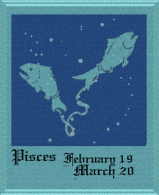
 Mat. 4:18 Jesus visits two fishermen, Simon and Andrew his brother. The sun moves along the ecliptic passing out of Aquarius [John the Baptist] and into Pisces, the two fish. Hence we have the theme of the Sun visiting two fish, or fishermen.
Part of another letter explaining the Jesus story. Presented here as a temporary explanation until I complete a better one.]
October 11, 2002
A comedian once mentioned that according to the Bible, Jesus had two brothers. “Wouldn't it be awful growing up and having Jesus as your brother? Your mother would always be saying, ‘Why can't you be more like your brother Jesus? He's the Messiah. He's perfect in every way. You, you've got to try harder.’”
Actually the real shocker is when you dig into history, as I've been doing for the past two years, and discover that outside the Bible there isn't a single reference to Jesus anywhere in recorded history for that time. Many people alive at that time wrote extensively about everything that happened, and yet there is not a single reference to Jesus anywhere in all this wealth of first hand accounts.
 Then you examine when the Bible itself was written, and discover that the Gospels (Matthew, Mark, Luke, John; the four books detailing the life of Jesus) are not to be referenced in any writings until the later half of the second century, a full 140 years after it allegedly happened. Even the Catholic Church admits a date of 70A.D. for the earliest Gospel, a full 40 years after the alleged event. [They have to because a certain passage in Mark could not have been written prior to an event that happened in 70AD.](The Catholic Bible, approved by the Pope himself with his signature on it, claims Mark was written in 70A.D.) Bible Scholars claim the Gospels were written in 170A.D. because there is no reference to them by anyone prior to that time, especially by certain people who definitely would have included references to them had they existed.
 The second shocker about Jesus is learning that there existed long prior to the alleged time of Jesus many other religions with identical stories of a crucified savior. Early Christian apologists admitted this and explained it away as the work of the Devil. Their general argument was, "What better way to for the Devil to combat our True Religion than for the Devil to have previously created a whole bunch of false religions identical to our True Religion."
 The third shocker, the one I am currently working on further unraveling and explaining on my web site, something which very few people have ever realized, and which you now are privy to this explanation, is the discovery that the whole story of Jesus, as well as the stories of all the other crucified saviors prior to Jesus, is an allegory for the Sun's annual journey through the Zodiac and the passage of the seasons of the year. This explains why all these stories are essentially the same. (Notice how the cross is the symbol that divides the four seasons of the year.)
Here is a brief explanation:
The Bible story then says, "After John was put in prison,..." (Mark 1:14) Suddenly John the Baptist is "put in prison." There is no further explanation in the Bible, which seems quite strange if John were a real person. We want to know why he was "put in prison." What crime was he accused of? Who threw him in prison? Was there a trial? Did Jesus attend the trial and speak on his behalf? No. Nothing more is said. Jesus just continues on his journey.
This is all very strange and hard to understand as a story of real life events, but it all makes perfect sense when understood as an astronomical allegory. The Sun, personified as Jesus, is in Aquarius, personified as John the Baptist. As the month progresses, and the earth continues it annual revolution around the Sun, the Sun appears to move out of Aquarius and into Pisces, the two fishes, and Aquarius at sunset ends up below the horizon. John the Baptist being put in prison is merely an allegory for the constellation Aquarius at sunset moving lower and lower until it is below the horizon at the end of the month and can no longer be seen. It requires no further explanation because it is a natural phenomenon. It is simply what happens.
 We celebrate Easter. East-er, when the Sun rises directly in the East. Easter is defined as the first Sunday after the first full moon after the Vernal Equinox, when the Sun rises directly in the East. We celebrate the crossing of the Sun over the equinox, when the days and nights are of equal length. A Crossification, or crucifixion. Jews celebrate "Passover" at this time, when the Sun "passes over" the equinox. From now on the days get longer, the Sun goes higher in the sky, and the crops begin to grow.
About half way through the story of Jesus an interesting thing happens. John the Baptist reappears and is beheaded. "he has risen from the dead!" says Matthew 14:2 Recall at the beginning of the allegory how Aquarius moved below the Western horizon at sunset as the year went from January to February and the Sun traveled from Aquarius to Pisces. Each zodiac constellation in turn goes below the horizon at sunset as each month passes. After six months the constellation of Aquarius begins to rise on the Eastern horizon at sunset. And it appears that the head of Aquarius is cut off by the horizon. This is John the Baptist rising from the dead, the dead being those who are below the earth. This is John the Baptist being beheaded.
The Zodiac is divided into twelve "houses." Each "house" contains one of the twelve Zodiac constellations. The "house" containing Virgo is known as the house of bread, because it's the house the sun is in during harvest time. Bethlehem is a word which can be found numerous times in the Old Testament. It is a Hebrew word. Actually it is two Hebrew words. Beth-lehem. Pronounced in Hebrew, "bayth leh'-khem". "bayth" is literally "house", and "leh'-khem" is literally "bread". Thus "Bethlehem" is literally "house of bread." It is a reference to the Zodiac "house of bread", which is where you will find Virgo, the celestial virgin. At the alleged time of Jesus there was no town on earth known as Bethlehem. Bethlehem was then known not as a town on earth, but a reference to a time of year — harvest time.
Virgo is the virgin that gives birth to the Sun each year when it passes out of her. She is the one who gives birth and yet remains always and forever a virgin. (The way Virgo is traditionally drawn on the planisphere the Sun passes out of Virgo between her legs). Farmers who till the fields are said to be wedded to this celestial virgin for which they wait for each year. Thus they are known as "husbandmen," and their tools such as tractors are know as impliments of husbandry. The DMV vehicle code book has a special section titled, "Impliments of Husbandry" which cover these vehicles.
Continuing with our story:
In the Jesus story we then have the Last Supper, when we eat the harvest. It is the end of harvest season -- it is the Last Supper. We eat the flesh of the fruit, figuratively the flesh of Jesus, the Sun, which make the fruit grow, and drink the blood of the grapes, figuratively the blood of Jesus, the Sun, which made the grapes grow. Without this food we would perish.
Jesus is handed over to Herod — a personification of Night. (See Matthew Chapter 2—The Birth of Jesus [this site]) Herod, or the darkness of Night, is taking over Jesus, the Sun, as the days get shorter and shorter in Autumn and darkness begins to reign.
Jesus is handed over to Pontius Pilate. "Pontius" is literally "of the sea", a reference to the sea of stars above. "Pilate" is literally "armed with a spear". Pontius Pilate is a personification of Sagittarius, the last constellation the Sun passes through during the last month of the year, Nov. 22 - Dec. 21, and the last person Jesus sees in the story. Sagittarius is a man on a horse with a bow and arrow. He is the man armed with a spear. The days get shorter and shorter as the year comes to a close. Things look dark and gloomy. What will happen to our savior, the Sun, who makes the harvest grow? Will he disappear forever?
Jesus is crucified and placed in a cave. It is the end of the story. A sad ending. But have faith. Jesus, the Sun, will arise again — a new year will begin. Three days after Jesus is placed in the cave he will arise again. This is the prophecy.
On Christmas day, December 25, we celebrate the birth of Jesus. December 22 was the Winter Solstice, the shortest day of the year, when the Sun was at its lowest. Three days later, on December 25, the sun rises 1/10 of it's width farther north — just barely detectable by carefully observing the shadows cast at sunrise. Our savior, the Sun, has been reborn, to begin the cycle of the year and the cycle of life again.
Originally Jesus was said to have been born in a cave. The Catholic Encyclopedia (1910) article on "Bethlehem" says, "The tradition of the birth in a cave was widely accepted, as we see from Origen's words about a century later: — In Bethlehem the cave is pointed out where He was born, and the manger in the cave where He was wrapped in swaddling clothes, and the rumor is in those places and among foreigners of the Faith that indeed Jesus was born in this cave —. (Contra Celsum, I, li.) It is reproduced also in the apocryphal gospels (Pseudo-Matt., xiii, ap. Bonaccorsi, op. cit., 159-163; Protevang. of James, xvii sqq., Bonaccorsi, 155-159; Gospel of the Infancy, II-IV, Bonaccorsi, 163-164)." [See Eusebius's Life of Constantine, lib. 3, chs xl, xli, and xlii.(offsite)] [Also see Matthew Chapter 2—The Birth of Jesus (this site)]
Hence the story is circular, just as the years are circular. A new year begins after the old year ends.
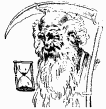 On New Years Eve we personify Father Time and Baby New Year, but we know these two figures aren't real people, they are merely personifications of the passage of time and the beginning of a new year. The current year is old and finished with. A new year is about to begin. The moment the Old Year ends a New Year begins. The cycle of life is circular and never ending.
In the Gospel story of Jesus, after his resurrection the story ends. People have always asked what did he do after that? Why does the story end here? Why isn't the rest of his life chronicled? — The reason is, if you want to read the continuation of the story, turn back to page one. The story is circular. Three days after Jesus dies and is placed in the cave he is born again, and the story begins anew.
In church it is customary to begin reading through one of the Gospels at the beginning of the year. Each Sunday we take the next chunk of the story and read it and the pastor makes a sermon on it, never realizing that the story is an allegory for the passage of time, the seasons of the year, which we ourselves live and experience, as we live our lives, dependent on the Sun for light and for food.
"In a world in which any moments of rest, celebration, meditation — the festivals of any religious tradition or spiritual orientation — are often seen as "a waste of time" because they detract from productive work, it is crucial to remind ourselves that work is not the only valuable behavior. Doing, making producing, must be part of a rhythm in which being also has its place. This is the ultimate message of the seasons of our joy: that there is joy in the seasons themselves, in our very decision to join in noting them, in celebrating them, in walking the spiritual path — the spiral — that they make." — Arthur I. Waskow, Jewish Scholar (1985) (From the book Seasons of our Joy by Arthur I. Waskow)
The whole Bible is mostly astrological allegories. The reason the book of Revelation doesn't make any sense is because it's an astrological allegory. It makes sense when you start to interpret it in that manner. The Old Testament also originated as an astrological allegory. The story of Adam and Eve is the story of Virgo and Bootes, the constellation next to Virgo. The whole story of Moses is an astrological allegory. There is no evidence that any of it actually happened, and quite a lot of evidence that it didn't. So is the story of Joseph and his coat of many colors, the youngest and most favorite of twelve brothers. The number 12 again is a tip off that this is an astrological allegory of the 12 months of the year and the 12 signs of the Zodiac.
Not only that, solar mythology goes beyond the Bible and can be shown to be the basis of most of our oldest and most cherished folk tales and fables. Little Red Riding Hood, Jack and the Bean Stalk, Cinderella, Homer's Iliad and Oddysey — they all trace their roots back to solar mythology as astrological allegories. They are creative personifications of natural phenomenon.
There's a whole lot of answers to be found in this area of research, and hardly anyone is looking in this direction. There's not even a PhD I can obtain in this field because the department doesn't yet exist at any university. I'm really on the cutting edge doing research in a field that doesn't even exist yet.
Is there no problem which I can not solve? Someone ought to hire me and pay me lots of money to solve their difficult problems. I have the ability to dig in and find the answer. The Bible was a hard nut to crack, but I cracked it. There's a more thorough explanation of the Gospel story revealing it to be an astrological allegory at my web site, including animated pictures of the stars and constellations.
The Story of Jesus is the story of the Sun passing through the Zodiac during the year. Note the following:
| Jesus goes on a journey during his ministry. | The Sun goes a journey through the Zodiac during the year. The journey of the Sun matches up with the journey Jesus takes during his ministry. |
| Jesus' ministry is said to last a year. | The Sun completes its circuit of the Zodiac in a year. |
| Jesus is said to have twelve disciples. | The year has twelve months. The Zodiac is divided into twelve "houses," representing the twelve divisions of the year (Capricorn, Aquarius, Pisces, Aries, Taurus, Gemini, Cancer, Leo, Virgo, Libra, Scorpio, Sagittarius.) There are twelve cycles of the moon in a year. The Jewish calendar is actually a Lunar calendar, with twelve months following the twelve cycles of the moon (Nisan, Iyyar, Sivan, Tammuz, Ab, Elul, Tishri, Cheshvan, Kislev, Tebeth, Shebat, Adar.) Occasionally it is necessary to throw in an extra month, Adar2, to keep the Jewish Lunar calendar in sync with the solar year, just as we occasionally throw in an extra day (Feb. 29) to keep our calendar in sync with the solar year. The prominence of the number 12 is always a strong sign that the story is an astrological allegory for the passage of the year. |
| The story of Jesus is circular. He originally was said to have been born in a cave1 — the same cave he is placed in at the end of the story when he dies, to be resurrected three days later. | The year is circular. A new year begins immediately after the old year ends. On New Years Eve we celebrate the end of the old year, personified as an old man, and the "birth" of the new year, personified as "Baby New Year." We don't actually think "Baby New Year" and "Father Time" are real people, we understand they are just personifications of abstract concepts. |
| Jesus is said to be resurrected after 3 days in the cave. We celebrate Jesus' birthday on December 25, three days after the Winter Solstice of December 22. | The Sun "dies" on December 22, the Winter Solstice, the shortest day of the year. Three days later the Sun rises 1/10 of a degree further North, just barely detectable by carefully observing shadows (I've observed the Sun's shadows and taken measurements and have determined it is possible to determine the position of the Sun to this accuracy). The Sun has been resurrected; a new year has begun. |
(Remember in the old days light bulbs didn't exist — the only light was the Sun)
John 8:12 When Jesus spoke again to the people, he said, "I am the light of the world." (The "light of the world" is the Sun.)
John 9:5 While I am in the world, I am the light of the world. (The "light of the world" is the Sun.)
Matthew 4:16 The people living in darkness have seen a great light; on those living in the land of the shadow of death a light has dawned." (The light is the Sun)
Matthew 17:2 His face shone like the sun, and his clothes became as white as the light.
John 1:3-8 Through him all things were made; without him nothing was made that has been made. (Without the Sun nothing would grow and we'd all be dead.) In him was life, and that life was the light of men. (The light is the Sun.) The light shines in the darkness, and the darkness has not overcome it (the Sun removes the darkness). There came a man who was sent from God; his name was John. He [John] came as a witness to testify concerning that light (the Sun), so that through him all men might believe. He [John] himself was not the light; he came only as a witness to the light. The true light (the Sun) that gives light to every man was coming into the world.
John 3:19-20 This is the verdict: Light (the Sun) has come into the world, but men loved darkness (night time) instead of light (the Sun) because their deeds were evil (criminals do their crimes at night). Everyone who does evil hates the light (the Sun), and will not come into the light (the Sun) for fear that his deeds will be exposed.
John 12:35-36 Then Jesus told them, "You are going to have the light (the light is the Sun) just a little while longer (the Sun will set soon). Walk while you have the light (the light is the Sun), before darkness (night time) overtakes you. The man who walks in the dark (at night) does not know where he is going. Put your trust in the light (the light is the Sun)while you have it, so that you may become sons of light." When he had finished speaking, Jesus left and hid himself from them (i.e. the sun set, because Jesus is the Sun).
John 12:46 I have come into the world as a light (the Sun), so that no one who believes in me should stay in darkness.
Ephesians 5:14 Christ (the Sun) will shine on you.
Philippians 3:20 For our conversation is in heaven (the celestial sphere above); from whence also we look for the Saviour, the Lord Jesus Christ (the Sun). (i.e. we should look upwards to the celestial sphere above to find our story.)
Colossians 3:2 Set your minds on things above, not on earthly things.
Luke 4:19 To preach the acceptable year of the Lord. (i.e. the story is about the passage of the year.)
(By the way the Old Testament also talks about God as being the Sun)
Psalms 84:11 "the Lord God is a sun..."
Deuteronomy 4:24 "For the LORD your God is a consuming fire," (the Sun is a consuming fire.)
Malachi 4:2 "the Sun of Righteousness..."
| The journey of Jesus is the journey of the Sun passing through the Zodiac | |
|---|---|
| The Sun passes through Capricorn, the goat (Dec. 22 - Jan. 19) The starting date is December 22, the Winter Solstice, the shortest day of the year, when the Sun is at its lowest ascension. This is the beginning of the Sun's annual journey. By December 25 it becomes apparent the Sun is once again climbing into the sky on it's annual journey — the sun rises slightly farther North and the days begin to get longer. We celebrate the birth of our Savior the Sun who will make the harvest grow so we will have food to eat. | Matthew chapter 2. King Herod looks to Bethlehem, the house of bread, Virgo, but Jesus is not there, because Jesus is in Capricorn. Also Luke chapter 2. |
| The Sun passes through Aquarius, the Water Bearer (Jan. 20 - Feb. 18). It is the rainy season. The theme is of water. The earth is baptized with the water of the yearly rains. | Jesus visits John the Baptist and is baptized with water. John the Baptist is Aquarius, the Water Bearer. John the Baptist (Aquarius) promises us Jesus (the Sun) will give us something better than water. Jesus (the Sun) will give us the harvest of food later on in the year. We need water to stay alive; but more importantly we need food. We can have the water now, but we will have to wait for the food until harvest time. (Matthew chapter 3; Mark chapter 1; Luke chapter 3; John 1:19-28) The Baptism of Rain is always at the beginning of the story, because rain begins the Harvest Cycle. |
| The Sun passes through Pisces, the Two Fish (Feb. 19 - March 20). This is a good time to go fishing, since it just rained last month there's lots of water around to fish in. There's also no harvest yet, so we'll have to live on fish for now. | Jesus visits Simon and his brother Andrew, who are fishermen. Simon and Andrew are personifications of the two fish of Pisces. (Matthew 4:18-22; Mark 1:16;) During this season the faithful Catholics, Episcopalians, and Mahommedans observe Lent, when they abstain from meat and live upon the fishes.2 |
| The Sun passes through Aries, the Ram or Lamb (March 21 - April 19) The starting date is March 21, the Vernal Equinox, when the Sun rises directly in the East. Christians celebrate East-er on the first Sunday after the first full moon after this date. Some ancient calendars place the Vernal Equinox as the beginning of the year. The Astrological Calendar found in Horoscopes in the newspaper always start with Aries, the Vernal Equinox. Spring is when lambs are born. | Jesus, the Sun, is now in Aries, and becomes the Lamb of God. (A young sheep is a Lamb, and a male sheep is a Ram.) |
| The Sun passes through Taurus, the Bull, (April 20 - May 20). | |
| The Sun passes across the Milky Way, that starry band that lies like a lake across the night sky, between Taurus and Gemini (around May 21-June 4). | Jesus crosses "the lake". (Mat 8:8; Mark 4:35; Luke 8:22; John 6:16-25;) |
| The Sun passes through Gemini, the twins Castor and Pollux (May 21 - June 20) | Mat. 8:28-34 Jesus heals two demon possessed men. (I bet their names were Castor and Pollux, the names of the two bright stars in Gemini. Also see Acts 28:11) |
| The Sun passes through Cancer, the Crab that thought to go backwards (June 21 - July 22) The starting date is June 21, the Summer Solstice, the longest day of the year, when the Sun is at its highest ascension. After this day the Sun does go backwards, beginning it's descent Southward, as the days get shorter and shorter. | |
| The Sun passes through Leo, the Lion (July 23 - Aug. 22), for the strong hot days of summer. | Mat. 9:9 Jesus (the Sun) visits "a man named Matthew" (the star Regulus). [See Why Regulus is Matthew (Devil's Pulpit Sermon by Robert Taylor).] This occurs around July 27, a few days into Leo. Some days later, Around 8/1-8/21, Aquarius rises in the West at sunset and appears to be beheaded by the horizon. This is allegorized as John the Baptist (Aquarius) being raised from the dead and being beheaded. (Mat. 14:1-12; Mark 6:14-29; Luke 9:7-9) Afterwards comes Jesus' transfiguration (Mat. 17:1-13, Mark 9:2-13, Luke 9:28-36). Jesus goes to a high mountain top and shines brightly, just as the Sun is high in the sky and shines warmly and brightly during the Summer months. [Mat. 14:34 "when they had crossed over, they landed at Gennesaret. Constellation Lyra? next to milky way? above scales of justice?] |
| The Sun passes through Virgo the eternal Virgin of the Harvest (Aug. 23 - Sep. 22). It's finally Harvest time! | Jesus (the Sun) makes his triumphant entry into Jerusalem (the Zodiac house of Virgo, the Virgin). Everyone is happy, because it's Harvest time! (Matthew chapter 21; Mark 11:1-11; Luke 19:28-44; John 12:12-19) |
| The Sun passes through Libra, the Scales of justice, when farmers sell the harvest (Sep. 23 - Oct. 23). The starting date is September 23, the Autumnal Equinox, the beginning of Autumn. On this day the Sun once again rises directly in the East and sets directly in the West. The day and night are once again of equal length. But darker days lie ahead. The days (good) will continue to get shorter and shorter, as night (bad) gets longer and longer. | Matthew 21:12-17 Jesus drives out the moneychangers and overturns their tables. (Actually they just leave after the harvest is sold, having completed their business.) "The Lord's Supper (or Last Supper)." (Mark 14:12-26; Luke 22:7-38) We all get together and eat the harvest, the flesh of the fruit, the blood of the grape, and give thanks to the Sun for providing us the harvest. |
| The Sun passes through Scorpio, the Scorpion, which figuratively stings and kills the Sun, causing it to slowly die, as the days are getting shorter, starting October 24. | Jesus curses the Fig Tree and it Withers (Mat. 21:18-22; Mark 11:20-21; Luke 26:17-30). Actually all the trees loose their leaves at this time of year because it is Autumn. That's what trees naturally do during this time of year. Judas betrays Jesus. The name Judas, literally means "disabled in the limbs, maimed, crippled," (see Strong's Number [2455]) The Scorpion disables with its sting. (that's actualy Strongs 376) Judas is a personification of Scorpio. |
| The Sun passes through Sagittarius (Nov. 22 - Dec. 21). Sagittarius is a man on horse holding a bow and arrow. He is the archer. He is a hunter. This is a good season to go hunting. | Jesus goes before Pontius Pilate (ποντιοσ πιλατοσ). (Matthew 27:2) Pontius literally means "of the sea" i.e. the sea of stars above (Strong's Number [4194]) and Pilate literally means "armed with a spear" (Strong's Number [4091]). Sagittarius, the archer, is the man armed with a spear. Pontius Pilate is a personification of Sagittarius, the last person Jesus sees in the story, and the last Zodiac sign the sun travels through. |
FOOTNOTES:
1. The writer of that portion of the Gospel according to Matthew which treats of the place in which Jesus was born, states that he was born in a house. In Matthew 2:11 the Greek word is οικια. (Strong's Number [3614]) However, the writer of the Luke version implies that he was born in a stable (Luke 2:7). If these accounts were contained in these Gospels in the time of Eusebius, the first ecclesiastical historian, who flourished during the Council of Nice (A. D. 327), it is very strange that, in speaking of the birth of Jesus, he should have omitted even mentioning them, and should have given an altogether different version. He tells us that Jesus was neither born in a house, nor in a stable, but in a cave. [Eusebius's Life of Constantine, lib. 3, chs xl, xli, and xlii.]
"The tradition of the birth in a cave was widely accepted, as we see from Origen's words about a century later: “In Bethlehem the cave is pointed out where He was born, and the manger in the cave where He was wrapped in swaddling clothes, and the rumor is in those places and among foreigners of the Faith that indeed Jesus was born in this cave”. (Contra Celsum, I, li.) It is reproduced also in the apocryphal gospels (Pseudo-Matt., xiii, ap. Bonaccorsi, op. cit., 159-163; Protevang. of James, xvii sqq., Bonaccorsi, 155-159; Gospel of the Infancy, II-IV, Bonaccorsi, 163-164)." Catholic Encyclopedia article on "Bethlehem" (1910)
(Also see St. Justin Martyr Dial., lxxviii)
Allegorically the cave is the dark abode from which the wandering Sun starts in the morning. As the Dawn springs fully armed from the forehead of the cloven Sky, so the eye first discerns the blue of heaven, as the first faint arch of light is seen in the East. This arch is the cave in which the infant is nourished until he reaches his full strength—in other words, until the day is fully come.
| Note how all the stars disappear at Dawn just before the Sun arrives, from whence we get the allegorical story of King Herod (a personification of Darkness, which reigns supreme at night) ordering the death of all the children. | |
REFERENCES:
Thomas William Doane Bible Myths and Their Parallels in Other Religions Chapter XVI: The Birth-Place of Christ Jesus, p. 154. Also p. 481. The book references George W. Cox: Aryan Mythology, vol. i, p. 153.
[Return to text.]
2. Kersey Graves The World's Sixteen Crucified Saviours: Christianity Before Christ, p.96 (1875)
Available online at http://media.isnet.org/off/XXtian/critic/16/16.html
Also at http://www.infidels.org/library/historical/kersey_graves/16/
Also at http://www.awitness.org/essays/bkup/16_crucified_saviors/
[Return to text.]