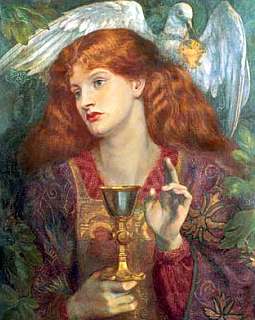
Mary Magdalene
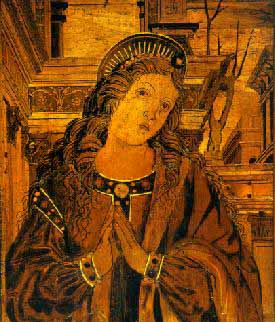
Mary Magdalene
In our current timeline - one wonders if Mary Magdalene was the wife of Jesus - and had a daughter with him named, Sarah - thus perpetuating the bloodline.
Mary Magdalene was the most important woman disciple in the movement of Jesus. Tradition has labeled her a prostitute, but there is nothing in the Bible to support this view and much to dispute it.
Mary Magdalene, which probably means "Mary of Magdala", a town on the western shore of the Lake of Tiberias, is described in the New Testament as a follower of Jesus both in the canon and in the apocrypha. Nothing is known about her outside of Scripture. Her feast day is July 22.
For part of her story, Catholics and Protestants agree: She is mentioned in Luke 8:3 as one of the women who "ministered to Christ of their substance". Their motive, according to the author of Luke was that of gratitude for deliverances he had wrought for them: Luke tells that out of Mary were cast seven demons, in an exorcism. These women accompanied him also on his last journey to Jerusalem (Matt. 27:55; Mark 15:41; Luke 23:55). They were witnesses to the Crucifixion.
There Mary remained until all was over, and the body was taken down and laid in a tomb prepared for Joseph of Arimathea. Again, in the earliest dawn of the first day of the week she, with Salome and Mary the mother of James, (Matt. 28:1; Mark 16:2); Peter 12), came to the sepulchre, bringing with them sweet spices, that they might anoint the body of Jesus. They found the sepulchre empty but saw the "vision of angels" (Matt 28:5). As the first witness to the Resurrection, Mary Magdalene hastened to tell Peter and another - unknown - apostle, (John 20:1, 2), (gaining her the epithet "apostle to the apostles") and again immediately returned to the sepulchre.
There she lingered thoughtfully, weeping at the door of the tomb. The risen Lord appeared to her, but at first she knew him not. His utterance of her name "Mary" recalled her to consciousness, and she uttered the joyful, reverent cry, "Rabboni". She would fain have clung to him, but he forbade her: "17 Jesus said to her, 'Do not cling to Me, for I have not yet ascended to My Father; but go to My brethren and say to them, "I am ascending to My Father and your Father, and to My God and your God."'"
This is the last entry in the canonic New Testament regarding Mary of Magdala, who now returned to Jerusalem.
Further attestation of Mary of Magdala and her role among some early Christians is provided by the apocryphal Gospel of Mary Magdalene. which survives in two 3rd century Greek fragments and a longer 5th century translation into Coptic. Tellingly, in the Gospel the testimony of a woman first needed to be defended. All of these manuscripts were first discovered and published between 1938 and 1983, but as early as the 3rd century there are Patristic references to the Gospel of Mary. These writings reveal the degree to which the gospel was despised and dismissed by the early church fathers. In the fragmentary text, the disciples ask questions of the risen Savior (a designation that dates the original no earlier than the 2nd century) and are answered.
Then they grieve, saying, "How shall we go to the Gentiles and preach the Gospel of the Kingdom of the Son of Man? If even he was not spared, how shall we be spared?" And Mary Magdalene bids them take heart: "Let us rather praise his greatness, for he prepared us and made us into men." She then delivers - at Peter's request - a vision of the Savior she has had, and reports her discourse with him, which shows Gnostic influences.
Her vision does not meet with universal approval:
"Peter also opposed her in regard to these matters and asked them about the Savior. "Did he then speak secretly with a woman, in preference to us, and not openly? Are we to turn back and all listen to her? Did he prefer her to us?"
Karen King has observed, "The confrontation of Mary with Peter, a scenario also found in The Gospel of Thomas, Pistis Sophia, and The Gospel of the Egyptians, reflects some of the tensions in second-century Christianity. Peter and Andrew represent orthodox positions that deny the validity of esoteric revelation and reject the authority of women to teach."
Tradition as early as the 3rd century identified as Mary Magdalene the woman who was a sinner in Luke 7:36-50:"
38 And stood at his feet behind him weeping, and began to wash his feet with tears, and did wipe them with the hairs of her head, and kissed his feet, and anointed them with the ointment."
Though there is no connection made in the New Testament, nor is the woman in the house of the Pharisee given a name, the idea that Mary was "the woman who was a sinner", or that she was unchaste, was developed by the Patristic writers of the 3rd and 4th centuries. This idea is rejected by most Protestants. Catholics, on the other hand, consider this one person to be, not only the sinner of Luke 7:36-50 but also Mary of Bethany, the sister of Martha and the resurrected Lazarus (Luke 10:38-42 and John 1:10); although the Roman Catholic Church withdrew from this linkage at the Second Vatican Council (1969) it survives strongly in folk Catholicism.
For some Christians, the idea developed by Church fathers, that Mary is also the woman that Jesus had rescued from being stoned to death (as recounted in the Pericope Adulterae) still holds true. However those critical scholars who are drawing conclusions from the canonic texts alone believe that the woman Jesus rescued and Mary were two separate persons. Conservative early-19th century theological traditions, vividly realized in the Mel Gibson movie The Passion of the Christ, portray the prostitute and Mary as the same person, and Martin Scorsese's earlier film adaptation of Nikos Kazantzakis's novel The Last Temptation of Christ followed a similar tradition.
As a Roman Catholic saint, Mary Magdalene's relics were venerated at Saint Maximin la Sainte Baume, Provence, and attracted such throngs of pilgrims that the great Basilica was erected there from the mid thirteenth century, one of the finest Gothic churches in the south of France. Though her bones were scattered at the French Revolution, her head is said to remain in her shrine in a cave at La Sainte-Baume near Marseille, although another medieval tradition holds that she died in Ephesus and was buried in Constantinople.
The Magdalene became a symbol of repentance for the vanities of the world, and Mary Magdalene was the patron of Magdalene College, Cambridge (pronounced "maudlin", as in weepy penitents). Unfortunately her name was also used for the infamous Magdalen Asylums in Ireland where supposedly fallen women were treated as slaves.
Some modern writers, notably the authors of the 1982 Holy Blood, Holy Grail (2003) and Dan Brown in the novel The Da Vinci Code (2003), hold that:
These writers cite non-canonical and Gnostic writings in selective portions to support their argument. While sources like the Gospel of Philip depict Mary Magdalene as being closer to Jesus than any other disciple, there is no ancient document which claims she was his wife. It is thought the meaning here is Mary Magdalene knew what Jesus was talking about. She understood him, while the disciples did not.
An argument for support of this speculation is that bachelorhood was very rare for Jewish males of Jesus' time, being generally regarded as a transgression of the first mitzvah (divine commandment) - "Be fruitful and multiply". It would have been unthinkable for an adult, unmarried Jew to travel about teaching as a rabbi, as Jesus certainly did.
A counter-argument to this is that the Judaism of Jesus' time was very diverse and the role of the rabbi was not yet well defined. Celibate teachers like John the Baptist were known in the communities of the Essenes, and Paul of Tarsus was an example of an unmarried itinerant teacher among the Christians, at a time when most Christians were still practicing Jews. It was really not until after the Roman destruction of the Second Temple in A.D. 70 that Rabbinic Judaism became dominant and the role of the rabbi made uniform in Jewish communities.
Mary Magdalene appears with more frequency than other women in the canonical Gospels and is shown as being a close follower of Jesus. Mary's presence at the Crucifixion and Jesus's tomb, while hardly conclusive, is at least consonant with the role of grieving wife and widow, although if that were the case Jesus might have been expected to make provision for her care as well as for his mother Mary. Given the lack of contemporary documentation, this scenario cannot be proven, and although some consider the idea desirable to believe, most scholars do not take it seriously.
Other reasoning would say that Christ was already married to the Church - an image that was developed first by Paul in what became the New Testament and then later expanded on by the Church fathers. Some writers, following an early tradition that Jesus is in a mystical sense the second Adam (again beginning with Paul and continuing with Irenaeus and others), embody this sense with literal parallels: like the first Adam, his bride was taken from his side when he had fallen asleep (died on the cross). In medieval Christian anagogic exegesis, the blood and water which came from his side when he was pierced, was held to represent the bringing forth of the Church with its analogy in the water of baptism and the wine of the new covenant. Thus Christ can be said to already have a wife in the Church; and so it would not be considered possible or tolerable to believe that he was otherwise married.
The Urantia Book (1955) maintains that Jesus was not married to Mary or any other woman. According to its account, he refused an offer of marriage at age eighteen because he was dedicated to his "Father's business" ("If I am a son of destiny, I must not assume obligations of lifelong duration until such a time as my destiny shall be made manifest"), but gained parental experience by becoming the sole supporter and father-figure to his siblings after Joseph died.
References and many more links - Wikipedia
Some people link Mary to the Holy Grail and the Knights Templar. Secular books with names such as Holy Blood, Holy Grail and The Woman With the Alabaster Jar expand on traditions that she committed sexual sins. They claim that Jesus married her and fathered one or more children. These books are based on fiction, not fact. below is quoted information from that text.
In popular Christian tradition Mary Magdalene is a prostitute who finds redemption by apprenticing herself to Jesus. And she figures most noticeably in the Fourth Gospel, where she is the first person to behold Jesus after the Resurrection. In consequence she is extolled as a saint, especially in France - where, according to medieval legends, she is said to have brought the Holy Grail.- Baigent, Leigh & Lincoln, The Holy Blood and the Holy GrailThe Magdalene is not, at any point in any of the Gospels, said to be a prostitute. When she is first mentioned in the Gospel of Luke, she is described as a woman 'out of whom went seven devils'. It is generally assumed that this phrase refers to a species of exorcism on Jesus' part, implying the Magdalene was possessed. But the phrase may equally refer to some sort of conversion and/or ritual initiation.
The cult of Ishtar or Astarte - the Mother Goddess and 'Queen of Heaven' - involved, or example, a seven-stage initiation [the seven veils]. Prior to her affiliation with Jesus, the Magdalene may well have been associated with such a cult. Migdal, or Magdala, was the 'Village of Doves', and there is some evidence that sacrificial doves were in fact bred there. And the dove was the sacred symbol of Astarte.
In some versions of history, Magdalene is viewed as the mother of the Merovingian Dynasty. Mary Magdalene was the redeemed sinner who was the first to see Christ after his Resurrection. Through her redemption from sin and her unique knowledge of the Risen Christ, she was regarded by the occult initiates of the Middle Ages as a medium of secret revelation. Those initiates had chosen the planet Venus as her symbol in the cosmos.- Henry Lincoln, The Holy Place
Long ago her name was Isis, Queen of the benevolent springs, Come to me all you who labour and are heavy laden, and I will give your the rest.. Others knew her as Magdalene with the celebrated vase full of healing balm. The initiated know her to be Notre Dame Des Cross.- Le Serpent Rouge
Mary Magdalene had her surname of Magdala, a castle, and was born of right noble lineage and parents, which were descended of the lineage of kings. And her father was named Cyrus, and her mother Eucharis. She with her brother Lazarus, and her sister Martha, possessed the castle of Magdalo, which is two miles from Nazareth, and Bethany, the castle which is nigh to Jerusalem, and also a great part of Jerusalem, which, all these things they departed among them.- Legenda Aurea (published in Genoa in 1275)
She was also high priestess of the Temple of Ishtar at Magdala, and as such she would have been the keeper of the doves. She is linked with Benjamite, the tribe which was ostracized because they were of the line of Cain. So too was Hiram Abiff, architect of the Temple of Solomon.- David Wood, Genesis
The idea that Mary [Jesus' mother] had been an adultress never completely disappeared in Christian mythology. Instead, the character of Mary was split into two: Mary the mother of Jesus, believed to be a virgin, and Mary Magdalene, believed to be a woman of ill repute.- Hayyim ben Yehoshua, The Myth of the Historical JesusThe idea that the character of Mary Magdalene is also derived from Miriam the mythical mother of Yeishu, is corroborated by the fact that the strange name 'Magdalene' clearly resembles the Aramaic term 'mgadla nshaya' meaning 'women's hairdresser'. Because the Christians did not know what the name 'Magdalene' meant, they later conjectured that it meant that she had come from a place called Magdala on the west of Lake Kinneret. The idea of the two Marys fitted in well with the pagan way of thinking. The image of Jesus being followed by the two Marys is strongly reminiscent of Dionysus being followed by Demeter and Persephone.