Ophiuchus the Serpent Holder
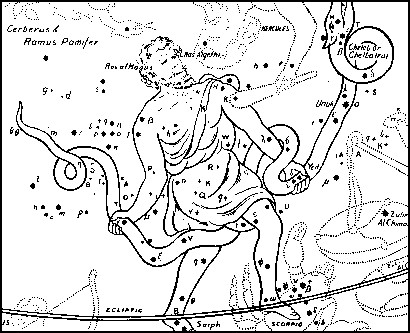
"Here, Serpens, the serpent, is seen struggling vainly in the powerful grasp of the man who is named O-phi-u-chus. In Latin he is called Serpentarius. He is at one and the same moment shown to be seizing the serpent with his two hands, and treading on the very heart of the scorpion, marked by the deep red star Antares (wounding)." (Bullinger)
"Coming out of the Arabic into the Greek, the name of Ophiuchus is Aesculapius. Aesculapius was one of the favorites of the Greek gods, a son of Apollo. Homer describes Aesculapius with all of the attributes of a man. He was a god-man. If you read of the death of Socrates, as described by Plato, you will notice the last request Socrates makes is to ask Crito, his friend, to repay a cock he owes to Aesculapius. Here was a god who was much on the mind of the great Socrates, even at the moment of his death.
"According to Greek mythology, he was the healer; he cured the sick. He was also reported to bring the dead back to life by means of blood taken from the side of the goddess of justice. He is called the 'Physician,' 'The Desired One,' 'The Health-Giver,' the 'Universal Remedy.' Finally, he suffered death from the lightnings of Heaven, but was raised from death to glory through the influence of his father, Apollo." (Kennedy)
The constellation Scorpio lies just beneath the foot of Ophiuchus, a man who holds a serpent. The name Ophiuchus is derived from the Greek words ophis (serpent) and cheiro-o (to handle) - hence, the Serpent Holder. Concerning the Hand of Ophiuchus, Richard Allen wrote ominously in his book, Star Names: Their Lore and Meaning: "ε was the Euphratean Nitax-bat, the Man of Death. Coincidentally, 'in modern astrology, which contained some singular survivals, the Hand of Ophiuchus is said to be a star 'of evil influence'." (927:302)
In Greek mythology, Ophiuchus is associated with Aesculapius, the son of the god Apollo and a mortal woman called Coronis. After Coronis died in childbirth, Aesculapius was reared by Chiron, the Centaur who taught him the art of healing. Aesculapius, supposedly the first doctor of medicine, not only learned to heal, but he also developed the ability to restore the dead to life. The pagan myth of Aesculapius is one of many which claim that the Hermetic arts and sciences were taught to men by the ancient gods.
"[Ophiuchus] is said to be Asclepius, whom Zeus placed among the stars to oblige Apollo. For Asclepius used his healing art to raise the dead... Ophiuchus was usually identified with Asclepius by both Greek and Roman authors... According to tradition, Asclepius was the son of Apollo and Coronis and was reared by Chiron, who instructed him in the art of healing."(570:141)
The famed Greek physician, Hippocrates, belonged to a family which claimed descent from Aesculapius. The original Hippocratic oath opened with an invocation of four Greek divinities: “I swear by Apollo the physician, by Asclepius, Hygeia, and Panacea, and I take to witness all the gods, all the goddesses, to keep according to my ability and my judgment the following oath.” Hygeia and Panacea were the daughters of Aesculapius; their names live on today in medical terminology as hygiene and panacea, which once meant magical potion. Occultists believe that Ophiuchus received the secret elixir of restoring life to the dead from a serpent. Pagan cults such as the Ophites worship this serpent as the giver of eternal life:
"The biblical school made [Serpens] the seducer of Eve, while in our day imaginative observers find another heavenly Cross in the stars of the head, one that belongs to Saint Andrew or Saint Patrick. Serpens shared with Ophiuchus the Euphratean title of Nutsirda, the Image of the Serpent; and is supposed to have been one of the representatives of divinity to the Ophites the Hivites of Old Testament times." (927:375)
Having received the elixir of life from Serpens, Ophiuchus, the Serpent-Holder, is said to restore the constellation Orion to life after he sets in the west, Orion having previously been wounded by Scorpio:
"Scorpius stung Orion and he fell mortally wounded. This act is represented in the sky movement of these two constellations. When Orion, mortally wounded, sets in the west, the Scorpion is just rising in the east, gloating over the success of his mission. Scorpius' triumph does not last long, however, for the next evening - as Scorpius sets in the west - Ophiuchus stands above Scorpius and tramples him to death. Ophiuchus then gives Orion a sip of his elixir and restores Orion to life. Thus Orion is seen to rise in the east again as both Ophiuchus and Scorpius descend in the west." (833) (Ophiuchus)
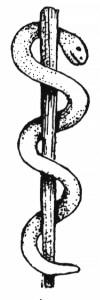
The staff of Aesculapius, around which a serpent is coiled, is today the symbol of the American Medical Association and the World Health Organization. This symbol is also suggestive of the Serpent who wrapped himself around the Tree of Knowledge in the Garden of Eden!
|
The Staff of Aesculapius evolved into the Caduceus, which was a magic healing wand with twin serpents entwined around a phallic rod. This wand belonged to Hermes, who is the Greek analogue of the Egyptian god, Thoth, founder of alchemy and sacred geometry.
|
STAFF OF AESCULAPIUS |
THE CADUCEUS |
Once again we find the motif of twins that is a recurring theme in the secret doctrine. The twin serpents of the caduceus symbolize the kundalini force that travels along the spinal column and facilitates out of body experiences. Interestingly, the twin serpents also had the power to effect sex changes:
"The mythical origin of his magic twin serpent caduceus is described in the story of Tiresias. Poulenc, in 'Les Mamelles de Tiresias' (The Breasts of Tiresias) tells how Tiresias--the seer who was so unhelpful to Oepidus [sic] and Family--found two snakes copulating, and to separate them stuck his staff between them. Immediately he was turned into a woman, and remained so for seven years, until he was able to repeat his action, and change back to male. The transformative power in this story, strong enough to completely reverse even physical polarities of male and female, comes from the union of the two serpents, passed on by the wand. Tiresias' staff, complete with serpents, was later passed on to Hermes...
"Occult Hermetic Connection: An occult description of the Caduceus of Hermes (Mercury) is that the serpents may represent positive and negative kundalini as it moves through the chakras and around the spine (the staff) to the head where it communicates with MIND by intellection, the domain of Mercury [wings].
"Caduceus Power Wand: This wand is sold at occult, new age & witchcraft stores such as Abaxion with descriptions such as 'It's central phallic rod represents the potentiality of the masculine, and is intimately surrounded by the writhing, woven shakti energies of two coupling serpents. The rod also represents the spine [sushumna] while the serpents conduct spiritual currents [pranas] along the ida and pingala channels in a double helix pattern from the chakra at the base of the spine up to the pineal gland'.
"According to occultists, there are three principal nadis (Sanskrit for channel) in the human body. The sushumna (the spinal column through which the life-forces flow), by which means we enter and leave the body, the Ida (refreshment and stimulation of spirit), which is associated with the higher mind or manas and the Pingala, (reddish-brown), associated with kama or the force of desire. (G. de Purucker 'Man in Evolution' ch. 15 & 16; and 'Fountain-Source of Occultism', pp. 458-63)." (1005)
Quetzalcoatl was the supreme deity of the Mayas and Aztecs and among the numerous twin gods in the pantheons of dualistic mythologies. As the Feathered Serpent-God of ancient Mexico and most famous of the gods of the New World, Quetzalcoatl reigned over a Golden Age of peace and abundance. As a celibate demi-god, he invented the Mayan and Aztec calendar and bequeathed the secret doctrine to his priests, who were also celibate. Quetzalcoatl was driven away on a serpent boat by his evil twin, Tezcatlipoca (the black twin), but is expected to return from the East (where he spread his knowledge of science and the arts) to reclaim his power among the Mesoamerican people. The name Quetzalcoatl means 'precious twin' as well as 'feathered serpent'. Based on the prevalence of twin serpent-gods in ancient cultures, it is possible that the twin snakes of the caduceus may also represent the concept of divine twins.
"Another very significant aspect of [Jeremy] Narby's research is his identification of a common feature throughout the shamanistic cultures (and ancient myths): divine twins as the bringers of wisdom, 'the theme of double beings of celestial origin and creators of life'. He points out,...quoting from Claude Levi Strauss, that the Aztec word coatl, as in the name Quetzalcoatl, means both 'snake' and 'twin'. (Quetzalcoatl can be interpreted as either 'feathered serpent' or 'magnificent twin'.). (268:353)
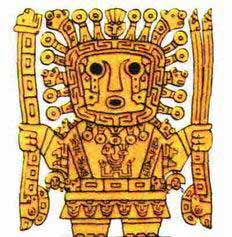
Quetzalcoatl / Viracocha
Quetzalcoatl's name among the Incas was Viracocha, another dualistic deity, the sun and the moon god combined.
"There is a pre-Incan legend that speaks of Viracocha who is depicted in many forms. There is a duality about this deity, which is not unlike gods in other civilizations - the good god and the warrior side to his personality. We see him as he enlightened god in the white robes who brings knowledge and the warrior god with staves in his hands and a sun symbol around his head, not unlike the sun god Ra in ancient Egypt. As we third dimension is a duality - all things have good and evil characteristics - including the gods of all myths. Viracocha - as duality is depicted as the sun god of creation [wearing a sun crown] and the moon god.
"Viracocha, as the feathered serpent god, is one of the great mysteries of ancient American cultures. He was called Kukulkan by the Mayas, Quetzalcoatl by the Aztecs, Viracocha by the Incas, Gucumatz in central America, Votan in Palenque and Zamna in Izamal." (1012)
There is also an association between Viracocha and Osiris who, it is claimed, ruled the world during the First Time: "Several authors have speculated upon the mythological connection between the Egyptian god Osiris, and the god Viracocha, of the people of Central Andes. Osiris is believed to have traveled around the globe bringing civilization to many nations... He was tall, of pale complexion, bearded and dressed in a long white robe." (607:286)
In his book, From Atlantis to the Sphinx, Colin Wilson observed other analogous deities: "The stories of the fish-god Oannes sound curiously like those of Viracocha and Kon-Tiki [Polynesian sun god]." (1014:149) Ralph Woodrow stated in Babylon Mystery Religion that Oannes was later venerated as John the Baptist, the Templars' messiah instead of Jesus. This would explain why the esoteric name of Grand Masters of the Prieuré de Sion has historically been John/Jean:
"Besides the fire ceremony that was observed on June 24, this day was also known among those heathen tribes as the festival of water. And had not John the Baptist been especially known as the one that baptized with WATER? And so this slight similarity helped disguise the continuation of the pagan day, now renamed.
"But the real significance that connected this day with water was that it was sacred to OANNES, the ancient fishgod! Stemming from another anicent Babylonian fable, as we mentioned earlier, Nimrod was supposed to have reappeared in the 'Mysteries' after he was slain as OANNES. In an article on Nimrod, Fausett says: 'Oannes the fishgod, Babylon's Civilizer, rose out of the red sea,'... And so we see how Nimrod, water, and the fish-god Oannes were all connected. Now in the Latin language...John was called Joannes. Notice how similar Joannes is to Oannes! And so...another pagan day was smoothly adopted...disguised with the name of John the Baptist." 494:167
'Jean' is the French variant of 'John' and 'Janus' as Ean Begg states in The Cult of the Black Virgin: "Janus is one of the most important Roman gods. His two faces illustrate not only his role as deity of beginnings, looking to past and future, but his essential duality as the original bisexual chaos and the form which emerged from it. Diana/Jana and Saturn are especially associated with him. He may have been Gallicized into Jean (John), one of the companions to the Black Virgin." (272:7)
Moreover, Janus was represented as a serpent: "Macrobius quotes Cicero (De Natura Deorum 2.27.67), who says Ianus (Janus) was originally called Eanus, which is derived from eundo (going), because Janus, who is the Universe, is always moving, whirling in a circle... This is the reason, he says, that the Phoenicians represent Janus by the Ouroboros serpent." (983)
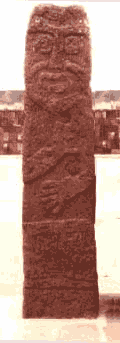
Hippolytus wrote in his Refutation of All Heresies: "The Assyrians say that fish-eating Oannes was (the first man...)..." (1015) Considering that Oannes and Osiris, which are probably pagan names for Adam (132:81), are also identified as Viracocha, the sun-god of the Incas, it is interesting to note in the photos below the identical hand positions of Pierre Plantard and the stele [stone pillar] representation of Viracocha. This positioning of the hands is precisely the same as certain French Black Madonnas pictured in the section, Virgo in Anticrist!
|
|
|
H.P Blavatsky associated Quezalcoatl, the serpent god, with Ham and Canaan, the Dragon race, known in medieval Europe as the Merovingian dynasty.
"Dr. Bourbourg hints that the chiefs of the name of Votan, the Quetzo-Cohuatle, or serpent deity of the Mexicans, are the descendants of Ham and Canaan. 'I am Hivim,' they say, 'Being a Hivim, I am of the great race of the Dragon (snake). I am a snake myself, for I am a Hivim.' And des Mousseaux, rejoicing because he believes himself fairly on the serpent's, or rather, devil's trail, hurries to explain: 'According to the most learned commentators of our sacred books, the Chivim or Hivim, or Hevites, descend from Heth, son of Canaan, son of Ham...the accursed!'" (195:554,Vol.I)
The Serpent Holder of medieval times was claimed to have been St. Benedict, another celibate and a Merovingian who founded the monastic Benedictine Order for the purpose of infiltrating and controlling the Roman Catholic Church: "...Julius Schiller...made of [Ophiuchus] Saint Benedict in the midst of the thorns, for it was this founder of the order of the Benedictine monks, who, with his followers in the 6th century inspired and carried on all the learning of the times, as Aesculapius-Ophiuchus had done in his day." (927:299) Like Quetzalcoatl, St. Benedict is credited with preserving the Hermetic arts and sciences during the period when the Roman Church dominated Western civilization and persecuted aberrant sects which spread the Gnostic heresy. (The reader is hopefully beginning to understand the true character of certain adversaries of the Church of Rome during the Middle Ages.)
At this point we shall venture to interpret the symbolism of the hand position of Viracocha, who appears to be embracing himself! As stated, Viracocha, the serpent god was celibate, as was St. Benedict, who was Ophiuchus, the Serpent-Holder of his era. An article by Peter Jones titled "Androgyny: The Pagan Sexual Ideal" documents that the ancient goddesses required their priests to emasculate themselves in varying degrees:
"Throughout time and across space, the pagan cultus consistently, though not exclusively, holds out as its sexual representative the emasculated, androgynous priest.... Androgynous priests were associated with the worship of the goddess Istar from the Sumerian age (1800 BC)... Examples of 'religious' androgyny can be found in various forms in Syria and Asia Minor in the third century B.C., but its clearest and closest expression in that area comes from the Roman Empire at the beginning of the Christian era. It is well documented that the Great Mother under the names of Atargatis or Cybele had androgynous priests, called Galli, who castrated themselves as a permanent act of devotion to the goddess. A particular version of the goddess is worshipped under the name of Artemis at Ephesus where Paul established a church (Acts 19). In Syria, Cybele is called Rhea, whose effeminized itinerant priests imitated the deeds of the mythological Attis, in trance-like ecstasies... The obvious intentions and results of such cultic mythology and practice were the feminization and emasculation of men under the occultic power of the goddess...
"At the beginning of the fifth century AD the cult of the goddess Cybele continued to have success. Augustine in his City of God vividly describes the 'games' offered in honor of Tanit, the celestial 'virgin' and mother of the gods, where obscene actors role-played disgusting acts 'in the presence of an immense throng of spectators and listeners of both sexes.' He also describes the public display of homosexual priests (galloi)... [T]he Mesopotamian assinnus, the Canaanite qedeshim, the Scythian ennares, and the Syrian galli ...took on the same androgynous appearance, engaged in the same ecstatic behavior, including self-mutilation, were associated with occultic spirituality, and so in many ways occupied a similar liminal relationship to 'normal' society." (1073)
What was the pagan rationale for an androgynous priesthood? The Encyclopedia of Religion gives some insight into androgyny and its appeal to pantheists of all ages: "Many myths point out that the permanently fused androgyne is, technically, the one creature in the world who is certain to be unable to copulate. As Alan Watts has remarked, the androgyne symbolizes a state 'in which the erotic no longer has to be sought or pursued, because it is always present in its totality'." (146:278) "Androgynes"
Monism, meaning 'single,' is a pantheistic conception of the world as opposed to 'dualism,' the good vs. evil heresy discussed above. Monism reduces all phenomena to one principle; therefore, the whole of reality constitutes one inseparable and indivisible entirety. It is from the Greek word "monism" that the terms "monk" and "monastic" were derived. Peter Jones observed that monastic celibacy was the Gnostic corollary to the pagans' androgynous priesthood:
"Later in the second and third centuries of the Christian church, the Gnostics were credited by their adversaries with mystery celebrations involving carnal knowledge. The charge is credible because 'Christian' Gnosticism was the attempt to Christianize pagan spirituality, even to the point of adopting some form of androgyny. In the ancient Gnostic texts such connections can be detected. The Church Father Hippolytus, documents how and why the 'spiritual' Gnostics did not hesitate to imitate pagan spirituality and sexuality in one form or another. He explains the Gnostic Naasene participation in the cult of the Goddess. 'Because they claimed that everything is spiritual,' the Naasenes did not become Galli physically but rather spiritually: 'they only perform the functions of those who are castrated' by abstaining from sexual intercourse. So, concludes Hippolytus, the Naasene Gnostics imitate the Galli, the castrated priests of Cybele. 'For they urge most severely and carefully that one should abstain, as those men (the Galli) do, from intercourse with women; their behavior otherwise...is like that of the castrated.' The mythological story of the castration of Attis thus led the Naasenes to conclude that the image of emasculation was a symbol of salvation. Attis cut off his testicles in order to 'break with the baser and material world and gain access to immortal life, where there is no longer either male or female.' These 'Christian' Gnostics sought, through a deep form of spiritual androgyny, a close association with paganism's understanding of salvation." (1073)
Dropping the Frame
In 1604, at the height of the 17th century Rosicrucian Enlightenment (when the the authority of the Roman Church over Europe had been significantly undermined by the Reformation) a Supernova appeared in the constellation of Serpentarius. This spectacle was noted by Peter Dawkins in The Great Vision: The Judaic-Christian Mysteries: The Vision and Birth of the New Rosicrucianism:
"A supernova is a star which explodes catastrophically, with a sudden liberation of most of its energy and the dissipation of nearly the whole mass of the star into space. Its explosion appears to us about ten thousand times as bright as an ordinary nova. The only supernovae observed in our Galaxy during the past thousand years occurred in A.D. 1006 (in Lupus), 1054 (in Taurus), 1572 (in Cassiopeia), and in 1604 (in Ophiuchus). All reached apparent magnitudes considerably brighter than zero, releasing as much energy in one second as our Sun does in sixty years... All of them are present-day radio sources." (902:69)
The 1572 supernova in Cassiopeia, which had preceded Serpentarius, was recognized by Rosicrucians as a "portent of some convulsive change in the order of the world...the entrance of the world into the seventh revolution that would inaugurate the golden age." (Ibid.) In her book The Rosicrucian Enlightenment, Frances Yates cited the Rosicrucian manifesto, Confessio Fraternatis, which attached similar importance to the 1604 supernova in Serpentarius (Ophiuchus/ Serpent Holder) as heralding the Golden Age to come:
"...before the end, God will allow a great influx of truth, light, and grandeur, such as surrounded Adam in Paradise, to be poured forth on mankind. New stars have appeared in the constellations Serpentarius and Cygnus which are signs of the coming of these things...
"...a representation of the Invisible College of the R.C. Brothers...[illustrates] in the sky...a Serpent and a Swan, bearing stars and alluding to the 'new stars' in Serpentarius and Cygnus mentioned in the Confessio as prophetic of a new dispensation...
"'...the Lord God hath already sent before certain messengers, which should testify his will, to wit, some new stars, which do appear and are seen in the firmament in Serpentino and Cygno, which signify and give themselves known to everyone, that they are powerful Signacula of great weighty matters.'" (Confessio Fraternitatis) (46:48,94,256)
According to The Guinness Book of Answers, "Ophiuchus is considered by European astrologers to be not so much the 13th sign as the second half of the sign of Scorpio." (982) The Constellations website confirms that "Out of the twenty-five days, from the 21st of November to the 16th of December, which the sun spends in passing from Libra to Sagittarius, only nine are spent in the Scorpion, the other sixteen being occupied in passing through Ophiuchus". (833) Richard Allen Hinckley indicates that Ophiuchus seems to have greater claim to a place in the Zodiac than does Scorpio: "Although nominally in the zodiac, the sun actually occupies but nine days in passing through the two portions [of Scorpio] that project upward into Ophiuchus, so far south of the ecliptic is it; indeed, except for these projections, it could not be claimed as a member of the zodiac." (927:364)
True, it will be under the sign of Scorpio that the earth will 'drop the frame' and transition into a "new and more etherealized formation...ascending into the New Earth Star." However, all of the evidence seems to locate the timing of this event in the Scorpio's decan, Ophiuchus.