Serpent Origins and the Real Origins of Freemasonry
This mysticism is indeed the great Masonic Secret, the Supreme Initiation…. It is old as is this world.
- La Trahison Spirituelle de la Freemason, J. Marques-Rivere
So, at the root of the secret is an electrobiological and chemical reaction inside the mind often termed the kundalini.
This we now know to be linked implicitly with the serpent from the internal process and vision, and therefore being spoken of as serpent power. But are there any real links to the world’s biggest secret society - the Freemasons?
It is clear that the serpent is, and has always been, a symbol of the Freemasons of which they have been perfectly proud.
The question is:
How many of its members realize what its all about?
Origins
Abraham, the Israelite father of mankind, and Hiram of the Freemasons, are one and the same. Both are based upon serpent worshipers with Indian Naga or serpent deity backgrounds. A grand statement, but one that I am not alone in making.
Flavius Josephus said in his History of the Jews:
These Jews are derived from the Indian philosophers; they are named by the Indians Calani. Megasthenes, sent to India by Seleucus Nicator, also said that the Jews were called “Kalani” and that they were an Indian tribe.
Clearchus of Soli said:
“The Jews descend from the philosophers of India. The philosophers are called in India Calanians and in Syria Jews. The name of their capital is very difficult to pronounce. It is called Jerusalem.”
If Abraham as the father of the Jewish race is therefore a legendary figure of India, then who is he, and did he exist at all? It’s time to upset traditionalists. The obvious person for an Indian Abraham is Brahma (A-Brahma) who just happens to have a consort and sister named Saraisvati - which is amazingly similar to the name of the Biblical Abraham’s wife, Sarai. Abraham is said to have learned his trade in Ur, which is very close to the Persian border - being en route to India.
It is also a fact that the name of Brahma spread throughout this entire area - so much so that the Persians even adopted him as one of their deities. So, the very area where Abraham is said to have learned his priestly trade is the very area that the Indian Brahma was being spread and worshiped.
What more can we find within this area of the Chaldees?
The Chaldeans were called Kaul-Deva, and they were a priestly caste living in, among other places, Afghanistan, Kashmir, and Pakistan. (Kaul-Deva meaning the Shining Calani, hence these were enlightened Shining Ones, a group going back to ancient Sumeria and outlined in my book The Shining Ones.)
So Abraham/Brahma learned his trade among the Chaldeans, who were related to the Indian subcontinent and were the Shining priesthood or enlightened souls. In this respect, then “Abraham” was simply a title given to the high priest or lord of the sect of Brahma. But if, as in ancient Egypt, he needed to duplicate the life of the gods, then he, too, would have needed a wife/sister.
The fact that Saraisvati was both Brahma’s consort and sister also relates to the Biblical account of Abraham.
But indeed she is truly my sister. She is the daughter of my father, but not the daughter of my mother; and she became my wife. (Genesis 20:12)
This same pattern of hidden Gnosis would later become part of the Mary/Jesus myth.
The complex twists and turns that modern writers such as Dan Brown in the Da Vinci Code seem to have to create to explain the seemingly peculiar nature of Jesus’ relationship with Mary the Mother and Mary Magdalene, are really quite remarkable. It is simple.
In the same way that Sarai is Saraisvati, she is also Isis, the greatest of Egyptian goddesses. Mary too is a duplicate of Isis. You see, Isis was the consort of Osiris, hence the wife part. She was therefore the mother of Horus the Savior - hence the mother of god.
But Horus was Osiris reincarnated, so Isis was also his sister. Mary the Mother, Mary Magdalene the lover/consort, and Mary of Bethany the sister are really and truly the hidden aspects of a much older Gnostic tradition that has no literal element at all! The three Marys are in reality three aspects of the one feminine principle - the feminine trinity.
Of course, we could find ourselves in trouble here, as nowhere does it state that Mary of Bethany was the sister of Jesus. However, it does state that Mary of Bethany was the sister of Lazarus, whom Jesus raised from the dead, or more pertinently was Jesus, raised from the dead.
You see, in Egyptian mythology it was the role of the son of god and savior, Horus, to raise his father, Osiris, from the dead and in a sense resurrect himself (as Horus was Osiris resurrected).
However, Lazarus and Osiris are distinctly different names and so cannot be related. Still, although there is much debate on the exact etymology, many believe that there is a proven link. How?
The ancient Egyptian designation for Osiris was Asar or Azar. Now, when the Egyptians spoke of their gods they indicated them with “the” and so we would have had “the Azar.” This term “the” also meant lord or god, like the Greek word for God, The-os or Theos. One of the Hebrew terms for Lord was El and was applied to their many deities, such as El-Shaddai or El-ohim.
So when the Hebraic writers included Osiris in their myths, they put him in as El-Azar - the Lord Osiris. This, in the later Latin translation, was changed to El-Azar-us. This use of the “us” was the way that masculine names ended in the Roman language.
In fact, in Arabic, Lazarus is still spelled El-Azir, missing the “us.” So we now have El-Azar-us, which reduced further into Lazarus. In this way the Egyptian, or should we say much older mythos, became the literal truth of the biblical record.
Horus, therefore, raised “El-Azar-us” or “El-Osiris” from the dead, just as Christ was to raise “Lazarus.” This story is an allegory of the sun god Osiris being reborn, but nevertheless gives us the remarkable fact that Mary of Bethany, as the sister of Lazarus, was in literary and esoteric reality, the sister of Jesus.
And so, as we find that Jesus and Mary were in reality based upon a much older Egyptian mythology, which itself stretches back even further in time to ancient Sumeria, we also find that the story of Abraham and Sarai is no different.
In the Koran (6:75), we find that Abraham’s father was called Azar (Osiris), and so Abraham was Horus, just as Jesus was Horus. Lo and behold, we also discover (Luke 16: 22–25) that Lazarus himself rested in the bosom of Abraham, just as Osiris, as the crippled god, rested in his resurrecting son’s arms.
And it was this Abraham, this Brahma or Osiris, that is said to have spawned the very Children of Israel. Let’s take a look at Abraham’s sons and see if we can reveal the hidden serpent lineage or serpent secrets that we found elsewhere in The Serpent Grail.
Abraham’s son Ishmael, by Hagar, his maidservant, also had children who lived in India, or Havilah (land of serpents), as it is in Genesis. Both famous sons of Abraham, Ishmael and Isaac, have names that revert back to the worship of that Hindu serpent deity Siva.
Ishmael is Ish-Maal in Hebrew, and in Sanskrit, Ish-Mahal means “Great Siva.” Isaac is Ishaak in Hebrew, and Ishakhu in Sanskrit - which means “Friend of Siva.” Most startling of all is the very name of Abraham himself, which could mean that Abraham was nothing other than a Naga King - Ab Ram actually means “exalted snake.”
Hiram, the famous Freemasonic and biblical builder of temples, was Ahi-Ram, and it is time to take a look at this mythical character.
Hiram and the Temple
Hiram of Tyre was a member of the Tribe of Naphtali, which had a standard of a serpent or basilisk. He was also said to be a son of the Tribe of Dan, which had an emblem of the serpent and the horse.
In The Woman’s Encyclopaedia of Myths and Secrets, Barbara Walker points out:
Writers of the Old Testament disliked the Danites, whom they called serpents (Genesis 49:17). Nevertheless, they adopted Dani-El or Daniel, a Phoenician god of divination, and transformed him into a Hebrew prophet.
His magic powers were like those of the Danites emanating from the Goddess Dana and her sacred serpents… Daniel was not a personal name but a title, like the Celtic one.
Here we have a distinct conclusion, that Daniel of the Bible is related to the very same Danu or Dana goddess of Celtic Europe, and that this goddess is conclusively related to serpents - in this case, the serpens astrological sign as worshipped by the Danites.
We also have confirmation that the Jewish people collected their belief system from those around them. Thus far, as we have gathered, they have melded the beliefs of India, Egypt, and now Phoenicia into their own growing system.
According to the book of Chronicles, Hiram was skillful in the work of gold, silver, brass, timber, and, importantly, stone. According to the book of Kings, the Temple was prepared in stone before it was brought to the site - perhaps prefabricated somewhere else. It was said that neither hammer nor axe, nor any tool of iron was used in the building. So, how was it built?
Well, in Exodus, Moses is told to build an altar to the Lord without tools, lest he should pollute it, and it seems the same symbolism was utilized here in the building of the Temple. According to Rabbinical teaching, the prefabrication was performed by the Shamir, a giant worm or serpent that could cut stones. According to the Islamic accounts of Rashi and Maimonides, the Shamir was a living creature.
This is hardly likely, unless we understand this creature to be ourselves. What is more likely is that the idea of the wisdom of the “worm” (which evolved from the word worm for serpent anyway) or snake, Shamir, was used in the construction of the symbolic Temple of 3 man - a Gnostic belief.
It was fabled that serpent-linked Nagas escaped their country and took this deep and seemingly architectural wisdom abroad. This linking of the esoteric and underlying principles of self-illumination, manifested here in architectural symbolism, eventually gave rise to modern Freemasonry.
The “architect gods” such as Thoth or Hermes are linked strongly with the serpent wisdom, as we discovered in The Serpent Grail. Other references also link the Shamir to the snake, such as the Testament of Solomon, which calls it a “green stone,” like the Emerald Tablet, 4 which obviously provides further evidence for the Shamir to have been serpent wisdom.
Returning to Hiram we find that the name Hir-Am actually means “exalted head of the people” (Hir = Head, exalted, Am = people) - and is closely related to Abraham (Ab Hir Am).
So he isn't Hi-Ram or Brahma? Is he a bull or a serpent? Serpent or a worm? The author jumps from one definition to another completely different one. Further, the A in front of a word (such as A-Bel and A-Braham) means 'Anti'. And Ram obviously means Ram, not exalted snake. Is it a Ram, a Bull, a Bull hater, a worm, a snake or an octopus?
However, it also has another and more telling meaning.
Ahi-Ram actually means “exalted snake.” So, in either meaning Hiram was the “exalted head” or “snake,” both meanings being paramount to the discovery of the thread of the snake cult and religious underlying beliefs - the mixture of the opposites within one’s own head as shown in the Serpent Grail.
Hiram was also believed by some (according to David Wood in his book, Genisis) to be descended from Cain via Tubal-Cain, who was said to be the only survivor of the “superior race” after the flood.
Tubal implies a link to Bel or Baal -the Bull, not the Snake
The race is supposed to be called Elohim (people of the “fiery snake”) or the “Shining Ones,” also known as the “serpent people.” This tale is derived from a text known as E or Elohim from around 750 B .C ., and also gives rise to the stories of the Dionysiac Architects - also linked with the Freemasons.
It is no wonder that the pillars of Hiram should be related closely to the worship of the snake. Rosslyn, and especially one of its mock temple pillars, is entwined with the symbolism of snakes, not just as a direct relation to the Norse myths of Yggdrassil, with its gnawing serpent, but as symbols of the religious power of the Gnostic serpent.
On the Secret Scroll discovered by Andrew Sinclair, one of the most important images is the sight of a large, coiled serpent beneath the Temple steps, with a crown, a pick, and a shovel, as if pointing towards the excavation of the Temple itself.
There is a legend that may back up Andrew Sinclair’s findings:
This Oriental legend tells how the Queen of Sheba was attracted to Hiram and that King Solomon became jealous. So jealous, in fact, that he plotted the death of Hiram. Molten metal used in the casting of a “brazen sea” was going to be used to kill Hiram, but he was saved by the “spirit” of Tubal-Cain - his ancestor - who is linked with serpent worship. He was saved, by the serpent, from death.
Hiram threw his “jewel” down a deep well, but was then killed by Solomon’s assassins by a blow to the head. It was said that three masters later found the body and venerated it. The jewel was found and placed on a triangular altar, which Solomon then had erected in a secret vault beneath the Temple (Josephus, Antiquities V111, 3:4).
What was the jewel of this builder, which caused so much veneration? Whatever it was, later crusader knights - under the guise of Knights Templar - were supposedly to dig furiously beneath the Temple to discover it.
The Templars are believed to have dug for other items they (and others, such as St. Bernard) thought were located there - such as the Ark of the Covenant. It may be that even this is symbolic and Gnostic language - the eternal search for our own divinity.
Following the dubious excavations, both the Templars and the Cistercians under St. Bernard grew in immense wealth.
Great building works were carried out across Europe - all hiding secret symbolism of the snake and all using the architectural skills discovered while on their travels in the Middle East. Greatest of all, however, is the symbolism that was brought back with them, which invaded European culture like a contagious virus, seeping into and onto its buildings and works of art and keeping alive an ancient tradition for us to one day rediscover.
The hollow and nonliteral Brazen Pillars of Hiram became the twin pillars of the later Masons - who, like Moses as the emergent serpent, emerged from the Templars.
These pillars were said to be hollow and to contain secret manuscripts - which reminds us of the supposed discovery of ancient and secret manuscripts from Rennes Le Château, also thought to have been found inside a pillar and made popular by The Da Vinci Code. In truth they do hold a secret, but not one that can be held in the hand.
Now it is time to take a look at another exterior source of the modern Freemasons to see if there are any parallel influences at play: the Dionysiac Architects we have just mentioned.
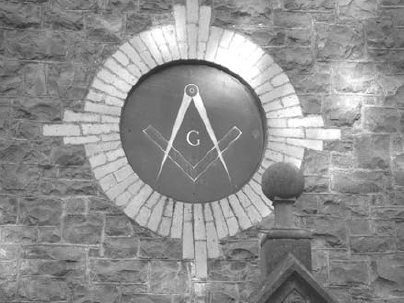
Masonic symbol at Llanfairfechan, Wales
These are said by Masonic historians to be the prime originators of their guilds.
A secretive group or secret society with doctrines said by Manly P. Hall (in Masonic, Hermetic, Quabbalistic & Rosicrucian Symbolical Philosophy) to be similar to the Freemasons. They are thought to have been great builders, reminiscent of the idea of the great architectural Nagas who escaped India.
It was supposedly this secret society, under Hiram Abiff, who built the Temple of Solomon and erected the great brass pillars now seen as Boaz and Joachim in Masonry. They were also known as the Roman Collegia and were said to have wandered around like the medieval Masons, building such fantastic places as the Temple of Diana at Ephesus (John Weisse, The Obelisk and Freemasonry).
Weisse also points out that the Collegia influenced the Islamic building efforts, which were later to become a turning point in Western European architecture after the crusades and possibly via the Collegia’s influence over the Templars, amongst others.
These Collegia were also thought to have been known before the Romans in Greece and were said to have worshiped the serpentine Bacchus. Considering the Masonic fascination with the Druids, there is little wonder that the infamous historian and archaeologist William Stukely believed them to have been the builders of Stonehenge and other ancient monuments.
Many Masonic writers love to associate themselves with the Druids and we find that they,
“had a high veneration for the Serpent. Their great god Hu, was typified by that reptile”.
(George Oliver, Signs and Symbols)
If it is true that the Dionysiac Architects and the Bacchus/Dionysus-worshipping Greek and Roman Collegia, were among the originators of the Freemasons, then it is highly likely that they were linked also with the serpent-worshipping Druids who were also known as Adders or Snakes.
They were all a later showing of the worldwide serpent cult - the same as those in India, Egypt, and elsewhere, who all had fantastic building skills and held secrets of the true and hidden Gnostic traditions. Today we can still see a remnant of this great architectural, serpent-worshiping and secretive cult in the Masons.
None of this author's claims are upheld by any real facts.
As George Oliver points out,
“The Serpent is universally esteemed a legitimate symbol of Freemasonry,” and now we see its history is worldwide, and some would say justifiably kept alive within the initiated Freemasons.