|

 |
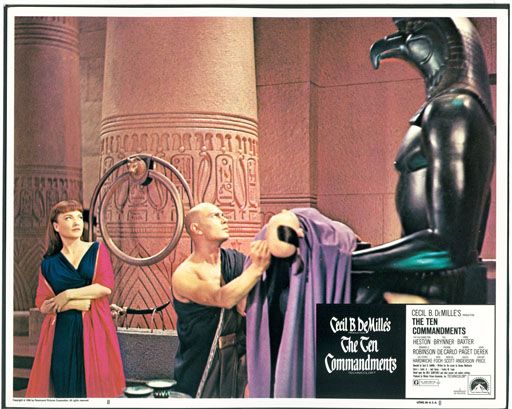
The True Resurrection was of Lazarus, and was Performed by John the Baptist.Herod cut off John the Baptist by removing his father from the priesthood to annul John's ascension as the next Kohen Gadol. Further information regarding the Exodus will be provided elsewhere, but for the sake of concise context, I will bring up how this time period and events regarding such relate to the raising of Lazarus. In the Old Testament (as well as in the 1956 movie The Ten Commandments by Cecil B DeMille), a few interesting events deserve mention:
All of that stated, it's time to move on to the Raising of Lazarus The term Lazarus is derived from the Hebrew "El" prefix and the Hellenic "us" being attached to the root Azar (Osir). Again, in Egyptian the S and Z interchange, as do vowels. The term Lazarus is a reference to the third aspect of the pre-Semitic Egyptian tri-form deity Ptah-Seker-Osiris. Again, The Father (Ptah) being the first aspect or form, The Firstborn Son Zechariah (Zeker Iah) being the second, and The Holy Ghost ("second-born Zechariah") - Lazarus (El-Osir: Osiris) being the third. Zechariah was the last High Priest of the Second Temple Period, whom by default became El (Lord) Osiris ("Azarus") when he was usurped by the Pharisees and Sadducees. Keeping in mind the covenant made between The Almighty and Moses at Mount Zion regarding the descendants of Aaron, traditionally, when a High Priest was no longer capable of presiding as the Kohen Gadol, his station would have passed onto his son - in Zechariah's case, John the Baptist. However prior to and suring the years ascribed to in the New Testament, Herod had installed his non-Aaronic political allies into the priesthood, thereby usurping (cutting off) John the Baptist as the next Kohen Gadol (High Priest). In biblical terms, Herod had both Zechariah and John cut off as the heads of the priesthood. If one changes the word "as" to the word "at" in the previous sentence, the truth of the matter at hand becomes evident. Thus it is easily realized that it was John the Baptist whom after his own "beheading" (excommunication by default from the priesthood) "raised" (reinstated) "Lazarus" (his own father) back to the title-station of Zechariah after Herod had apparently "cut off" his father, which enraged Herod and led to John's crucifixion at the hands of the Pharisees. Note that nothing whatsoever is written about an individual named Zechariah after John the Baptist is "named". Zechariah just suddenly disappears as if into thin air. Curiously, in the Old Testament, it is stated that the prophet Zechariah was "murdered" "between the altar and the sanctuary" for rebuking the ruler, just as the New testament claims that John was "beheaded" for rebuking Herod. The New Testament Zechariah was of course the head of the Jewish priesthood: John was to become likewise. By default, as Zechariah's son and heir apparent, Zechariah being "cut off" from the priesthood would amount to John likewise being "cut off" as well. The exact circumstances that culminated in Herod "cutting off" Zechariah are unclear, but it is obvious that by him doing such, it would have led to John being in danger of losing his station as heir apparent to the High Priesthood, thus leading to him "resurrecting" his father before he himself was cut off as well. It is significant to realize that whomever wrote the New Testament account of the raising of Lazarus (John 11) went to the seemingly unnecessary trouble of making the claim that although Lazarus was "raised from the dead", he was supposedly not raised until the fourth day - too late for him to be afforded the ability to return to his previous title-name (Zechariah) and station as the High Priest. The mention of "Jesus" being too late to raise Lazarus properly is overtly pointless if in fact it was meant to be taken in a physical sense due to the fact that Lazarus had nonetheless been raised "from the dead", and as such, it need not have even been mentioned. So why would the author state that Jesus delayed his journey to Lazarus, thereby arriving on the fourth day? The fact that the author felt it important to push this claim is because in proper context, the author was trying to peddle the narrative that Zechariah's being "cut off" was official, which in turn unmasks the author as being on the side of the Romans, the Pharisees, and/or the Sadducees as opposed to those whom he was supposedly writing about. In proper chronology, Zechariah rebuked Herod. Herod usurped the priesthood by appointing his own non-Aaronic political allies to the priesthood. When John found out that his father Zechariah had been usurped, he went - as the heir apparent High Priest - and "raised" Lazarus (his father Zechariah), causing the Romans, the Pharisees, and possibly the Sadducees to become incensed enough to have him crucified supposedly "against Rome's will". Another significant point to be made, is that so little is written about Zechariah's influence as High Priest on John and Jesus' youths. The fact that Zechariah was a lone holdout in a temple that had become political, corrupt and bastardized is beyond doubt. So why wasn't this significant personage - the godfather of the virgin Mary, uncle of Jesus Christ and father of John the Baptist - featured in prominence by the gospel writer(s)? Was it because they were at odds with regards to the Roman occupation of Judea? Or perhaps, was it because the zealots - whom the Flavians were at war with and whom Josephus betrayed - named themselves the Sicarii after none other than Zechariah - the father of the True Christ? Sicae my ass According to the New Testament, Zechariah raised Jesus' mother Mary as his own daughter. That said, John 11 records the Raising of Lazarus as follows (annotations and footnotes are mine): "Now a man named Lazarus was sick. He was from Bethany, the village of Mary and her sister Martha1. (This Mary, whose brother Lazarus2 now lay sick, was the same one who poured perfume on the Lord and wiped his feet with her hair3.) So the sisters sent word to Jesus, “Lord, the one you love is sick4.” When he heard this, Jesus said, “This sickness will not end in death5. No, it is for God’s glory so that God’s Son may be glorified through it6.” Now Jesus loved Martha and her sister and Lazarus. So when he heard that Lazarus was sick, he stayed where he was two more days7, and then he said to his disciples, “Let us go back to Judea.” “But Rabbi,” they said, “a short while ago the Jews there tried to stone you8, and yet you are going back?” Jesus answered, “Are there not twelve hours of daylight9? Anyone who walks in the daytime will not stumble, for they see by this world’s light. It is when a person walks at night that they stumble, for they have no light.” After he had said this, he went on to tell them, “Our friend Lazarus has fallen asleep; but I am going there to wake him up10.” His disciples replied, “Lord, if he sleeps, he will get better11.” Jesus had been speaking of his death, but his disciples thought he meant natural sleep. So then he told them plainly, “Lazarus is dead, and for your sake I am glad I was not there, so that you may believe12. But let us go to him.” Then Thomas (also known as Didymus) said to the rest of the disciples, “Let us also go, that we may die with him13.” On his arrival, Jesus found that Lazarus had already been in the tomb for four days14. Now Bethany was less than two miles from Jerusalem, and many Jews had come to Martha and Mary to comfort them15 in the loss of their brother. When Martha heard that Jesus was coming, she went out to meet him, but Mary stayed at home. “Lord,” Martha said to Jesus, “if you had been here, my brother would not have died16. But I know that even now God will give you whatever you ask.” Jesus said to her, “Your brother will rise again17.” Martha answered, “I know he will rise again in the resurrection at the last day.” Jesus said to her, “I am the resurrection and the life. The one who believes in me will live, even though they die; and whoever lives by believing in me will never die. Do you believe this?” “Yes, Lord,” she replied, “I believe that you are the Messiah, the Son of God, who is to come18 into the world.” After she had said this, she went back and called her sister Mary aside. “The Teacher19 is here,” she said, “and is asking for you.” When Mary heard this, she got up quickly and went to him. Now Jesus had not yet entered the village20, but was still at the place where Martha had met him. When the Jews who had been with Mary in the house, comforting her, noticed how quickly she got up and went out, they followed her, supposing she was going to the tomb to mourn there. When Mary reached the place where Jesus was and saw him, she fell at his feet and said, “Lord, if you had been here, my brother would not have died16.” When Jesus saw her weeping, and the Jews who had come along with her also weeping, he was deeply moved in spirit and troubled21. “Where have you laid him?” he asked. “Come and see, Lord,” they replied. Jesus wept22. Then the Jews said, “See how he loved him!” But some of them said, “Could not he who opened the eyes of the blind man have kept this man from dying23?” Jesus, once more deeply moved24, came to the tomb. It was a cave with a stone laid across the entrance25. “Take away the stone26,” he said. “But, Lord,” said Martha, the sister of the dead man, “by this time there is a bad odor, for he has been there four days27.” Then Jesus said, “Did I not tell you that if you believe, you will see the glory of God?” So they took away the stone. Then Jesus looked up and said, “Father, I thank you that you have heard me28. I knew that you always hear me, but I said this for the benefit of the people standing here, that they may believe that you sent me29.” When he had said this, Jesus called in a loud voice, “Lazarus, come out!30” The dead man came out, his hands and feet wrapped with strips of linen, and a cloth around his face31. Jesus said to them, “Take off the grave clothes and let him go.” Therefore many of the Jews who had come to visit Mary, and had seen what Jesus did, believed in him. But some of them went to the Pharisees and told them what Jesus had done32. Then the chief priests and the Pharisees called a meeting of the Sanhedrin33. “What are we accomplishing?” they asked. “Here is this man performing many signs. If we let him go on like this, everyone will believe in him, and then the Romans will come and take away both our temple and our nation.” Then one of them, named Caiaphas, who was high priest that year34, spoke up, “You know nothing at all! You do not realize that it is better for you that one man die for the people than that the whole nation perish.” He did not say this on his own, but as high priest that year34 he prophesied that Jesus would die for the Jewish nation, and not only for that nation but also for the scattered children of God, to bring them together and make them one. So from that day on they plotted to take his life35. Therefore Jesus no longer moved about publicly among the people of Judea36. Instead he withdrew to a region near the wilderness, to a village called Ephraim, where he stayed with his disciples. When it was almost time for the Jewish Passover, many went up from the country to Jerusalem for their ceremonial cleansing before the Passover. They kept looking for Jesus, and as they stood in the temple courts they asked one another, “What do you think? Isn’t he coming to the festival at all?” But the chief priests and the Pharisees had given orders that anyone who found out where Jesus was should report it so that they might arrest him37." Lazarus' Sisters Lazarus' sisters were Mary (Isis: Elizabeth) and Martha (Nephthys), which is proven as follows: Osiris' sisters were Isis and Nephthys, the first being his wife, and both being mothers of his "two" son"s". Elizabeth literally translates to El (Lady) Isa (Isis) of the House (Beth). Isis was often referred to as Meri ("Beloved") in Egyptian scripture. Zechariah was the husband of Elizabeth, just as Seker-Osiris was the husband of Isis. The term Mary was intentionally convoluted as a tacit reference to Elizabeth in both the Raising of Lazarus as well as the Conception and Birth of The Christ in order to mislead the reader. Martha (Nephthys) assisted Mary (Isis) in the resurrection of Osiris, which culminated in the "second birth" of Anubis-Horus (John the Christ - Iusa Krst: The ever-manifesting (IU) Zeker (SAKR) = Son of Ptah (ST)) - see Source 1. and Source 2 and Source 3 and Source 4 and Source 5 and Source 6 and Source 7 and Weak Counter Arguments
|