|

 |
Ancient Arcana - A Walk Through the Ancient WorldWhy was Saint Peter said to have been crucified upside-down?The Crucifixion of Saint PeterThis dramatic scene depicts the crucifixion of Saint Peter, one of the twelve Apostles and the first Bishop of Rome. The figure to the left of Saint Peter holds a key, a traditional symbol of this Saint. His execution was ordered by the Roman Emperor Nero, who blamed the city’s Christians for a terrible fire that had ravaged Rome. Peter requested to be crucified upside down, as he felt unworthy to die in the same manner as Christ. Who is Saint Christopher, and why was his sainthood removed?Once a Saint, Always a Saint? Kind Of - Unless You're DemotedApril 26, 2014, 9:00 AM In 1969, some saints were removed from the universal calendar. The Catholic Church removed 93 saints from the universal calendar and revoked their feast days in 1969 when Pope Paul VI revised the canon of saints and determined that some of the names had only ever been alive as legends or not enough was known about them to determine their status. "The purpose was to clean up a crowded liturgical calendar,” he said. "They decided to remove particular feast days of those saints whose origins were shrouded in more mystery than manuscripts." As the Vatican prepares to elevate Popes John XXIII and John Paul II on Sunday, here’s a look of some famous demoted saints: Saint Christopher Among Catholicism’s most popular saints, Christopher was listed as a martyr. Legend had it he carried a child who grew increasingly heavy across a river -- the child was supposed to be carrying the weight of God. But there wasn’t enough historical evidence the man ever existed, so Pope Paul VI dropped him. Saint Ursula Saint Ursula suffered a similar fate when the Catholic Church decided she was only a myth. She is thought to have been the leader of a group of virgins who were murdered at Cologne. Ursula was also a princess whose father had arranged for her to marry a powerful pagan king. Saint Nicholas Who can forget Saint Nicholas, the man who gave us the story of Santa Claus? He was also known for his extreme generosity and only eating on Wednesdays and Fridays. Saint George Saint George is remembered as a brave martyr -- often depicted as a hero slaying a dragon in paintings. When he scolded the Roman Emperor Diocletian for killing Christians, he was tortured and finally beheaded, according to the myth. Martyr Christopher of Lycia, and, with him, the Martyrs Callinika and AquilinaThe Holy Martyr Christopher lived during the third century and suffered about the year 250, during the reign of the emperor Decius (249-251). There are various accounts of his life and miracles, and he is widely venerated throughout the world. Saint Christopher is especially venerated in Italy, where people pray to him in times of contagious diseases. There are various suggestions about his descent. Some historians believe that he was descended from the Canaanites, while others say from the “Cynoscephalai” [literally “dog-heads”] of Thessaly. Saint Christopher was a man of great stature and unusual strength. According to tradition, Saint Christopher was very handsome, but wishing to avoid temptation for himself and others, he asked the Lord to give him an unattractive face, which was done. Before Baptism he was named Reprebus [Reprobate] because his disfigured appearance. Even before Baptism, Reprebus confessed his faith in Christ and denounced those who persecuted Christians. Consequently, a certain Bacchus gave him a beating, which he endured with humility. Because of his renowned strength, 200 soldiers were assigned to bring him before the emperor Decius. Reprebus submitted without resistance. Several miracles occurred along the way; a dry stick blossomed in the saint’s hand, loaves of bread were multiplied through his prayers, and the travellers had no lack thereof. This is similar to the multiplication of loaves in the wilderness by the Savior. The soldiers surrounding Reprebus were astonished at these miracles. They came to believe in Christ and they were baptized along with Reprebus by Saint Babylus of Antioch (September 4). Christopher once made a vow to serve the greatest king in the world, so he first offered to serve the local king. Seeing that the king feared the devil, Christopher thought he would leave the king to serve Satan. Learning that the devil feared Christ, Christopher went in search of Him. Saint Babylas of Antioch told him that he could best serve Christ by doing well the task for which he was best suited. Therefore, he became a ferryman, carrying people across a river on his shoulders. One stormy night, Christopher carried a Child Who insisted on being taken across at that very moment. With every step Christopher took, the Child seemed to become heavier. Halfway across the stream, Christopher felt that his strength would give out, and that he and the Child would be drowned in the river. As they reached the other side, the Child told him that he had just carried all the sins of the world on his shoulders. Then He ordered Christopher to plant his walking stick in the ground. As he did so, the stick grew into a giant tree. Then he recognized Christ, the King Whom he had vowed to serve. Saint Christopher was brought before the emperor, who tried to make him renounce Christ, not by force but by cunning. He summoned two profligate women, Callinika and Aquilina, and commanded them to persuade Christopher to deny Christ, and to offer sacrifice to idols. Instead, the women were converted to Christ by Saint Christopher. When they returned to the emperor, they declared themselves to be Christians. Therefore, they were subjected to fierce beatings, and so they received the crown of martyrdom. Decius also sentenced to execution the soldiers who had been sent after Saint Christopher, but who now believed in Christ. The emperor ordered that the martyr be thrown into a red-hot metal box. Saint Christopher, however, did not experience any suffering and he remained unharmed. After many fierce torments they finally beheaded the martyr with a sword. This occurred in the year 250 in Lycia. By his miracles the holy Martyr Christopher converted as many as 50,000 pagans to Christ, as Saint Ambrose of Milan testifies. The relics of Saint Christopher were later transferred to Toledo (Spain), and still later to the abbey of Saint Denis in France. In Greece, many churches place the icon of Saint Christopher at the entrance so that people can see it as they enter and leave the building. There is a rhyming couplet in Greek which says, “When you see Christopher, you can walk in safety.” This reflects the belief that whoever gazes upon the icon of Saint Christopher will not meet with sudden or accidental death that day. The name Christopher means “Christ-bearer.” This can refer to the saint carrying the Savior across the river, and it may also refer to Saint Christopher bearing Christ within himself (Galatians 2:20). The skull of Saint Christopher is located in the Monastery of Karakalou on Mount Athos. Pieces of the Holy Relics of Saint Christopher are found in the Monasteries of Prousos in Evritania, Nativity of the Theotokos on Aegina, the Holy Unmercenary Physicians in Kastoria, and Kykkos on Cyprus. Mysterious Dog-Headed St. Christopher Reminds Of The Egyptian Jackal God AnubisEllen Lloyd - AncientPages.com - The lives of many saints are often shrouded in mystery. St. Christopher who died as a martyr is one of the most venerated Christian saints. Yet, there is a lot we don’t know about the man who died as a martyr. The truth is that we don’t even know if he existed in the first place. What is even more intriguing is that in the Byzantine Museum in Athens, Greece, we come across something remarkable, something that could shed light on his identity. Here we find an icon of a Dog-Headed St. Christopher. Why is St. Christopher depicted with a dog head? What Does Jackal God Anubis Have In Common With St. Christopher?It’s curious because the holy Christian reminds of the Jackal God Anubis, one of the immortal Egyptian gods. In the underworld, Anubis was the protector of the dead bodies. His widely known epithet the ‘Lord of the sacred land’ or ‘Lord of the pure land’ emphasized his supreme power over desert areas covered with necropolises. Also his title ‘He who is upon his sacred mountain’ relates to the jackal god watching over the burials of the dead from the heights of the desert cliffs. In the Pyramid Texts, there is a reference to ‘the Jackal, the Governor of the Bows’, more exactly, nine bows – nine figures depicted as literal bows, probably representing captives – the enemies of Egypt. According to the Catholic Church, St. Christopher is the patron of bachelors, transportation, traveling, storms, epilepsy, gardeners, holy death, and toothache. The Mysterious Dog-Headed RaceAncient legends mention a mysterious dog-headed race that once lived among men. According to the Orthodox Arts Journal, “dog-headed men appear in the story of St-Mercurios, a warrior saint whose father was eaten by two dog-headed men later converted by St-Mercurios. These dog-headed men’s savage nature could be unleashed by St-Mercurios on the enemies of the Roman empire in a way analogous to how Romans and later Christians used Barbarians in their own wars.” In Medieval times it was commonly accepted at the time that there were several types of races, the Cynocephalus, or dog-headed people, being one of many believed to populate the world. Walter of Speyer, a German poet and writer portrayed St. Christopher as a giant of a cynocephalic species in the land of the Chananeans who ate human flesh and barked. The use of dog-headed men in iconography is not limited to the icon of St-Christopher. These enigmatic beings appear also in images of Pentecost, prominently in Armenian manuscripts, but also in Western images. Did St. Christopher Exist?Tracing St. Christopher’s life and death requires a lot of research. We don’t know his true identity. Historical evidence is based on legends that suggest this intriguing man lived during the Christian persecutions of the Roman emperor Decius (249 to 251), and that he was captured and martyred by the governor of Antioch. Historian David Woods has proposed that St. Christopher's remains were possibly taken to Alexandria by Peter of Attalia where he may have become identified with the Egyptian martyr Saint Menas. The Orthodox icon of St. Christopher presents him as a warrior cynocephalus, a dog-headed man from Lycea. Sometimes he is also of gigantic size as well. According to his tradition, he was a Roman soldier taken from the far end of the world who converted and was martyred by an Emperor. St. Christopher died because he refused to sacrifice to the pagan gods. The king ordered him to be killed. Various attempts failed, but finally, Christopher was beheaded. Before his death, St. Christopher had managed to convert thousands of people to Christianity. His feast is on July 25 every year. The Strange Legend of St. Christopher, and Whether or Not He Had the Head of a DogFirst of all: St. Christopher is still a saint. His feast day of July 25th was dropped as part of the revisions to the universal calendar in compliance with Mysterii Paschalis in 1970 because so little was known about him and many other early saints. He wasn’t, however, unsainted, and devotions are perfectly acceptable and remain popular, and local churches are free to recognize the traditional feast day. It’s simply a matter of no longer being on the universal calendar. A more interesting question is: did he have a dog’s head? This seems unlikely given, you know, basic biology, but let’s investigate. The Legend of Christopher Christopher died in either the 3rd or 4th century depending upon whether it was the emperor Decius and Dacian who ordered the persecutions. The legends of Christopher are all rather late, and popular devotion didn’t really emerge until the middle ages. Remember, early martyrologies were often merely lists of names, and the pious had to fill in the rest the best they could. Sometimes there were stories handed down, and even written accounts as with Perpetua and Felicity, but often a saint might just attract legends the way polyester attracts lint. Perhaps it’s in the name. Thus, Felix is faithful. And Christopher becomes a Christ-bearer.
17th century According to medieval Latin narratives, with Jacobus de Voragine in the Golden Legend being the most vivid, Christopher was giant named Reprobus (meaning “outcast”) from Canaan. Standing over seven feet tall (twelve feet tall according the Jacobus), he was in the service of a Canaanite king, swearing only to serve the most powerful man in the land. One day he saw the king make sign of the cross every time a jester mentioned the devil. Deciding this meant the devil was more powerful, and went in search of him. He came across a host of soldiers, one of whom was more terrible than the others. When this man asked Christopher what he sought, he answered, “I seek to serve the devil as my master.” The soldier claimed to be the devil, and Christopher gladly entered his service. As they were traveling down a road they came upon a wayside cross, and the demon was so struck with terror that he took a long detour to avoid it. Christopher demanded to know why, and the demon told him about Christ and how His sign filled him with fear. So Christopher went in search of Christ, and finally found a hermit who preached the faith to him. The hermit suggested various mortification and prayers to Christopher as part of his new faith, but the giant rejected them all. Finally, they agreed that he would set up a hut by a river where many travelers perished attempting to cross. With a pole, his huge size, and his strength, he would be able to guide wayfarers safely across, and this would be his service to Christ.
17th century One day, while in his hut, he heard the voice of a child calling to him, “Christopher, come out and carry me across.” He lifted the boy onto his shoulders, but as he got part way into the river, the child grew unbearably heavy, almost crushing and dragging him under the water. Only with great effort did he finally make it across. Weary and surprised, he said to the child, “You put me in great danger. It was as though I had the weight of the whole world on my shoulders.” The child replied, “Do not be surprised, for not only did you carry the whole world, but He who created it. I am Christ your king, who you serve, and if you want proof, plant your staff in the ground by your hut and it will leaf and bear fruit.” With that, the child vanished, and Christopher did as he was told. The next morning, the staff bore leaves and fruit like a palm. After his encounter with the Lord, Christopher went to Samos, a city in Lycia, where Christians were being persecuted. He planted his staff again, and again it fruited, and thousands were converted by the miracle. The king, however, was enraged, and sent soldiers to collect him. These, too, he converted, but he went to the king anyway. When Christopher refused to sacrifice to the king’s gods, he was imprisoned. Two women—Nicaea and Aquilina—were sent to tempt him away from his faith, but these he converted. They returned to the king and used their girdles to pull down his idols, whereupon they were killed. Christopher was brought before the king to be tortured. An iron helmet was heated and placed on his head, and he was chained to an iron chair and placed in the flames. Nothing happened and the chair collapsed. Next, four hundred bowmen were ordered to fire upon him, but their arrows merely hung in the air and none so much as scratched him. One, however, spun in midair and returned to strike the king, putting out his eye. “Tyrant,” Christopher said, “I will be dead by tomorrow. Then make a paste with my blood and rub it on your eyes, and you will recover you sight.”
The next day, Christopher was beheaded. The king placed his blood in his eye and prayed to the God of St. Christopher. He was healed immediately, and then baptized, ordering that anyone who blasphemed the God of Christopher should be beheaded, which probably wasn’t the lesson he was supposed to learn, but … baby steps. The Dog Headed Saint Much of this has the form and flavor of certain kinds of medieval hagiography meant for didactic purposes rather than any attempt at real biography. There’s no indication of any continual tradition about Christopher down the through the ages, which is why he lost his slot on the universal calendar. That doesn’t mean he didn’t exist. It just means the person of Christopher who emerged in a popular medieval cult has only a passing relation to an historical figure named Christopher who died a martyr’s death. His death is what made him a saint. His legend is what made him a teaching tool. There’s been some attempt to connect him to St. Menas, with claims that they’re the same person revered under different names. This has to do with sources that say he was in the Third Valerian Cohort from Marmarica, located in North Africa, and that he was martyred in Antioch. Menas is the Coptic patron of travelers, which reinforces this theory. It’s possible that we’re seeing one person taking on two identities and multiple legends as he’s adapted for Coptic, Greek, and Latin traditions. If you follow this path away from the legendary material, there are all kinds of interesting byways, but I’m not convinced we’re even talking about the same Christopher at this point, nor do I see how you can craft a genuine biography of a 3rd century martyr using 14th century Ethiopic texts. What’s peculiar is that in some eastern icons Christopher is depicted with the head of a dog. This is commonly attributed to a linguistic error. Christopher was a Canannite, which in Latin is Cananeus. Change one letter of the Latin and you get Canineus, or Caninite: Dog-men. Dog-headed men were described in some medieval travel texts, so it’s not so far fetched to thing the philological answer is the best one. There’s even a word for it: cynocephaly. For example, in Historia gentis Langobardorum, Paul the Deacon writes:
Note, however, that Paul doesn’t believe this. Marco Polo also mentions cynocephali:
Again, was he being literal or just making a point about their savagery? Explanations that require the people of the middle ages to be morons get the Spock Eyebrow from me. I more inclined to think the similarity in Cananeus/Canineus led iconograpers to make a theologically meaningful visual pun. Christopher was a brute willing to put himself in the service of the devil because he worshipped power, but in his encounter with the Lord he learned to truly serve Power in humility and faith. Isn’t that kind of like the loyalty of a dog? A beast, certainly, but a faithful beast. In other words, they did not literally believe a saint had the head of a dog. Rather, as with all icons, there’s a meaning to be uncovered in prayer and meditation. It’s not an illustration. I’m not alone in this opinion. An Orthodox writer named Jonathan Pageau has written a lengthy reflection on the deeper meanings of these icons, with a focus on the monstrous as a way depicting the alien or foreign. I think the symbolism is probably more simple than this, but he unpacks a lot of interesting points along the way and it’s certainly worth a read. Finally, some people say these images have to do the survival of worship of Anubis, the dog-headed Egyptian god. If you run across someone who makes this claim, go ahead and poke them in the eye for me. Oh My Dog! St Guinefort and St ChristopherBy Minjie Su Somewhere around the second quarter of the thirteenth century, a good Dominican friar known as Stephen de Bourbon (1190-1261) took it upon himself to travel the width and breadth of southern France, to visit, record, and expunge, superstitious and heretical beliefs. One day, when he was preaching and hearing confessions in the diocese of Lyon, he heard the shrine of St Guinefort. Thinking that this must be a local saint who somehow escaped his knowledge, Stephen decided to get to the bottom of the matter, but to his great surprise, St Guinefort turned out to be a dog. St Guinefort’s Story The story of St Guinefort is a familiar one. It is an archetype of the ‘faithful dog’ motif, codified as 178A in the Aarne-Thompson Motif-Index. According to Stephen, who faithfully recorded the tale in De supersticione (‘On Superstition’), Guinefort was originally a greyhound belonging to a lord and was put in charge of the his infant son when the lord and lady of the house went out. Upon returning, the nurse saw blood around the cradle and around the dog’s muzzle. The baby must have been killed and eaten by the dog, everyone thought. Out of grief and anger, the lord killed Guinefort. Upon further investigation, however, they discovered the baby – unharmed – and a snake that apparently died from the dog’s bite. Guinefort, as it turned out, was a loyal and brave dog to the very end: when he saw a snake crawling towards the cradle, he dashed out, knocking the cradle (and the baby) over on the way, and killed the intruder. Realising what grave mistake they had made, the lord buried Guinefort in the castle well and had it piled up with stones to mark the ground. As time passed on, the castle was reduced to ruins, but the legend of the dog was never forgotten. Peasants around the district started to visit Guinefort’s tomb and brought offerings; the dog was worshipped as defender of little children, just as he was in life. Stephen, of course, recognised the Devil’s work in all this; he had the dog’s corpse dug up and burned with the trees around. A fine was put in place for anyone caught worshiping Guinefort in the future. Other Cases of the “Faithful Dog” motif Similar tales are also found in other regions. In Wales, in the village of Beddgelert, for instance, Llywelyn the Great, Prince of Gwynedd, killed his dog Gelert under the same circumstance, only that the story ends not with Gelert being worshipped as a saint but with Llywelyn’s remorse and guilt. Though having buried Gelert with great pomp, the Prince kept hearing the dying yelp of the dog. He never smiled again. Another Celtic-influenced text with the ‘faithful dog’ motif is Arthur and Gorlagon, one of the four Latin Arthurian romances composed in the fourteenth century. Here the author does not really use the motif, but shows off his knowledge of it: when King Gorlagon was trapped in wolfish form, he was taken in by King Torleil (just as Bisclavret and Melion were). Sleeping in the king’s bedroom, the wolf discovered the affair between the queen the king’s squire and attacked the man. To get rid of the wolf (because he was a witness to their crime), and to get away with adultery, the queen hid her child, saying that the wolf killed the baby and would’ve killed her as well, had not the squire rushed in to save her. The king, unlike Guinefort’s master, did not act upon emotions. He thought about the wolf’s past behaviour and pondered the matter, giving the wolf enough time to acquit himself by locating the baby. The lovers were killed instead. St Christopher’s Tale Although St Guinefort was denied by Stephen de Bourbon, it does not mean canine-ish beings cannot be canonised. St Christopher is probably the most famous of the non-human saints, but he does not start as a dog-head. One of the most popular versions of St Christopher’s story is told in the thirteenth century bestseller Legenda aurea (The Golden Legend). There, he is a man – a Canaanite to be precise – known as Reprobus. In his search for the mightiest lord, he served kings and even the Devil himself, but at last he found Christ and was baptised as Christopher. Then he travelled to Lycia, praying to God so that he may understand their language. The pagan king of Lycia took him as a fool and beheaded him after torturing him. Before his ordeal, however, St Christopher instructed the king to make a little clay mixed with his blood to rub on his eye (which was blinded by an arrow that had been meant for St Christopher). The king did as he was told and said, ‘in the name of God and St Christopher!’ He was healed immediately and was converted to Christianity. St. Christopher performed his miracle in martyrdom. So why a dog? When it comes to the Orthodox tradition, however, the saint is depicted as having a dog’s head. This canine imagery is believed to have come from a mistranslation of cananeus (Canaanite) to canineus (canine). St Christopher becomes represented as a warrior-saint who belongs to the Cynocephali, and the story that he prays to God to understand the language of Lycia is retold as his praying to God to speak like man. The Cynocephali are a race of dog- headed men who devour each other. They are, therefore, very much similar to the Mermedonians in Andreas, in terms of their cannibalistic appetite. Both the Mermedonians and the Cynocephali are understood as barbarian, pagan, and bestial – the latter probably more so than the former. The Mermedonians are sylfætan (self-eaters) because they have no alternative options – in other words, they do not have an agricultural society like we do. The Cynocephali are the same, but further to that, they are even more bestial and monstrous due to their hybrid bodies. A dog is a carnivore; it eats raw meat and will, if it is out of control, attack men. Why should dogs eat bread and drink wine like humans do? Saint ChristopherWikipedia
Saint Christopher (Greek: Ἅγιος Χριστόφορος, Hágios Christóphoros, lit. 'Christ-bearer'; Latin: Sanctus Christophorus) is venerated by several Christian denominations as a martyr killed in the reign of the 3rd-century Roman emperor Decius (r. 249–251), or alternatively under the emperor Maximinus Daia (r. 308–313). There appears to be confusion due to the similarity in names "Decius" and "Daia". Churches and monasteries were named after him by the 7th century.
His most famous legend tells that he carried a child, who was unknown to him, across a river before the child revealed himself as Christ. Therefore, he is the patron saint of travelers, and small images of him are often worn around the neck, on a bracelet, carried in a pocket, or placed in vehicles by Christians. HistoricityProbably the most important source of the historicity of Christophorus is a stone inscription published by Louis Duchesne in 1878. The copy of the stone inscription and the first publication took place on 7 April 1877 by Matthieu Paranikas in the Anatolia magazine in Constantinople. The stone of the size of 2 m × 1 m (6 ft 7 in × 3 ft 3 in) was found in the ruins of a church in the ancient Chalcedon. The inscription bears witness to the laying of the foundation stone, the construction and the consecration of a church in the name of "Saint Christopher's Martyrdom". The inscription also bears witness to the chronological dates from the laying of the foundation stone to the consecration of the church; the construction of this Christophorus church dates back exactly to the time of the Fourth Ecumenical Council, the Council of Chalcedon. The inscription also mentions the names of the state ministers of the Byzantine Empire and those church ministers who were involved in the laying of the foundation stone, the construction or the consecration of the church. The inscription reads:
The German archaeologist Carl Maria Kaufmann writes:
Not far from the Church of St Christopher, which was under construction at the time, was the Basilica of St Euphemia, in which the Council took place; the consuls Protogenes and Sporacius, mentioned in the stone inscription, are mentioned in the Council Acts. This inscription attests to the veneration of Christophorus in the 5th century in Chalcedony and, consequently, the existence of Christophorus, who probably in the period of the Great Persecution in the 4th century suffered the martyrdom. Then for the year 553 a bishop of Arkadiopolis in Lydia is testified, who had taken the name Christophorus. A nunnery in Galatia was consecrated to Saint Christopher around the year 600. EpicEpics about the life and death of Saint Christopher first appeared in Greece in the 6th century and had spread to France by the 9th century. The 11th-century bishop and poet Walter of Speyer gave one version, but the most popular variations originated from the 13th-century Golden Legend. According to the legendary account of his life Christopher was initially called Reprobus. He was a Canaanite, 5 cubits (7.5 feet (2.3 m)) tall and with a fearsome face. While serving the king of Canaan, he took it into his head to go and serve "the greatest king there was". He went to the king who was reputed to be the greatest, but one day he saw the king cross himself at the mention of the devil. On thus learning that the king feared the devil, he departed to look for the devil. He came across a band of marauders, one of whom declared himself to be the devil, so Christopher decided to serve him. But when he saw his new master avoid a wayside cross and found out that the devil feared Christ, he left him and enquired from people where to find Christ. He met a hermit who instructed him in the Christian faith. Christopher asked him how he could serve Christ. When the hermit suggested fasting and prayer, Christopher replied that he was unable to perform that service. The hermit then suggested that because of his size and strength Christopher could serve Christ by assisting people to cross a dangerous river, where they were perishing in the attempt. The hermit promised that this service would be pleasing to Christ. After Christopher had performed this service for some time, a little child asked him to take him across the river. During the crossing, the river became swollen and the child seemed as heavy as lead, so much that Christopher could scarcely carry him and found himself in great difficulty. When he finally reached the other side, he said to the child: "You have put me in the greatest danger. I do not think the whole world could have been as heavy on my shoulders as you were." The child replied: "You had on your shoulders not only the whole world but Him who made it. I am Christ your king, whom you are serving by this work." The child then vanished. Christopher later visited Lycia and there comforted the Christians who were being martyred. Brought before the local king, he refused to sacrifice to the pagan gods. The king tried to win him by riches and by sending two beautiful women to tempt him. Christopher converted the women to Christianity, as he had already converted thousands in the city. The king ordered him to be killed. Various attempts failed, but finally Christopher was beheaded. The name Christopher, as used in the Anglophone world, is the English version of the Greek name Χριστόφορος (Christóphoros or Christóforos). It is formed from the word elements Χριστός (Christós, 'Christ'), and φέρειν (phérein, 'to bear'), together signifying, "Christ bearer". Widely dispersed into other languages and cultures from the Greek, many native forms of Christopher are used both to refer to the saint and as a personal name. Veneration and patronageEastern Orthodox liturgyThe Eastern Orthodox Church venerates Christopher of Lycea (or Lycia) with a Feast Day on 9 May. The liturgical reading and hymns refer to his imprisonment by Decius who tempts Christopher with harlots before ordering his beheading. The Kontakion in the Fourth Tone (hymn) reads:
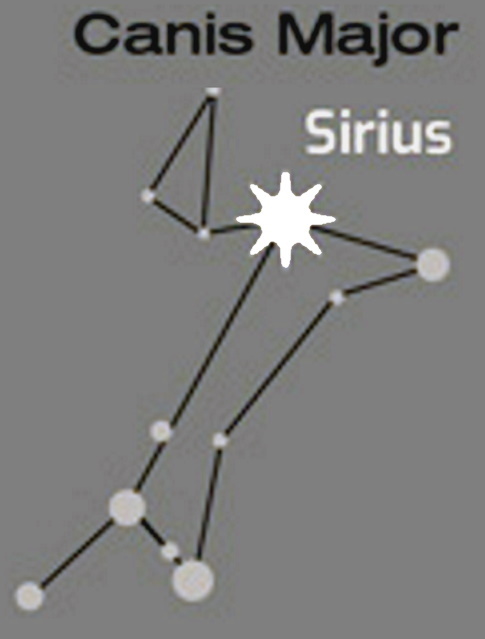
Roman Catholic liturgyThe Roman Martyrology remembers him on 25 July. The Tridentine calendar commemorates him on the same day only in private Masses. By 1954 his commemoration had been extended to all Masses, but it was dropped in 1970 as part of the general reorganization of the calendar of the Roman rite as mandated by the motu proprio, Mysterii Paschalis. His commemoration is of Roman tradition, in view of the relatively late date (about 1550) and limited manner in which it was accepted into the Roman calendar, but his feast continues to be observed locally. Sirius, Saint Christopher and the Dog Days of SummerWhy We Call Them the Dog Days of SummerOrange Beach, Ala. – (OBA) – The "Dog Days of Summer" refer to the hottest, stickiest, most sultry days of summer. Traditionally, they occur in the period between early July and early August. The term "Dog Days" was coined by the ancient Greeks and Romans, who referred to these days as "dies caniculares" (days of the dogs). This was because they associated the hot summer days with the star Sirius, also known as the Dog Star, in the constellation Canis Major (the Greater Dog). During this period, Sirius rises at the same time as the sun. The ancients believed that Sirius, being the brightest star in the night sky, contributed to the heat of the day, thus leading to the term "Dog Days". Due to the precession of the Earth's axis, the actual astronomical events that the Greeks and Romans were referring to occur at different times of the year now. The Dog Days of Summer in 2023 are from July 3 to August 11 (40 days). Whatever dates they fall on, the phrase "Dog Days of Summer" is still used colloquially to refer to the hot, lazy days of midsummer. Stay hydrated! On the northern Gulf Coast, the Dog Days of Summer are marked by a consistent pattern of hot, humid weather. This is when the subtropical sun scorches the coast and the temperature often reaches its annual peak. The heat is accompanied by high humidity, a product of the warm Gulf waters, making the air feel even more stifling. Residents and visitors alike seek refuge in the shade or air conditioning during the day, saving outdoor activities for the cooler, early morning or evening hours. Despite the intense heat, the Dog Days of Summer on the Gulf Coast are also a time of vibrant sunsets, warm sea breezes, and an abundance of marine life, making it a uniquely beautiful time of year. Sirius - ImbolcMany cultures have believed that the stars represent the consciousness of God. Meditate on them, celebrate their presence through story telling, dance and ritual and you can gain knowledge of the divine and enlightenment. They twinkle and shine and fill us with wonder. Going out on a cold, frosty night and looking up to the stars brings a sense of awe and delight, connecting one to another and to the universe.
Star light, star bright, the first star I've seen tonight. Pinocchio - The theme song of the movie can be taken as inspired by Sirius. When you wish upon a star, makes no difference who you are. Sirius, also called Alpha Canis Majoris or the Dog Star, appears blue-white, brightest star in the night sky. The primary reason for the star’s impressive appearance is because it’s a close neighbour to earth. January and February are perfect months for both Northern and Southern Hemisphere observers. It's visible in evening skies in late winter; in late summer, you'll find it in the east in the pre-dawn hours.
A world wide association with dogs and wolves might be linked to the astral layout in that Sirius seems to be following a giant in the sky, Orion. One easy way to find Sirius in winter evening skies is to locate Orion. The bright star is a short distance southeast of Orion; the three stars of Orion’s belt can be used as a “pointer” to Sirius. Sirius might also be called the New Year’s star, reaching its highest point in the sky around the stroke of midnight. That’s true for every New Year’s Eve. Because the stars rise and set two hours earlier with each passing month, on 1st February 2023, Sirius will be highest at around 10 p.m. local time. If our sun's warmth keeps the physical world alive, Sirius is considered to keep the spiritual world alive. It is the “real light” shining in the East, the spiritual light, whereas the sun illuminates the physical world, which is considered to be a grand illusion. The Mysterious Connection Between Sirius and Human HistoryIn Irish mythology a dog accompanies a water goddess: Boann (River Boyne) and Dabilla. He died when the river flooded, being turned into the stones of Rockabill, just off the coast near the exit of the Boyne into the Irish Sea. The Boyne floods in the winter, and there is a suggestion that Newgrange was aligned to the rise of Sirius as well as the sun, at winter solstice. You will find more on this fascinating research at Anthony Murphy's wonderful website - sirius-the-dog-star-shone-into-newgrange-when-it-was-built. Taking in Irish and other cultures' connections - Kindle unlimited - Newgrange-Sirius-Mystery-Cosmology-Symbology-ebook
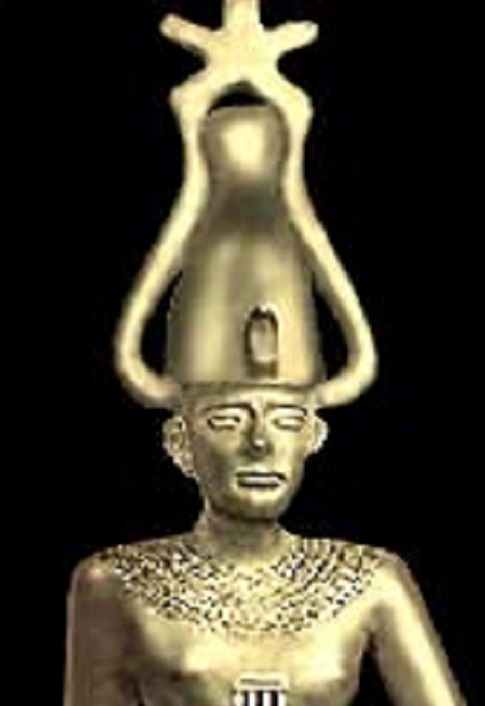
Egyptian floods, Greek and Roman feversWe cannot consider Sirius without mentioning the Fever Sun and Dog days. So, a short diversion from Imbolc in February to Summer. Sirius is associated with an Egyptian goddess - Sothis / Sopdet. She was usually shown wearing the crown of Upper Egypt with a star on top, and her title was the “Bringer of the New Year and the Nile Flood”. This is an important time of year, celebrated by Egyptians as an annual holiday for two weeks starting 15th August, known as Wafaa El-Nil, confirming the cycle of the seasons and fertility of the land. The annual flooding of the Nile was a sign that the fertile season was beginning. This deposited rich black earth onto the fields surrounding the river, taking place as Sirius was rising just before the sun, after having disappeared from the skies for roughly 70 days. (Before that it was too close to the sun to be seen.) This inundation took place in early July, and was the beginning of the Egyptian year. The helical (dawn) rising of Sirius (early August in 21st century) in the summer brought hot weather to the Greeks and Romans, and was known as the "Scorcher". The Romans believed that during the “dog days” of July the heat drove dogs rabid. 3rd July to 11th August - Dog Days of Summer Humans could develop a fever called seirasis, from the Greek name for Sirius, Seirios, “scorching”. The Romans, who saw Sirius as red, sacrificed red dogs to it during the three agricultural festivals: the Robigalia in May to avert rust on the crops, then the Floralia and Vinalia, festivals of flowers and fruits. Bible Quote:The only breed of dog mentioned by name in the Bible is the greyhound (Proverbs 30:29-31, King James Version): "There be three things which do well, yea, Which are comely in going; A lion, which is strongest among beasts and turneth not away from any; A greyhound; A he-goat also."
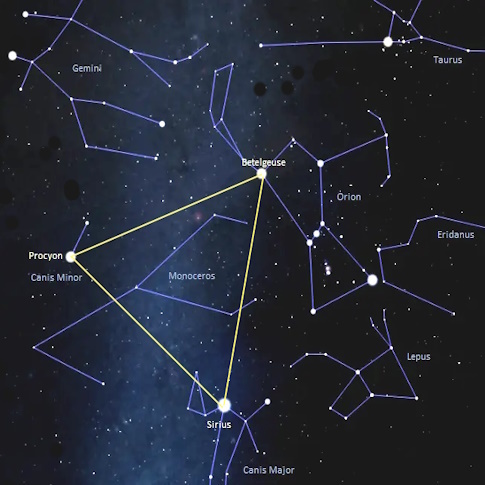
Winter Triangle - Betelgeuse, Sirius and ProcyonProminent in the night sky in the northern hemisphere during the winter months, from December to March, these three stars are seasonal indicators and can be guides for navigators. The three first-magnitude stars that form the Winter Triangle lie in the constellations Orion, Canis Major and Canis Minor. Betelgeuse, the second brightest star in Orion marks the right shoulder of the Hunter (left from our perspective) and appears just above Orion’s Belt. Sirius, the brightest star in the constellation of Canis Major, marks the Great Dog’s muzzle. Procyon is the brightest star, marking the heart, in the faint constellation Canis Minor. Representing the smaller of the two dogs following Orion, Canis Minor appears directly south of Castor and Pollux, the brightest stars in Gemini. The triangle is a universal symbol of enlightenment, strength, and healing. In the Macedonian folklore, Sirius and Procyon were known as the “wolves” – Volci – circling a plow with oxen, represented by the constellation of Orion, the celestial hunter. The Dogon ConnectionA controversial book, The Sirius Mystery, published in 1971 by Robert Temple, proposed that an ancient West African tribe from Mali – the Dogons – knew that Sirius was actually two stars, A and B. As they did not have telescopes, and these stars cannot be separated by the naked eye, he believed that the Dogons had “direct” connections with beings from Sirius. They were also studied by many including anthropologists Marcel Griaule and Germain Dieterle. In Dogon mythology, humanity is said to be born from the Nommo, a race of amphibians who were inhabitants of a planet circling Sirius. They are said to have “descended from the sky in a vessel accompanied by fire and thunder” and imparted great knowledge to humans. The Dogon’s mythology is very similar to Sumerian, Egyptian, Israelite and Babylonian legends of the myth of a “great teacher from above”. Perhaps the longest processional celebration in the world, taking several years, is the Sigui. Starting in the northeast, at Youga Dogorou, each village takes turns celebrating and hosting elaborate feasts, ceremonies, and festivities. They celebrate for around a year before the 'sigi' moves to the next village. The last one started in 1967 and ended in 1973; the next one will start in 2027, as they occur every 60 years. A ritual to honor and recognize these first ancestors. Male initiates learn a secret language and carve their mask which is said to represent hunters, warriors, healers, women, and people from neighboring ethnic groups. The masks may also depict animals, birds, objects, and abstract concepts. Cintamani StoneA mythical Buddhist / Hindu relic - one of four artifacts - that fell from the sky during the reign of king Lha Thothori Nyantsen of Tibet. Referred to throughout history as a wish granting jewel it is believed to have originated in Sirius. There is no proof that it exists today. The Tibetan symbol for the Cintamani is the pyramid of triple circles. This is reminiscent of the Triple Spiral symbol seen at Newgrange. Worship of SiriusQuote link : Sirius and Hephaistos myths and legends were strongly present in Bronze Age Mediterranean communities Sirius is most probably the star worshiped by the ancient inhabitants of Metsamor, Armenia, ” Elma Parsamian explains. Sirius the most important star – worshiped at Karahundj Armenia’s Stone Circle “Between 2800-2600 BCE Sirius could have been observed from Metsamor in the rising rays of the sun. It is possible that, like the ancient Egyptians, the inhabitants of Metsamor related the first appearance of Sirius with the opening of the year." "We believe they worshiped the star Sirius, but how? I like to imagine there was a procession of people holding lights. These carved holes throughout the complex may have been filled with oil and lit. Just imagine what it must have looked like with all those little fires going all over the steps of the observatory. Like a little constellation down on earth.” The Dog Days of SummerIn the ancient world, the constellations of Orion and Canis Major (especially the Dog Star, Sirius) were calendar markers for planting and reaping. Sirius, the Dog Star, sets in the west in spring and is absent from the sky for seventy days, then its heliacal (just before dawn) rising in the east marked the beginning of the Dog Days when the sun was said to burn at its most fierce and rainfall to be at its lowest level. The Old Farmer’s Almanac of 1792 lists the timing of the Dog Days as the days beginning July 3rd and ending on August 11th (Old Lughnasa), and they are traditionally listed as such in the present day. They are a period of desiccating heat, when summer growth and moistness ends, and the sun dries the corn ready for harvesting, ushering in the Autumn and the gathering of the First Fruits. Sirius (‘Scorching Star’) is the brightest star in the sky, and lies in the constellation of Canis Major, the ‘Greater Dog’ which, along with Canis Minor the ‘Little Dog’, follows the constellation of Orion the hunter across the sky, helping him pursue Lepus the Hare or confront Taurus the Bull. Canis Major has been associated with dogs from the earliest times. The ancient Assyrians called the Dog Star the ‘Dog of the Sun’ or ‘Star Dog of the Sun’. The Assyrian month of Abu (July-August) signified ‘fiery hot’ because the sun was in Leo and therefore raging like a lion. The Romans sacrificed a red-coloured dog in May, when Sirius disappears for seventy days below the western horizon, to ensure the health of the forthcoming crops. The hottest part of the year, which dried the grain ready for harvesting, they called the dies cani cultriac or ‘Dog Days’. They thought that Sirius was a distant sun (the central sun of the Milky Way, in fact) which during the Dog Days rose with our sun to add its own heat, making the weather unbearable. Its influence was considered baneful and malign. Pliny wrote that Sirius burned with “…a bright fire and sheds a killing light’ and went on to say that ‘this is the constellation which has the most widespread effects on earth. At its rise the seas are rough, wine in the cellars bubbles, marshes are stirred.” Aristotle said “…this is a period of great upheaval when the sea is extremely rough and amazing catches are made, when fish and mud rise to the surface.” Hesiod described it as ‘a desiccating sun’, burning up plants and making the seeds in the earth sterile by depriving them of food. Animals die of thirst, vines are burned and humans are prostrated with fevers and illness, especially siriasis (a type of meningitis which attacks young children). According to these ancients, the Dog Days are a time of cruel heat when men’s skins are burned and their throats parched with thirst. Those afflicted with hydrophobia were said to have been driven mad by Sirius. In fact, the Greeks imagined the constellation of Canis Major in the form of a rabid dog with its tongue lolling and its eyes bulging. The astronomer Manilius said: “…such is the heat diffused among the constellations, and everything is brought to a halt by a single star.” He went on to relate how the heat brought out the worst in people, with anger, hatred and fear, impetuosity, frayed tempers and arguments, all fanned by alcohol. It was during this time that the Adonia Festival was celebrated in Greece, as Theophrastus said ‘when the sun is at its most powerful’. During the festival women would plant small gardens – called Gardens of Adonis and dedicated to the vegetation god – in clay pots or wicker baskets. These were composed of wheat, barley, fennel and lettuces. The women would climb ladders up to their rooftops, thereby placing the little gardens as close to the sun as they could. During this time of year the great heat gives an impetus to a plant’s growth, but this can become leggy and spindly with the plant outgrowing its strength, while young shoots wither in dryness. The gardens were left to grow for only eight days to come to maturity, in contrast to the eight months taken by the cereal crop under the auspices of the goddess Demeter. At the culmination of the festival the gardens were taken from the roofs and cast in to the sea or into springs. Thereafter August was sacred to the goddess Demeter and her daughter Persephone. In Norse myth the Dog Star Sirius is called Lokabrenna (‘the Burning of Loki’ or ‘Loki’s Brand’). Sif was the wife of Thor, the god of thunder. She had beautiful golden hair until Loki cut it all off for a prank. Thor was so angry that he wanted to kill the trickster, but Loki was able to persuade the dwarfs to make some magical hair for Sif, which once it touched her head, would grow like her own hair. It is clear that Sif’s hair is the golden corn, which is cut and regrows with the next year, making her a corn or harvest goddess. Her husband is the thunder god who brings the fertilizing rain to the earth in the summer, to make the corn grow. Loki, usually described as a god of wildfire and heat, is associated here with Sirius and the heat of the Dog Days, which causes the ripening and subsequent cutting of the grain. The Feast of St. Christopher falls on 25th July. He is the patron saint of travellers, portrayed in the Eastern Church as a man with the head of a dog. He has two festivals on May 9th (in the Eastern Church) and July 25th (in the Western church) and these dates correspond to the setting and rising of Sirius, the Dog Star. This suggests an interesting Pagan origin for the Christian saint who carried the Christ Child across a raging river in a storm, and thus he became the patron of travellers who often wear St Christopher medals for protection. In ancient Egypt, Sirius was the main seasonal marker which mobilised the whole calendar. In contrast to elsewhere, the Egyptians thought its heliacal rising after its absence from the sky for seventy days brought the Nile inundation, the annual floods which carried rich alluvial mud for planting, and began the Egyptian year in the month Wep-renpet, ‘Opener of the Year’. They thought of Sirius as a feminine sun which added its own power to the usual sun, and the festivities at the Temple of Hathor in Dendera were chiefly concerned with the birth of this new sun. People would gather on the roof of the temple to see her rise with the sun Ra, sitting on the prow of his solar boat and uniting her rays with his as they melted into the dawn light. The Egyptians called the star Septit (or Sothis in the Greek form), titled ‘the Water Bringer’ and identified it with Isis. During the festivities at Dendera, a statue of Isis/Hathor was carried up to the roof to face Sirius and the rising sun. Isis appears in the Pyramid Texts as the chief mourner for her husband, the vegetation god Osiris (identified with the constellation Orion), whom she brought back to life with magic. The rising of Sothis was considered to be the goddess coming to mourn her husband and revive him (as corn god) with the flooding of the Nile. Sirius disappears from the sky for seventy days before its heliacal rising. This marked its death and rebirth and re-started the calendar. The Egyptians noted that every ten days one of the thirty six decans (the stars that kept the calendar, chosen because they followed the same pattern as Sirius) disappeared into the west and remained unseen for a period of time before reappearing with the dawn in the east. As one ‘died’ another was ‘reborn’ every ten days, according to Papyrus Carlsburg 1. During the period the star was missing, it was said to have entered the Duat (‘Embalming House’) or netherworld, where its impurities were shed, preparing it for rebirth. The Egyptian mummification process took seventy days, the period of time the decans spent in the Duat. Of all the stars only the heliacal rising of Sirius coincides with the length of our solar year of 365.25 days. Each year it started time – and therefore order, the seasons and creation – and because of this it was sometimes linked with the benu bird of creation. The benu had alighted on the primordial mound which had emerged from the elemental waters, the only place not submerged and when it flew away, the sun rose for the first time and brought light and life to the world, just as the heliacal rising of Sirius did each year. The Greeks identified the benu with the phoenix. Tacitus (1st century CE) reported that it took 1461 years for the benu to fly to the east and back. This was because the Egyptians calculated that Sothis took 1461 years to recycle through their 365 day calendar, moving forward by a day every four years (which accrued because they had no leap year). This was called a Sothic Year. © Anna Franklin, heavily condensed from Lughnasa, History, Lore and Celebration by Anna Franklin, Lear Books The Grail and the Canine Conundrumby Dan Green Most of us at some point in our life have noticed that the word God, the Supreme and Infinite Personal Being, in reverse presents us with the word ‘dog’, man’s best friend. Given the importance of the title of our Creator, I could only wonder if they could be any significance in why the mirror imaging of the word should draw our attention to a contract drawn up between Man and dog, as remote as 10,000 years ago. Who was responsible for the naming of ‘God’, likewise who named the first dog? The plot thickens when we discover that the origin of both words is unclear, the exact history of the word God remaining unknown and the origin of dog tantalisingly one of the greater mysteries of English etymology having no known root in other languages. What might be the concealed connection? There are two possible ‘leakages’ within the religious spectrum.The first concerns St Dominic, founder of the Catholic order of Dominicans and, interestingly as we will see later, Patron Saint of astronomers.
St. Dominic and Dog According to his mother whilst pregnant she saw in a dream a dog holding torch in its mouth that ‘seemed to set the earth on fire’. As in his name, the Latin version of the Dominican order is Dominicanus, or, ‘Domini Canus’ translating as ‘Dog of the Lord’. A second hint relates to Byzantine depictions showing the much venerated Catholic Saint St Christopher as dog headed.
Dog headed St Christopher For me, the conundrum took on an even deeper adventure with the discovery in 2005 of a most unexpected image upon Christ’s platter at the scene of the Last Supper high up the stain glass Great East Window of Lincoln Cathedral, England which, owing to its small size, had gone unnoticed until the glass was inspected prior to cleaning.
Dog on the plate, Great East Window, Lincoln Cathedral No loaf of bread or cup of wine on the plate as one would expect, instead a dog! This was the beginning of an amazing quest that is still vibrantly on going today, exposed as being allied to the global mystery of Rennes-le-Chateau with metaphors and symbology pertaining to ‘The Holy Grail’. Additionally, along the Nave within the Cathedral, at a 15thc German woodcut of Jesus on his journey to Calvary, we see the same dog again, curiously and insouciantly apart from the scene and yet staring up at the oppressed Jesus.
Dog at the Station of the Cross, Lincoln Cathedral Two books and one movie documentary later on the subject, I still find myself being led through the mechanism of synchronicity and the agency of the Collective Unconscious to discover more. It would have been fortuitous to have found the dog on the platter at Lincoln alone, but as the trail began to connect with the biblical figure of Mary Magdalene, I found another unexpected dog on stain glass, this time in France.
Church of Mary Magdalene, Beziers, France
Detail – Dog at the feet of Mary The church of the Grail entwined Mary Magdalene within the Languedoc town of Beziers in France has a significance in history, for it was here on the Feast Day of Mary Magdalene in 1209 that the entire village of its 20,000 Cathar stronghold were mercilessly wiped out in an act of genocide by the Catholic Church for the residents belief that Jesus and Mary were husband and wife. Again, on stain glass, this time at the feet of the Virgin Mary we find a dog, cryptically connecting the church and its history with that of, Lincoln Cathedral. The dog is holding torch in its mouth, unmistakenly allying the image to St Dominic whose usual statues show him with a dog holding a torch, as well as a star above his forehead for at the time of his baptism his godmother saw a star of extraordinary magnitude descend from the heavens to nestle there. Traditionally the origin of the rosary is accredited to Dominic when the Virgin Mary appeared to present him with it. From the Latin ‘rosarium’ it is not difficult to see its connection with ‘rosa’, the rose, symbol of Mary Magdalene and the Holy Grail. In 2011, back in Lincoln at a Chapel in the General Hospital and led again by serendipity, I found another representation of a on looking dog in a biblical stain glass scene, this time of Joseph and Mary as she holds the baby Jesus.
Joseph and Mary with baby Jesus – Lincoln County General Hospital Chapel With these constant reappearances of a dog, what are we being told, and who is telling us? My understanding of the symbologies that are employed in religious icons, painting and sculptures, often going unnoticed as they are not expected to be there, is that they are the handiwork of the Collective Unconscious working through the unwittingly innocent artist or sculptor, it is as if Mind itself is ensuring the placing of them there to guarantee true accounts of events are never truly lost.That these anomalies often go without our recognition is explained by the neurological phenomenon called Scotoma. It is simple – the brain only sees what it expects to see and bypasses what is actually there until it is pointed out at length. Perhaps the best known example of this returns us to the Last Supper where it went unnoticed for centuries in Da Vinci’s painting that the disciple John alongside Christ actually looked like a woman, for many now, a representation of Mary Magdalene. The answer to why we are seeing this unexpected dog in Christly associated presentations, and why the word god in reverse is dog does appear to be emanating from the deep unconscious. Back in the early 90’s in the days when many of us where still using word processors and ribbon, my wife made an alarming discovery. Removing it from the machine, she took a look at my freshly discarded ribbon and within moments exclaimed to me, ‘Why have you put these messages in here?’ as she studied the sequence of words that obviously were viewed in reverse. Sure enough, in amongst the vast length of unwinding ribbon there were clear words and short sentences. How could I have created this, something that would have belonged more appropriately in a spy movie with its hidden script, let alone not notice? It was simply just the reversed product of what I had written naturally and intentionally? At that time I did not realise that I would not be alone in this phenomenon, which I now recognise as a bi-product of what is now referred to as the phenomenon of Reverse Speech – hidden backward messages in speech – discovered by Australian David John Oates during the 1980’s who announced that bi-level speech or language functions both backwards and reverse, giving numerous examples of how on reversed tape amidst obvious and expected of gibberish, intervals of short sentenced clear statements relating to the forward speech constantly appear as unconscious thought patterns. Futhermore, these words and messages is the unconscious and more truthful mind speaking correcting the inconsistencies – and deliberate lies – of conventional speech. In an email to me, David confirmed that god and dog are what he calls constant reversals, ‘They will always reverse to each other – I don’t document them when I hear them.’ Is it possible that ‘dog’ is an older lost word than ‘god’, and if so, where or what is the significance? Outside of both a dog and, in a sense, Jesus being ‘Man’s best friend’, the most famous of dog related instances is that of the brightest star in the heavens, Sirius, apparently given the appellation ‘The Dog Star’ as it is the chief body in the constellation of Canis Major, the Big Dog. If we read the word ‘canine’, like or pertaining to the dog, as the sounding ‘K9’ and translate’ K’ to be the 11th letter of the alphabet, and add the 9 to it, we total 20, the number of the Tarot card that is Judgement, and ‘Judgement Day’ is also known as The Day of Christ. Time now to embark (canine pun intended!) on a short paper chase investigating links to the word that designates the young offspring of a dog. ‘Puppy’, a young dog , diminutive ‘pup’, from the App. French ‘poupee’ – a doll or puppet, Latin ‘pupa’. Pupa is a word referring to an intermediate stage of development in inveterbrates, an evolution, again from Latin ‘pupa’ which means ‘a girl or doll’. ‘Puppet’ comes from the Old French ‘poupette’ diminutive from Latin ‘pupa’. It seems that from puppy we have traced both doll and girl. Time now to look at a particular type of puppet, the marionette, its origin from the French diminutive of the name Marion, itself a diminutive of Mary, of Mary. By taking an investigation starting with puppy we have found a girl, Mary. Mary Magdalene? The female of the dog, the bitch, is receptive for pregnancy when ‘in heat’, and Sirius the dog star and its origin ‘Seirios’ (containing both anagrams ‘rose’ , the symbol of the Magdalene, an ‘sire’ an animal term meaning to beget) means ‘scorching’ and to signify heat. In Revelations 16:22, Jesus refers to himself as, ‘the bright and morning star’. Sirius, seven times brighter than any other star in the heavens is that very bright and morning star – if one knows where to look in the southern sky in spring it can be seen with the naked eye in broad sunshine.
Bright and Morning Dog Star Sirius It is in perfect alignment with the star formation in the belt of Orion known as the ‘The Three Kings’, those of the Orient – more correctly ‘orientation’ – who followed the star of Bethlehem that led them to Christ’s birth place, the three stars representing the three Magi who traced him to his manger. Given this, it looks suspicious when we come across well known the phrase ‘A dog in a manger’, the accepted explanation for the expression meaning someone who has something of value that they cannot or will not use themselves but which they won’t let anybody else have either…the secret of a connection with Sirius, of which the five pointed blazing star, that blazing ‘torch,’ can be seen in every Masonic Lodge, and surely the same star associated with the Dog Lord Dominic? Is the Collective Unconscious telling us that Sirius in some way is responsible for the birth and evolution of the human race? The origin of the word ‘doll’ which we found earlier, is another classic unknown which I have found to belong to the word ‘model’, the original pattern and design of the human race. If Sirius is in some way an Erik Von Daniken style substitute for our understanding of God’s creation of mankind, it would make sense of the name of the tribe, the Dogon of Southern Mali, when reversed – ‘No god’ – for it was this primitive African tribe who first learned precise astronomical understanding of Sirius from their ancestors, centuries before modern day astronomers finally made their own discoveries that embarrassingly confirmed those of the Dogon. Radio astronomy has proven to us that the iron content of the star Sirius is the same as the iron in our blood and the iron of the earth and of our solar system. The blood and the Grail? Copyright 2011 Dan Green More articles by the author >> Hermanubis – The Most Magically Useful God You've Never Heard OfEmerging from the sometimes literally psychedelic period of Greco - Egyptian syncretism, Hermanubis is a hybrid form of the Egyptian funerary god, Anubis, and the Greek messenger-trickster, Hermes. The combination of the two provides a psychopomp PAR EXCELLENCE. He is depicted as having the body of Hermes and the head of Anubis. His most famous surviving statue is viewable in the Vatican Museum. So 2018 is the Chinese year of the Dog (I can hear my neighbour's husky barking about when i'm typing these letters). I don't know a better timing to write and post this chapter from Gordon White's excellent book, "The Chaos Protocols" about Dog-Headed Deities and Archetypes and HIGH STRANGENESS, then at this particular moment. Don't shoot the messenger, but rather thank the deputy and give him some credit. (that would be me). After all we're on the glorious live-hunt for those nasty and sneaky Archons. As you may probably already tell, I really, really enjoyed reading this book (read it twice now), and I KNOW it can change your world view on so many levels. It's also a rich practical guide and it arms you with a vast range of spells and rituals for overcoming this "black iron prison" we find ourselves in. ...But enough of my ramble. Locked and loaded, let's get to the actual meat! THE REVEALER OF MYSTERIES OF THE LOWER WORLD, NOT OF HELL OR HADES, BUT OF OUR EARTH (THE LOWEST WORLD IN THE CHAIN OF WORLDS), AND ALSO OF THE SEXUAL MYSTERIES. HE WAS ALWAYS REPRESENTED WITH A CROSS IN HIS HAND, ONE OF THE EARLIEST SYMBOLS OF GENERATION OR PROCREATION.
Cynocephalic (dog-headed) Gods are supremely ancient and widespread. As for Hermanubis specifically, his origin is something of a moving feast. Plutarch, for instance, identifies Anubis with Hermes and with the star Sirius (the dog star). But the dog/messenger/Sirius connection is found at least as far back as the early New Kingdom where we see cynocephalic figures greeting the rising sun at the four doors of the eastern horizon on one of Ramses II’s obelisk. The rising of Sirius marked the beginning of at least two of Egypt’s simultaneous calendar systems. Firstly, the return of Sirius to the eastern skies in late summer after a seventy-day period (the same length of time as the mummification procedure) heralded the flooding of the Nile, the natural phenomenon responsible for Egypt’s bounteous agricultural harvest. Secondly, Egyptian sacred calendars ran on a much longer year, the Sothic year—named for the heliacal rising of Sirius/Sothis—lasting 1,461 solar years. This calendric notion survives into the Egyptian concept of the decans—mighty spirits that hold sway over sections of the night sky. The sequence of decans begins with Hermanubis, and here we can see his role as psychopomp and opener of the ways. He appears from the underworld and travels across the sky at the head of the entire parade of star gods. From here, the whole notion of Sirius/dog/initiator and the late summer skies is absorbed into the mythology of the early European church. If you look at the calendar of saints from the end of July to the beginning of September, it is filled with dogs. Most famously is Saint Christopher, beloved of mad taxi drivers and mothers with large prams the world over, on July 25. His hagiography states explicitly that he was a giant from the land of Chananeans/canines whose only form of communication was barking. In southern France you find Saint Roch, August 17, and Saint Guinefort, who was/is an actual dog, on August 22. Another direct continuation of Hermanubis is found via Saint Bartholomew on August 24. In Myths of the Dog Man by David Gordon White (no relation), we read: “We find a version of the Coptic Acts of Bartholomew with a Latin codicil… The codicil reads: “These are the acts of Bartholomew, how upon leaving the land of Ichthyophages, went to Parthos with Andrew and Christianus, the cynocephalic man.” A similar codicil is found much earlier, in the approximately fifth-century Syriac version of the acts of Matthew and Mar Andrew: it says that the apostles converted the “City of Dogs, which is ‘Irqa,’” situated north of the Crimea.” Given that there is a zero archeological evidence for any of these people and a growing academic theory suggesting that much of the Christian story is a retelling of star lore (twelve apostles, twelve zodiacal houses and so on), then “converting the City of Dogs” could represent the incorporation of the Sirian corner of the sky into the emerging religion. Saint Christopher’s feast day falls on the ancient ritual known as the kunophontis, the “massacre of the dogs,” a sacrifice performed to appease the restless dead ancestors of Apollo’s son, Linos, who was killed and eaten by dogs. It was quite common to see cynocephalic statues of Christopher at the gates to European cities right up until the Middle Ages. Here we have the “way opener” meet the dog-headed crosser of boundaries and spiritual insight. Before our very eyes, Hermanubis has continued along with us in the march of western culture. Christopher is the only cynocephalic being in the post – Christian western world to be given a name, although there have been dog “races” and “people” for centuries. These peoples are from Libya, Egypt, northern India, andthe Horn of Africa, which most of the time was considered the same place. Thus cynocephaly was a visual shorthand for eastern spiritual influence. Interestingly, it currently appears that dogs were first domesticated in southeast Asia. Other direct continuities are found in Origen’s accounts of the beliefs of the heretical gnostics. He writes that the gnostics believe “men … [after death] assumed the shapes of these theriomorphic spirits and were called lions, bulls, dragons, eagles, bears and dogs.”46 Note that all these animals can be found in the constellations of the classical world, giving us a very poignant indicator of where the gnostics located their afterlife—among the stars. Returning to David Gordon White: The cynocephalic Hermanubis and Erathoath (Hermes-Thoth) are products of the Greco- Egyptian astrological tradition, and we may further glimpse, in the Coptic commemoration of Bartholomew’s martyrdom on the first day of the month of Thot (August 29), an evocation of that animal-headed Egyptian deity whose symbolism was carried over into the Hellenistic world in the figure of Hermes Trismegistus. Second-century Alexandrian coins depict Hermes-Thoth together with cynocephalic apes and the caduceus, and another Ophite source, an “Abraxis” gemstone, depicts the cynocephalic Hermanubis holding a sceptre in each hand and standing between a half moon and a star, on the other side is the archon Michael. These Hellenistic traditions were the sources of Christian zoomorphic depictions of the four evangelists as well: these first spread from Asia Minor and the Coptic Christians of Egypt into Sicily, Visigoth Spain, Merovingian Southern France, and Celtic Ireland, with the cynocephalic Christopher hard on the trails. Why dogs, death, and late summer? Why would this be my recommended route into magical dealings with the dead? This is a very, very old Indo-European association … possibly a dozen millennia old. In numerous Indo – European traditions, the dead are compared to a herd or flock, with a divine shepherd and his dog or dogs managing the herd. We see echoes of this tradition with Hekate—to whom dogs are sacred—hounding lost souls; we see it with Cerberus guarding the threshold to the underworld; we see it in the Roman tradition of household gods and spirits, Lares, often depicted wearing dog-skins. In book XXII of The Iliad, Homer describes Sirius as the hound of Orion. During the dog days, Orion’s hound “redoubled the fiery heat of the sun, bringing, in the afternoon, suffering to all living creatures Suffering and illness are consistently associated with the dog days and their presiding spirits. The origins of this connection are likely functional. Even today, high summer is a time of mosquitoes, viral outbreaks and water-borne illnesses, the baking heat leading us to drink from smaller and more dubious water sources. Thus the threshold between the former year and the new year was fraught with sickness and danger. It was and for much of the world still is a dangerous, liminal time. Liminality gave both Hermes and Anubis some of their many titles. In some places, Anubis held the title of Apherou, meaning “way-opener.” Hermes had many similar titles such as Psychopompos, meaning “conductor of souls.” You could not find a better hybrid to deepen your interactions with the dead. Following are several ways you can do that.
|